10 Better Paying Jobs Without Degrees in Europe for 2024
For many, the path to a rewarding career is thought to run exclusively through university. This traditional mindset, however, overlooks a landscape rich with opportunity, particularly within Europe's robust skilled trades sectors. The reality is that a university degree is not a mandatory ticket to a high salary. In fact, the soaring demand for practical, hands-on expertise has created a wealth of better paying jobs without degrees for individuals ready to build tangible skills.
This guide is for you: the technician, the tradesperson, or anyone aiming for a career change that values practical expertise over academic credentials. We've bypassed generic advice to bring you an actionable list of ten high-earning roles that value experience and specialised training. Each entry breaks down what you need to know, from typical pay ranges across Europe to the specific certifications that will get you noticed. We'll also provide examples of how to frame your skills on a modern, ATS-optimised CV, ensuring your application gets past the robots and into the hands of a hiring manager. Your experience is your greatest asset; let's translate it into a career that offers both financial stability and professional growth.
Ready to build a CV that truly reflects your skills? Start creating your professional, ATS-optimised CV in minutes with the Europass CV builder from europass.ai.
1. Commercial Electrician
If you have a knack for technical problem-solving and hands-on work, becoming a commercial electrician is one of the most stable and lucrative career paths available. This role is a prime example of the better paying jobs without degrees that reward specialised skills over a formal university education. Commercial electricians install, maintain, and repair the complex electrical systems that power businesses, from retail centres in Berlin to large-scale industrial facilities in Rotterdam.
Unlike their residential counterparts, commercial electricians tackle more complex systems involving higher voltages and intricate wiring schematics. This specialisation directly translates to higher earning potential. Newly qualified electricians in countries like Germany or the UK can start around €30,000-€38,000, with experienced professionals rising to €50,000-€65,000+, especially those with master electrician status or specialised expertise in automation.
Your Path to Qualification
The primary route into this trade is a registered apprenticeship, which typically combines 3-4 years of paid, on-the-job training with classroom instruction. This "earn while you learn" model is highly effective across Europe. Employers value candidates who can demonstrate mechanical aptitude, a strong understanding of safety protocols (like VDE standards in Germany), and the ability to read technical blueprints. Progressing from an apprentice to a journeyman and eventually a master electrician (Meister) significantly boosts your income and career options.
How to Showcase Your Skills on Your CV
When you’re ready to highlight your qualifications, your CV needs to be precise and impactful. Use the Europass CV builder from europass.ai to create a professional document that gets noticed by European recruiters.
Here are sample bullet points for a commercial electrician’s CV:
- Installed and maintained three-phase power systems and switchgear for large commercial projects, including a 10,000-square-metre logistics centre in Valencia.
- Expertly diagnosed and repaired complex electrical faults in industrial automation systems, reducing equipment downtime by 15%.
- Successfully led a team of two apprentices on a major office lighting refit, completing the project 10% under budget and ahead of schedule.
- Achieved a 100% safety record across all projects by rigorously adhering to local and EU electrical wiring regulations.
Key Insight: Specialising in high-demand areas like solar panel installation, EV charging stations, or building automation systems can make you an even more valuable candidate, commanding higher pay and offering greater job security across the European Green Deal initiative.
2. HVAC Technician
For individuals who enjoy mechanical systems and hands-on troubleshooting, a career as an HVAC technician offers excellent stability and earning potential. This role is a perfect example of the better paying jobs without degrees that value technical expertise. HVAC (Heating, Ventilation, and Air Conditioning) technicians install, maintain, and repair the climate control systems essential for offices in Paris, hospitals in Rome, and industrial facilities across the continent.
The demand for skilled HVAC technicians is consistently high due to the need for system upgrades, energy-efficient installations, and routine maintenance. This constant demand supports strong wage growth, with newly qualified technicians often starting around €28,000-€35,000. Experienced and certified professionals, especially those working with complex commercial systems, can earn €45,000-€60,000+ annually in markets like the Netherlands or Switzerland.
Your Path to Qualification
The most common entry route is an apprenticeship, which typically lasts 2-4 years. This combines paid, practical work alongside an experienced technician with formal study. Employers look for candidates with strong mechanical aptitude, a logical approach to problem-solving, and a commitment to safety. Key certifications, like F-Gas handling, are legally required across the EU and significantly increase your employability.
How to Showcase Your Skills on Your CV
A well-structured CV is vital to showcase your technical capabilities. Use the Europass CV builder from europass.ai to create a document that effectively communicates your value to potential employers.
Here are sample bullet points for an HVAC technician’s CV:
- Installed and commissioned complete HVAC systems for over 20 new-build residential properties, ensuring compliance with all building regulations.
- Diagnosed and repaired faults in complex commercial refrigeration units for a major supermarket chain, reducing client downtime and preventing costly stock loss.
- Conducted preventative maintenance on a portfolio of 50+ commercial contracts, improving system efficiency by an average of 10%.
- Maintained a perfect safety record while handling F-Gas refrigerants, adhering strictly to EU environmental and safety standards.
Key Insight: Specialising in high-demand fields like commercial refrigeration, smart building climate control, or energy-efficient heat pump technology can set you apart, leading to higher-paying contracts and greater career security.
3. Skilled Plumber
For individuals who enjoy practical problem-solving, a career as a skilled plumber offers exceptional stability and earning potential. This trade is a classic example of better paying jobs without degrees, where technical expertise and reliability are valued far more than a university education. Plumbers install, maintain, and repair the vital water, drainage, and heating systems in everything from new homes in Dublin to high-rise office buildings in Frankfurt.
This essential trade commands a high salary due to the specialised knowledge required to work safely and effectively. Newly qualified plumbers can expect to earn between €28,000-€38,000, with experienced and licensed professionals easily reaching €45,000-€65,000+. Those who become master plumbers or run their own successful contracting businesses can earn significantly more.
Your Path to Qualification
The most effective route to becoming a plumber is through a registered apprenticeship, which typically lasts around three to four years. This combines paid, on-the-job training under the supervision of experienced plumbers with vocational school instruction. Employers seek candidates with strong manual dexterity, logical thinking skills, and an excellent understanding of health and safety regulations.
How to Showcase Your Skills on Your CV
A well-crafted CV is crucial for landing the best apprenticeships and jobs. It needs to clearly demonstrate your practical skills and accomplishments. You can build a standout document using the Europass CV builder from europass.ai.
Here are sample bullet points for a skilled plumber’s CV:
- Installed and commissioned complete plumbing and central heating systems for over 50 new-build residential properties, adhering strictly to building codes and schematics.
- Diagnosed and repaired complex faults in commercial boiler systems, restoring service for business clients and minimising operational disruption.
- Achieved relevant gas safety registration (e.g., RGI in Ireland) and consistently maintained a 100% safety compliance record.
- Successfully managed emergency call-outs for burst pipes and blockages, earning a 98% positive customer feedback rating for rapid and effective service.
Key Insight: Specialising in high-demand, sustainable technologies like heat pump installations, solar thermal systems, or greywater recycling can significantly increase your market value and future-proof your career.
4. Wind Turbine Technician
For those who enjoy working at height and have a strong mechanical and electrical aptitude, a career as a wind turbine technician is an exhilarating choice. This role is a perfect example of the better paying jobs without degrees available in the rapidly expanding renewable energy sector. Wind turbine technicians, or "wind techs," install, inspect, maintain, and repair the massive turbines that generate clean energy across Europe, from the coasts of Denmark to the fields of Spain.
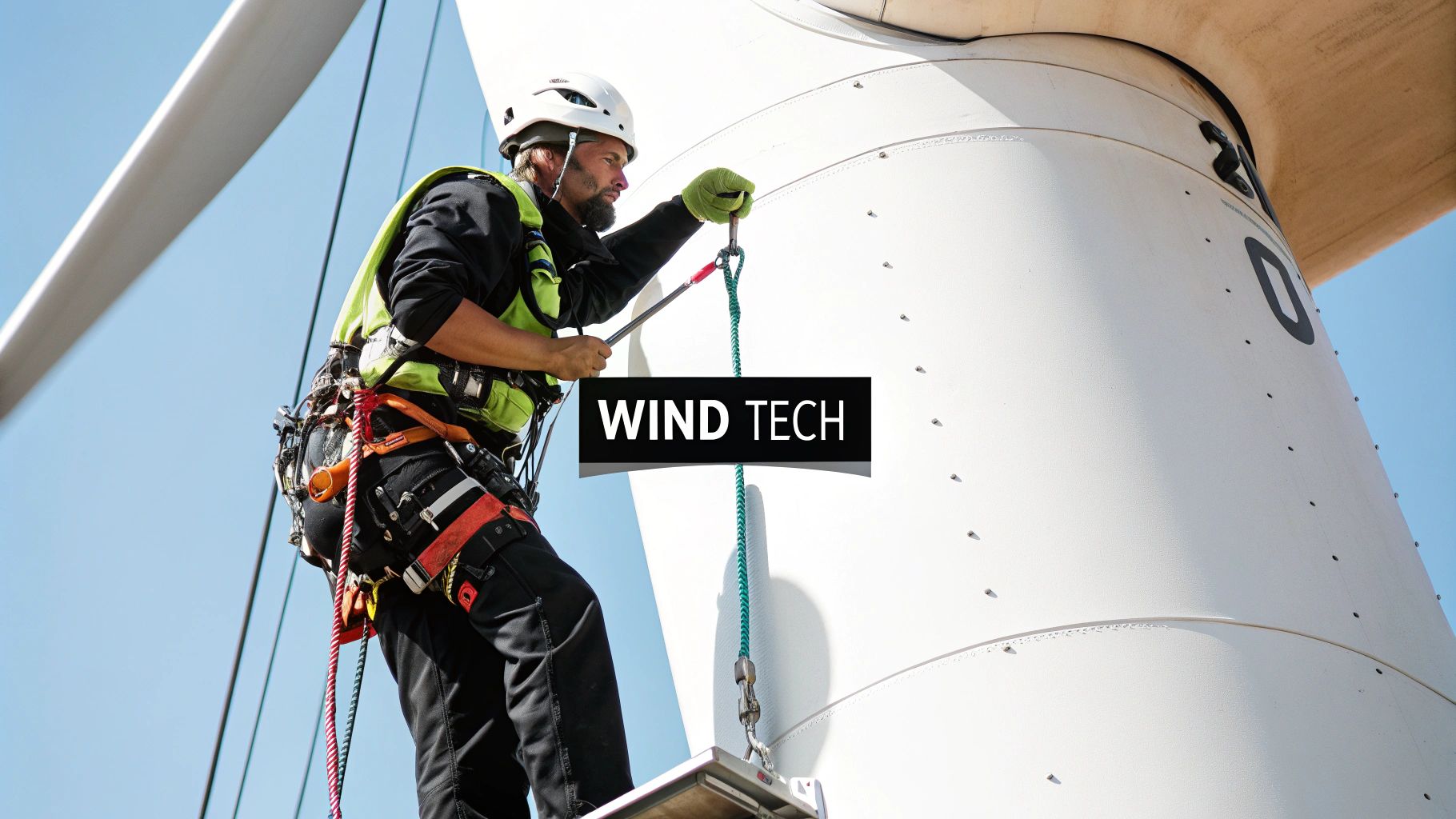
The role is physically demanding and requires a commitment to safety, but the rewards are significant. This specialised skill set commands excellent pay, with starting salaries for newly certified technicians typically in the €35,000-€45,000 range. Experienced and senior technicians can earn upwards of €60,000-€75,000+, especially those who work offshore or in lead roles.
Your Path to Qualification
The most direct route is through a specialised training programme, often lasting from 6 to 24 months. Crucially, employers look for candidates with industry-recognised safety certifications from the Global Wind Organisation (GWO), which cover first aid, manual handling, fire awareness, and working at heights.
How to Showcase Your Skills on Your CV
A powerful CV is essential to break into this competitive field. You must clearly highlight your technical certifications and hands-on experience. The Europass CV builder from europass.ai can help you structure your qualifications to impress renewable energy employers.
Here are sample bullet points for a wind turbine technician’s CV:
- Performed scheduled maintenance on Vestas V117 turbines, including gearbox oil changes and hydraulic system inspections, improving turbine availability by 8%.
- Certified in GWO Basic Safety Training (BST), demonstrating proficiency in First Aid, Manual Handling, Fire Awareness, and Working at Height.
- Troubleshot and repaired complex electrical faults in turbine control systems, successfully restoring three non-operational turbines to full capacity.
- Conducted blade inspections and minor composite repairs using rope access techniques, consistently adhering to strict site safety protocols.
Key Insight: Gaining certifications for offshore work can significantly increase your earning potential. The offshore wind sector is growing rapidly and requires technicians with specialised safety training, making you a highly sought-after candidate.
5. Construction Foreman/Supervisor
For those with proven experience in the trades and natural leadership abilities, stepping up to a Construction Foreman or Supervisor role is a highly rewarding career move. This position is a textbook example of better paying jobs without degrees, where on-site experience is valued far more than a university education. Foremen are the backbone of any construction project, overseeing crews, coordinating tasks, ensuring safety, and making sure the job is completed on time and to standard.
The increased responsibility comes with a significant pay increase. Salaries for newly appointed foremen often start around €40,000-€50,000. Experienced supervisors managing large commercial or industrial projects can command salaries well in excess of €60,000-€80,000+, particularly with specialised certifications.
Your Path to Qualification
There is no university shortcut to this role; you earn it through experience. The typical path involves 5-10 years of hands-on work in a trade like carpentry or bricklaying. Aspiring foremen should actively seek opportunities to lead small teams, develop strong communication skills, and gain a deep understanding of health and safety regulations, often formalised with qualifications like the SMSTS (Site Management Safety Training Scheme) in the UK or equivalent certifications in other European countries.
How to Showcase Your Skills on Your CV
When you apply for a supervisor role, your CV must prove you can lead. It needs to transition from showcasing your trade skills to highlighting your management capabilities. The Europass CV builder from europass.ai helps you structure this information for maximum impact.
Here are sample bullet points for a Construction Foreman’s CV:
- Supervised a crew of 15+ multi-trade professionals on a €2.5M commercial office build, delivering the project four weeks ahead of schedule.
- Implemented and enforced rigorous site safety protocols, resulting in a zero-accident record across 18 consecutive months.
- Managed daily work schedules, material procurement, and subcontractor coordination, improving operational efficiency by 20%.
- Trained and mentored four apprentices, successfully guiding them to achieve their qualifications in their respective trades.
Key Insight: To stand out, quantify your leadership achievements. Instead of saying you "managed a team," specify the team size, project value, and any positive outcomes you achieved, such as finishing under budget or improving safety metrics.
6. Certified Welder
For individuals with a steady hand and an eye for precision, a career as a certified welder offers a direct route to a high-demand, well-compensated trade. This field is a fantastic example of better paying jobs without degrees that value hands-on expertise. Welders fuse metal components for everything from automotive manufacturing in Germany to shipbuilding in Poland and critical infrastructure projects across Europe.
A newly qualified certified welder can expect to earn €30,000-€40,000, while experienced professionals, particularly those with coded welding qualifications in high-demand processes like TIG or MIG, can command €50,000-€70,000+. Advancing to a Welding Inspector role, responsible for quality assurance, can push earnings even higher.
Your Path to Qualification
Entry into welding is typically through an apprenticeship or a vocational training course. These programmes provide the foundational skills and safety knowledge required to pass certification tests. Certifications like EN ISO 9606 are the industry standard across Europe and prove your competence in specific welding processes and materials. Employers seek candidates with proven practical skills, a strong commitment to safety, and the ability to interpret technical drawings.
How to Showcase Your Skills on Your CV
A powerful CV is crucial for standing out. Use the Europass CV builder from europass.ai to detail your certifications and project experience professionally. You’ll also need a compelling cover letter; you can learn how to write a cover letter that complements your CV perfectly.
Here are sample bullet points for a certified welder’s CV:
- Achieved and maintained EN ISO 9606 coding for TIG and MIG welding on carbon and stainless steel, ensuring 100% compliance with project specifications.
- Fabricated and welded structural components for a major bridge refurbishment project, consistently meeting tight tolerances and quality standards.
- Reduced material waste by 10% through optimised cutting and fabrication techniques while working in a high-volume manufacturing environment.
- Performed visual and non-destructive testing (NDT) pre-checks on all welds, resulting in a 99.8% pass rate upon formal inspection.
Key Insight: Securing coding for specialised industries like aerospace, petrochemicals, or subsea engineering can dramatically increase your earning potential and make you an indispensable asset to employers.
7. Heavy Equipment Operator
For those who command precision and enjoy operating powerful machinery, a career as a heavy equipment operator is a standout choice among the better paying jobs without degrees. These professionals are the backbone of major construction, mining, and infrastructure projects, expertly handling machinery like bulldozers, excavators, and cranes. Their skill in shaping the land is rewarded with excellent pay and high demand.
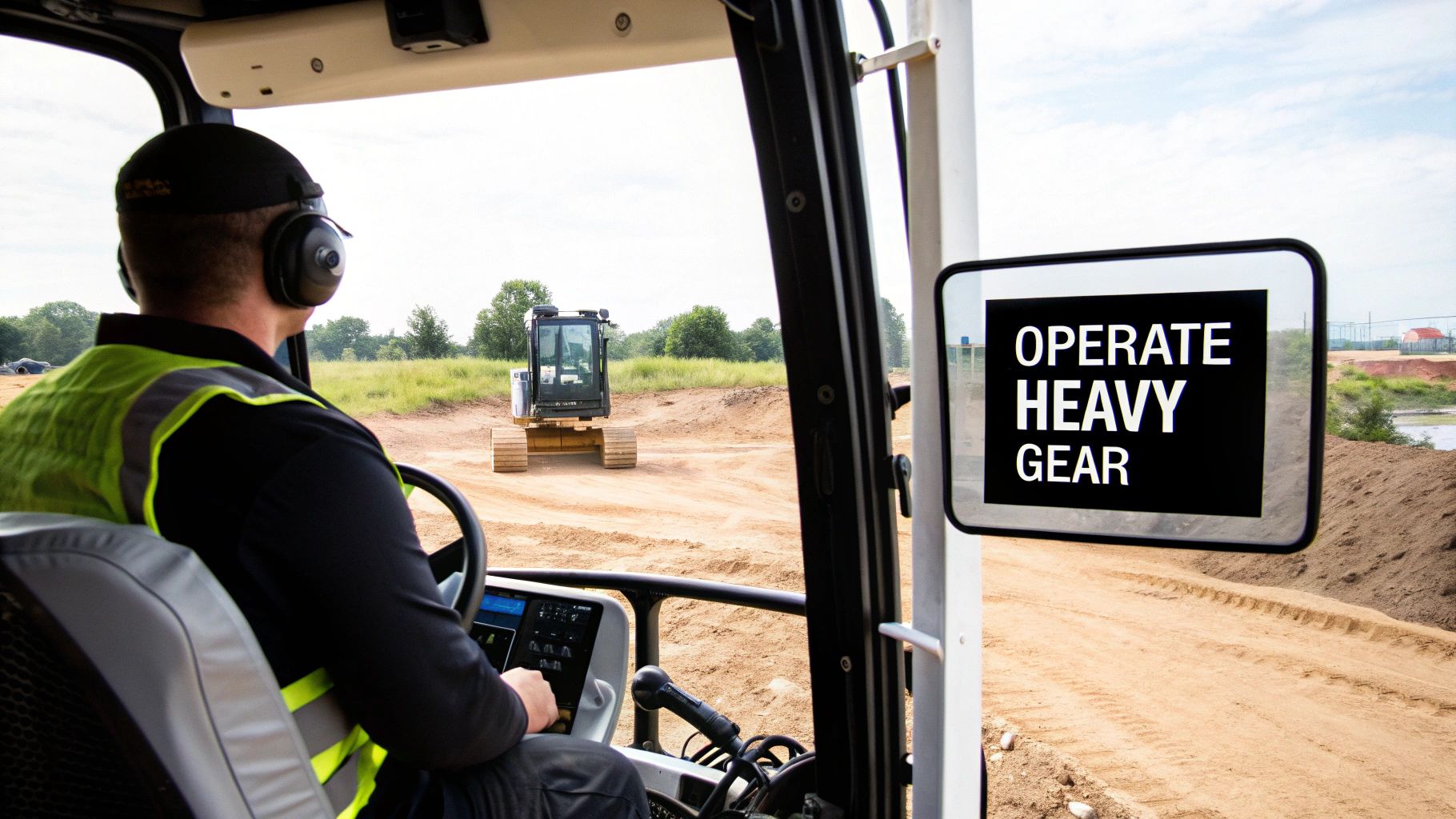
Operating heavy equipment requires a unique blend of spatial awareness, technical skill, and a deep commitment to safety. The complexity of the role is reflected in the salary. Entry-level operators can expect to earn €32,000-€40,000, with experienced professionals commanding €50,000-€70,000+. Highly specialised roles, such as operating large tower cranes on city skyscraper projects, can push earnings significantly higher.
Your Path to Qualification
While a university degree isn't necessary, formal training and certification are essential. You can gain qualifications through private training schools or apprenticeships. Certifications like the CPCS card in the UK or equivalent national licenses are industry standards and prove your competence to employers. A strong safety record is non-negotiable and a key factor in career progression.
How to Showcase Your Skills on Your CV
Your CV must clearly communicate your qualifications, hands-on experience, and dedication to safety. Use the Europass CV builder from europass.ai to ensure your document is professional and ATS-friendly.
Here are sample bullet points for a heavy equipment operator’s CV:
- Operated a 20-tonne excavator with GPS guidance for precise trenching and grading on a major motorway expansion project, consistently meeting project specifications.
- Logged over 2,500 incident-free hours operating bulldozers, front-end loaders, and compactors in high-traffic construction environments.
- Performed daily pre-operation inspections and routine maintenance on all assigned equipment, reducing mechanical downtime by 20%.
- Holds a valid EU-recognised operator license for Excavator 360, Forward Tipping Dumper, and Telescopic Handler.
Key Insight: Specialising in complex machinery, such as tunnel boring machines (TBMs), large-capacity cranes, or advanced GPS-equipped excavators, will make you an indispensable asset and significantly increase your earning potential.
8. Industrial Maintenance Technician
For those who excel at diagnosing and fixing complex machinery, a career as an industrial maintenance technician is a critical role in the manufacturing sector. This position is a perfect example of the better paying jobs without degrees, as it values specialised technical skills far more than a university education. These technicians are the backbone of modern production, responsible for maintaining and repairing the sophisticated equipment that keeps factories running.
From automotive plants and food processing facilities to pharmaceutical manufacturing, these technicians ensure minimal downtime. Their work involves electrical, hydraulic, and pneumatic systems. This diverse skill set leads to excellent earning potential, with starting salaries often in the €35,000-€42,000 range, increasing to €55,000-€70,000+ for experienced technicians with sought-after certifications.
Your Path to Qualification
The most common pathway is through a technical training programme or an apprenticeship in industrial maintenance or mechatronics, typically lasting 2-3 years. Employers seek candidates with strong mechanical aptitude, logical problem-solving abilities, and a deep understanding of safety procedures. Certifications in areas like Programmable Logic Controller (PLC) programming are highly valued.
How to Showcase Your Skills on Your CV
Your CV must clearly demonstrate your technical capabilities and the direct impact of your work. The Europass CV builder from europass.ai can help you structure this information effectively to impress manufacturing employers.
Here are sample bullet points for an industrial maintenance technician’s CV:
- Maintained and repaired hydraulic and pneumatic systems on high-speed packaging lines, increasing equipment uptime by 20%.
- Proficient in diagnosing and troubleshooting faults in Siemens PLC systems, reducing average repair time by 30%.
- Implemented a predictive maintenance programme using vibration analysis and thermal imaging, preventing three major equipment failures in six months.
- Led a complete overhaul of a critical conveyor system, completing the project under budget and ensuring a 100% safety compliance record.
Key Insight: Gaining expertise in predictive maintenance technologies, such as IoT sensors and condition monitoring software, will place you at the forefront of Industry 4.0. This specialisation makes you invaluable to employers aiming to modernise their operations.
9. Elevator Technician/Mechanic
For individuals with a strong mechanical aptitude and a head for heights, a career as an elevator technician is one of the most financially rewarding better paying jobs without degrees. These highly skilled professionals install, maintain, and repair the lifts, escalators, and moving walkways that are essential to modern infrastructure in every major European city.
This niche trade demands a blend of electrical, electronic, and mechanical knowledge. The high level of responsibility commands an impressive salary, often starting around €35,000 for apprentices and rising to €60,000-€85,000+ for qualified technicians. Experienced specialists, particularly those working in major urban centres, can earn even more.
Your Path to Qualification
The standard entry route is a rigorous apprenticeship, typically lasting 4-5 years. This involves paid on-the-job training combined with extensive classroom study covering hydraulics, electrical systems, and safety regulations. Employers seek candidates who are physically fit, detail-oriented, and excellent problem-solvers.
How to Showcase Your Skills on Your CV
A precise and professional CV is vital to secure a competitive role. The Europass CV builder from europass.ai can help you structure your experience to highlight the specific skills employers want.
Here are sample bullet points for an elevator technician’s CV:
- Installed, commissioned, and maintained a range of traction and hydraulic lift systems in high-rise commercial and residential buildings.
- Diagnosed and rectified complex mechanical and electrical faults, reducing lift downtime by an average of 20% across my maintenance portfolio.
- Successfully modernised five elevator systems in a central business district, upgrading controllers to improve energy efficiency.
- Maintained a flawless safety record by strictly adhering to all relevant EU and national safety regulations for lifting equipment.
Key Insight: This is a highly specialised trade. Highlighting your commitment to safety and continuous professional development is crucial for career advancement.
10. Sheet Metal Worker
For individuals who enjoy precision and building tangible products, a career as a sheet metal worker offers a robust and rewarding path. This skilled trade is a fantastic example of better paying jobs without degrees, where craftsmanship and technical expertise are highly valued. Sheet metal workers fabricate, assemble, and install products made from thin metal sheets, such as HVAC ducting, roofing, and industrial equipment enclosures.
This role requires a blend of artistry and engineering. The demand for these skills leads to strong earning potential. A newly qualified worker can expect to earn €28,000-€35,000, with experienced specialists earning €45,000-€60,000+. Those who advance into supervisory roles or specialise in high-tech fabrication can command even higher salaries.
Your Path to Qualification
The most common entry route is a registered apprenticeship, which typically lasts 3-4 years. This "earn while you learn" model provides paid on-the-job training complemented by classroom-based technical instruction. Employers look for candidates with good mathematical skills, spatial awareness, and a high degree of manual dexterity.
How to Showcase Your Skills on Your CV
A well-crafted CV is crucial for standing out. Focus on specific projects and measurable achievements. Use the Europass CV builder from europass.ai to format your experience professionally.
Here are sample bullet points for a sheet metal worker’s CV:
- Fabricated and installed over 500 metres of commercial HVAC ducting for a new hospital wing, adhering to precise architectural specifications.
- Proficient in using CAD software to design and model custom metal components, improving material efficiency by 10%.
- Specialised in architectural metal roofing, completing installations on multiple high-value commercial properties.
- Maintained a flawless safety record while operating fabrication machinery, including press brakes, shears, and plasma cutters.
Key Insight: Developing proficiency in Computer-Aided Design (CAD) software is a powerful way to accelerate your career. It allows you to move from fabrication to design, opening doors to higher-level roles and increasing your value to employers significantly.
Your Next High-Paying Role is Within Reach
This guide has illuminated a powerful truth: a university degree is not the only path to a financially rewarding career. We explored ten high-demand roles, from the intricate work of an Elevator Technician to the leadership of a Construction Foreman. Each underscores the immense value of specialised skills and hands-on experience. The common thread is opportunity, demonstrating that the European job market is rich with better paying jobs without degrees for those willing to pursue them.
These roles are not merely jobs; they are foundational careers that build our cities and power our future. The misconception that a four-year degree is a prerequisite for a high salary is outdated. Employers in these sectors prioritise verifiable skills, relevant certifications, and a demonstrated ability to solve practical problems.
Key Takeaways to Propel Your Career Forward
- Certifications are Your Currency: In place of a degree, industry-recognised certifications (like GWO for wind techs) act as your proof of expertise. They are a non-negotiable asset.
- Experience is Your Foundation: Your hands-on experience is what sets you apart. Translate this into quantifiable achievements on your CV to show your value.
- A Strategic CV is Your Master Key: Your skills are only as valuable as your ability to communicate them. An ATS-optimised CV, tailored to the specific language of the trade, is crucial for getting noticed.
Your Actionable Next Steps
Empowered with this knowledge, your path forward is clear.
- Identify Your Target Role: Review the list and select one or two roles that align with your interests. Research the specific entry requirements in your country.
- Map Your Skill Gaps: Honestly assess your current skill set against the requirements of your target job. Identify the certifications or apprenticeships you need.
- Craft a Tailored Application: Do not rely on a generic CV. Use the sample bullet points in each section as a template to showcase your accomplishments effectively.
The demand for skilled tradespeople has never been higher. These better paying jobs without degrees offer more than just a salary; they provide a chance to build a tangible legacy through skilled, meaningful work. Your expertise is in high demand, and with the right strategy, your next career move is an attainable reality.
Are you ready to showcase your skills and land one of these high-paying roles? Your hands-on experience deserves a professional CV that gets past automated screening systems. Create Your Professional CV with Europass.ai and take the first confident step towards the career you deserve.
Great CVs get work done
Work smarter with the CV builder trusted by skilled workers for more than a decade.
It's easy
