8 Example CV Student Templates for the European Trades in 2024
Stepping into the European job market as a student or recent graduate can feel daunting, especially in hands-on fields like construction, manufacturing, and the trades. Your CV is your first and most critical opportunity to make a strong impression, but where do you start when your professional experience is still developing? This guide is designed to demystify the process and give you clear, actionable steps. We will provide a comprehensive look at an example CV student template for various common situations, complete with detailed strategic analysis and expert tips.
We understand the unique challenges you face, from effectively showcasing practical skills learned in college or through apprenticeships to translating part-time work into tangible career potential. This article will show you exactly how to structure your CV to highlight relevant coursework, hands-on projects, and any work experience you have. You will learn how to articulate your abilities and ambitions in a way that resonates with hiring managers in these practical fields.
By the end of this guide, you will have the confidence and the tools to build a CV that not only gets noticed by recruiters but also successfully navigates modern ATS (Applicant Tracking System) scans. Ready to build a CV that opens doors to apprenticeships and entry-level roles? Create Your Professional CV with Europass.ai.
1. High School Student CV with Internship Experience
This foundational CV format is designed for high school students with limited formal work history who are targeting their first internships, apprenticeships, or entry-level roles in technical fields. Its primary purpose is to translate academic achievements, vocational coursework, and hands-on project experience into compelling qualifications for practical jobs. This approach effectively bridges the gap between the classroom and the workplace, making it an excellent example CV for a student transitioning into a skilled trade.
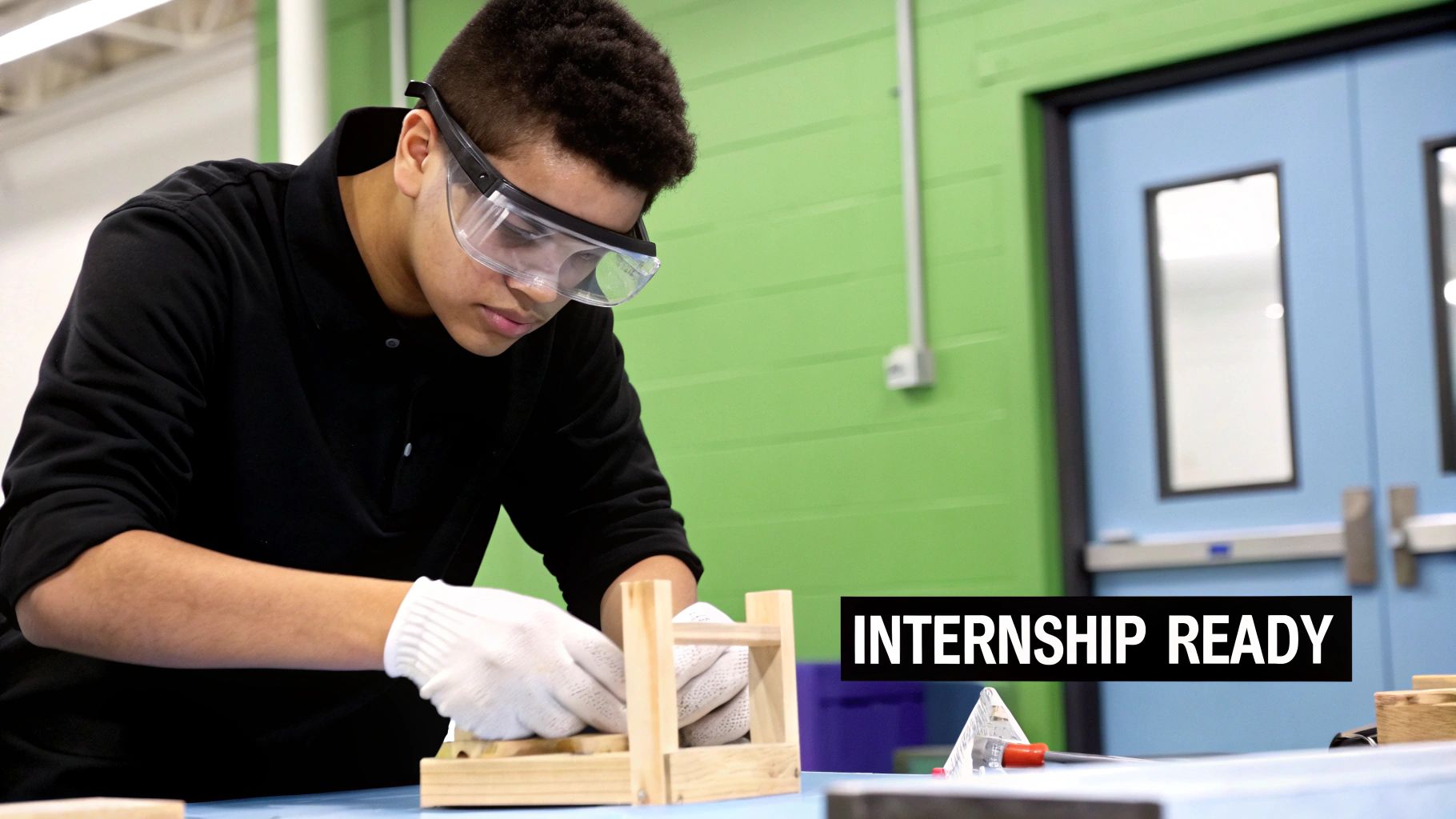
This CV structure prioritises potential over extensive experience. By strategically highlighting relevant school projects, technical skills, and any part-time work or internships, it demonstrates your enthusiasm, work ethic, and foundational knowledge. It shows employers that while you may be new to the professional world, you have already started building the specific skills they need.
Strategic Breakdown and Key Tactics
- Lead with Education and Relevant Coursework: Place your education section near the top. Instead of just listing your school, include specific, relevant modules like 'Introduction to Electrical Wiring', 'Metalwork & Fabrication', or 'Principles of Logistics'.
- Create a 'Projects' or 'Practical Experience' Section: Dedicate a section to detail hands-on work from school or personal time. Describe what you built, repaired, or organised. Use strong action verbs to describe your contributions.
- Quantify Everything Possible: Numbers provide powerful context. Instead of saying "Completed a welding course," write "Completed a 40-hour MIG welding certification course with a 95% final assessment score."
Key Insight: For a student CV, your projects are your work experience. Frame every school assignment or technical course as a professional task. Document the skills used, tools operated, and the final outcome, just as you would for a paid job. This reframes your academic background into a portfolio of practical capabilities.
Actionable Takeaways
To adapt this example CV for student applications, focus on tailoring your skills and projects to the job description. If applying for a warehouse internship, highlight experience with stock-taking for a school event. For an electrician apprenticeship, detail a project where you assembled a simple circuit board. This targeted approach demonstrates genuine interest and suitability.
2. College Student CV with Part-Time Trade Work
This hybrid CV format is designed for college or university students who are balancing academic studies with part-time work in construction, manufacturing, or logistics. Its purpose is to demonstrate exceptional time management, practical skill development, and a strong work ethic. This approach effectively showcases how theoretical knowledge from a degree is being applied and reinforced in a real-world setting, making it a powerful example CV for a student targeting graduate schemes or full-time roles post-graduation.
This CV structure expertly blends academic credibility with hands-on trade experience. By placing equal emphasis on your degree progress and your part-time job responsibilities, it tells a compelling story of ambition and reliability. It proves to employers that you are not just a theoretician; you are a proactive individual who understands the practical demands of the industry you are studying to enter.
Strategic Breakdown and Key Tactics
- Create a Powerful Professional Summary: Start with a summary that immediately connects your studies to your work. For example: "A third-year Construction Management student with two years of hands-on experience as a part-time Site Assistant, adept at applying academic principles of project scheduling and safety compliance in a live construction environment."
- Divide 'Experience' and 'Education': Present both sections prominently. Under your part-time role, use bullet points to detail responsibilities and achievements, showing progression if possible. Under education, list relevant modules like 'Structural Engineering' or 'Supply Chain Management' to complement your practical skills.
- Showcase Acquired Certifications: Dedicate a small section to any industry-specific certifications gained through your part-time work, such as a CSCS card, Forklift Operator Licence, or First Aid at Work. This adds significant professional credibility.
Key Insight: Your part-time job is not just a job; it's a long-term internship. Frame your experience to highlight how you are actively applying classroom concepts. This transforms what might seem like a simple student job into a deliberate career development strategy, demonstrating foresight and dedication to your chosen field.
Actionable Takeaways
To make this example CV for student work for you, quantify your contributions in your part-time role. Instead of "helped on-site," write "Assisted a team of 5 in daily site preparations, contributing to a 10% improvement in workflow efficiency." If you are an engineering student working in a warehouse, highlight how you identified an inefficiency in the stocking process. This direct link between your academic mind and your practical work makes you an exceptionally attractive candidate.
3. Recent Graduate CV with Trade Certification Focus
This specialised CV format is for recent graduates of vocational schools, apprenticeship programmes, or technical colleges who have just completed formal training in a skilled trade. Its primary goal is to showcase newly acquired certifications, licences, and core technical competencies, placing them above limited on-the-job experience. This approach is ideal for individuals entering fields like electrical work, plumbing, welding, or HVAC, making it an excellent example CV for a student ready to launch their professional trade career.
This CV structure immediately signals to employers that you possess the exact, verified qualifications required for the role. By leading with your professional credentials, you demonstrate compliance with industry standards and a readiness to contribute from day one. It effectively shifts the focus from a lack of long-term employment to a wealth of certified, up-to-date, and relevant technical skills.
Strategic Breakdown and Key Tactics
- Prioritise a 'Certifications & Licences' Section: Place this section prominently near the top of your CV, immediately after your professional summary. This ensures your most critical qualifications are seen first.
- Be Meticulously Specific: List the full, official name of each certification, the issuing body, and the date of completion or expiry. For example, 'City & Guilds Level 3 Diploma in Electrical Installations (2365)' is far more impactful than 'Electrician course'.
- Include All Safety Training: Create a subsection for crucial safety credentials like CSCS cards, First Aid, and any specific equipment or manual handling training. This shows a commitment to workplace safety, a key concern in trade industries.
Key Insight: For a newly qualified tradesperson, your certifications are your proof of competence. They are non-negotiable requirements for many roles. By highlighting them prominently, you pass the initial screening and immediately establish yourself as a qualified candidate, even before an employer reads about your apprenticeship projects.
Actionable Takeaways
To make this example CV for student graduates effective, align your listed competencies directly with the job description. If a role requires specific welding techniques, ensure your relevant certifications (e.g., 'BS EN 9606-1 Coded Welder') are clearly visible. For an HVAC role, your 'F-Gas Category I' certification should be front and centre. This tailored strategy confirms you are not just qualified in general, but specifically qualified for their job.
4. Online Learner CV with Self-Directed Skill Development
This modern CV is for students and career changers who have built technical skills through non-traditional routes like online courses, tutorials, and self-directed projects. Its purpose is to legitimise skills acquired outside of formal apprenticeships. This format is a powerful example CV for a student who needs to demonstrate practical competence and self-motivation to employers in manufacturing, logistics, and construction.

The CV structure validates your learning journey by focusing on tangible outcomes. By presenting a portfolio of completed projects and listing certifications from recognised online platforms, you prove that your skills are both real and relevant. It shows employers you are a proactive, resourceful individual capable of independent learning, a highly valued trait in any industry.
Strategic Breakdown and Key Tactics
- Create a 'Certifications & Online Learning' Section: Position this section prominently. List courses from reputable providers like Coursera, edX, or industry-specific training bodies. Include the course title, the provider, and the completion date.
- Develop a 'Portfolio of Projects' Section: This is crucial. Detail the projects you completed using your self-taught skills. For example, a self-taught welder might list "Fabricated a custom steel workbench" and describe the techniques used. Link to an online portfolio with photos or videos.
- Emphasise Practical Application: Use your descriptions to focus on doing, not just learning. Instead of "Watched CNC programming tutorials," state "Programmed and executed 5 CNC projects using skills acquired from online tutorials, achieving 99% accuracy to design specifications."
Key Insight: For an online learner, your portfolio is your proof of skill. You must translate digital learning into physical results. Frame your self-directed education as a deliberate choice to gain specific, job-ready competencies, and use your projects to provide the evidence that employers need to see.
Actionable Takeaways
To make this example CV for student applications effective, directly connect your online training to the job requirements. If applying for a warehouse role, highlight the 'Supply Chain Logistics' certificate you earned on LinkedIn Learning. For a trainee electrician role, showcase the circuit projects you built based on online courses. Backing up every online course with a practical project demonstrates that you can apply knowledge effectively.
5. First-Generation Student CV with Limited Family Work Background
This CV format is thoughtfully designed for first-generation students whose families may have limited experience with formal corporate or trade employment structures. Its purpose is to reframe and translate valuable life experiences, family contributions, and cultural skills into a professional language that resonates with hiring managers. This approach provides an excellent example CV for a student who needs to bridge the gap between their unique background and professional expectations.
This CV structure highlights resilience, adaptability, and a strong work ethic derived from non-traditional sources. By articulating informal responsibilities, such as managing a family side business or using multilingual skills to support the community, it showcases inherent leadership, problem-solving, and communication abilities. It demonstrates to employers that your unique life experiences have equipped you with the practical skills and initiative they value highly.
Strategic Breakdown and Key Tactics
- Professionally Frame Informal Experience: Translate family or community work into professional achievements. For instance, "helped with the family business" becomes "Managed stock and coordinated daily tasks for a team of 3 in a small-scale family enterprise."
- Highlight Transferable and Soft Skills: Dedicate a prominent section to skills like adaptability, problem-solving, and cross-cultural communication. Use brief examples to illustrate them, such as "Demonstrated problem-solving by troubleshooting equipment issues during a community project."
- Emphasise Formal Training and Certifications: Give weight to any formal qualifications, apprenticeships, or certifications you have earned. This provides concrete evidence of your commitment to your chosen trade and your ability to succeed in structured learning environments.
Key Insight: For a first-generation student, your life experience is a source of professional strength. Your CV should tell a story of initiative and resourcefulness. By translating informal roles and cultural skills into business-centric language, you demonstrate a level of maturity and practical know-how that other candidates may lack.
Actionable Takeaways
To make this example CV for student applications work for you, focus on identifying the underlying professional skills in your daily life. If you served as the primary translator for your family, highlight your bilingual proficiency and communication skills. If you helped organise community events, describe it as project coordination and team leadership. Seeking guidance from a career counsellor can also help you frame these experiences effectively. This targeted approach ensures your authentic background is seen as a significant asset.
6. Career Changer CV with Transferable Skills Bridge
This strategic CV format is for professionals transitioning from non-trade careers into fields like construction, manufacturing, or logistics. Its purpose is to acknowledge previous career achievements while clearly translating transferable skills to the new industry. This approach is invaluable for mid-career changers seeking to leverage existing experience, such as project management or team leadership, while highlighting new technical qualifications.
This CV structure builds a compelling narrative around your career change, demonstrating that your move is a deliberate and well-prepared step. By prominently featuring a professional summary that explains your motivation and connecting past roles to future responsibilities, you proactively address potential questions from recruiters. It shows them that your diverse background is a unique strength, not a liability.
Strategic Breakdown and Key Tactics
- Open with a Powerful Professional Summary: Start with a targeted summary that explicitly states your intention to transition into the new field. Mention your motivation, key transferable skills, and any recent, relevant certifications (e.g., health and safety, specific trade courses).
- Create a 'Transferable Skills' Section: Dedicate a distinct section near the top of your CV to bridge your past and future. Use industry-specific language. For instance, 'Managed retail teams of 15+' becomes 'Led and coordinated crews of 15+ to meet operational targets'.
- Highlight New Training and Certifications: Place your new qualifications prominently, possibly even before your professional experience if they are highly relevant to the target role. This immediately signals your commitment to the new career path.
Key Insight: For a career changer, your CV must tell a clear and confident story. Don't hide your previous experience; reframe it. A corporate manager's budget oversight skills are directly applicable to project cost management in construction. Your ability to translate past competencies into the language of your new industry is crucial.
Actionable Takeaways
To adapt this CV for your career change, your primary task is translation. If moving from administration to manufacturing quality control, rephrase 'organised office workflows' as 'developed and implemented process workflows to enhance efficiency'. For a teacher becoming a trades apprentice, emphasise 'mentoring students' as 'training and coaching junior team members'. This targeted rewording ensures your valuable experience is recognised by hiring managers in your new field.
7. Apprentice-in-Progress CV with Hands-On Learning Emphasis
This specialised CV format is for active apprentices who are simultaneously completing formal training and working in their trade. Its purpose is to showcase ongoing skill development, document increasing on-the-job responsibilities, and highlight structured learning achievements. This approach is perfect for an apprentice seeking advancement or applying for a technician role mid-training, making it a powerful example CV for a student who is already in the workforce.
This CV structure highlights your unique status as both a learner and a worker. By clearly stating your apprenticeship progress and quantifying the hands-on experience gained, you demonstrate a commitment to your trade, a proven safety record, and a clear trajectory of growing competence. It shows employers that you are a dedicated and developing professional with documented, practical skills.
Strategic Breakdown and Key Tactics
- State Your Status Clearly: Begin with a professional summary or title that immediately clarifies your position, for instance, "Third-Year Apprentice Electrician (3 of 4 years completed)". This manages expectations and frames your experience correctly.
- Quantify On-the-Job Experience: Use specific numbers to add weight to your accomplishments. Instead of "Assisted with wiring," write "Assisted lead electricians in installing and testing over 150 residential electrical circuits in compliance with BS 7671 standards."
- List Certifications and Modules: Create a dedicated section for credentials earned during your apprenticeship. Include essential safety tickets like a CSCS card, First Aid at Work, or specific equipment operation licences. List key modules you have passed.
Key Insight: For an apprentice-in-progress CV, your current training programme is the central narrative. Structure your experience to show a clear progression of responsibilities. Demonstrate how your on-the-job tasks have evolved from basic support to more independent work as your formal knowledge has grown. This proves you are not just a trainee but an advancing tradesperson.
Actionable Takeaways
To adapt this example CV for student apprentices, align your documented experience with the requirements of the role you're targeting. If applying for a commercial project, emphasise your experience with three-phase systems or large-scale installations. For a lead apprentice role, highlight instances where you mentored junior apprentices or took charge of specific tasks. This customisation proves you are ready for the next step in your career.
8. Multilingual Student CV with Language & Cultural Skills
This CV format is for bilingual or multilingual students targeting roles in diverse construction, manufacturing, or warehouse environments. Its purpose is to position language proficiency and cultural competency not just as secondary skills, but as core professional assets. This approach reflects the reality of increasingly multicultural workforces in skilled trades and is an essential example CV for a student who can bridge communication gaps on a busy worksite or factory floor.

This CV structure moves beyond simply listing languages. It strategically integrates these skills throughout the document, showing how they have been applied in practical situations to improve safety, efficiency, and team cohesion. It demonstrates to employers that you are not just technically capable but are also a valuable communicator who can foster a more inclusive and productive work environment.
Strategic Breakdown and Key Tactics
- Create a Prominent 'Languages' Section: Place a dedicated language skills section near the top, right after your professional summary or key skills. Use standardised proficiency levels like 'Fluent', 'Advanced', or 'Native'.
- Contextualise Your Language Skills: In your work experience or projects, explicitly state how you used your language abilities. For example, "Utilised fluent Polish to translate safety instructions for team members, ensuring 100% compliance."
- Highlight Cultural Competency: Go beyond language to mention cross-cultural communication skills. This shows you can effectively manage diverse teams, resolve conflicts, and understand different workplace norms.
Key Insight: For a student with language skills, your ability to communicate is a powerful tool for safety and productivity. Frame your multilingualism as a direct solution to common workplace challenges like miscommunication, training new staff, and improving customer relations. This transforms a personal attribute into a quantifiable business asset.
Actionable Takeaways
To adapt this example CV for student applications, focus on mirroring the language of the job description and the company's environment. If a firm operates in a region with a large Spanish-speaking population, your English-Spanish fluency is a major selling point. Quantify your impact wherever possible, such as "Reduced onboarding time for new hires by 25% by providing training in both English and Vietnamese."
Comparison of 8 Student CV Types
| Template | Complexity (🔄) | Resource needs (⚡) | Expected effectiveness (⭐) | Results / Impact (📊) | Ideal use cases & Tips (💡) |
|---|---|---|---|---|---|
| High School Student CV with Internship Experience | Low — simple, guided layout | Minimal: GPA, coursework, school projects, teacher refs | Moderate ⭐⭐ — good for internships/apprenticeships | Secures interviews for entry roles; entry into apprenticeship pipelines | Ideal for 16–19-year-olds; use action verbs, list safety certs, quantify training hours |
| College Student CV with Part-Time Trade Work | Medium — balance academics + work | Part-time job records, certifications, promotion examples | High ⭐⭐⭐ — strong for transition to full-time trade roles | Demonstrates reliability; improves interview-to-offer conversion | Ideal for 19–25 students; connect coursework to work, show progression and metrics |
| Recent Graduate CV with Trade Certification Focus | Low — focused credential-first format | Official certifications/licenses, apprenticeship docs, project summaries | High ⭐⭐⭐ — effective where credentials matter most | Faster hiring for certified technician roles; ranks well with recruiters | Ideal for 18–30 grads; place certifications near top, include issuing body and dates |
| Online Learner CV with Self-Directed Skill Development | Medium — requires portfolio and verification | Portfolio links, recognized online certificates, project evidence | Variable ⭐⭐–⭐⭐⭐ — strong if portfolio credible | Can win project roles or interviews if practical work is proven | Ideal for self-taught entrants; use recognized platforms, include photos/videos and quantified projects |
| First-Generation Student CV with Limited Family Work Background | Medium — needs careful professional framing | Community/family work descriptions, mentorship refs, training records | Moderate ⭐⭐ — effective with D&I-friendly employers | Highlights resilience and adaptability; opens diversity-focused opportunities | Ideal for 18–30 first-gen students; translate informal tasks into workplace skills, emphasize certifications and refs |
| Career Changer CV with Transferable Skills Bridge | High — strategic re-mapping of past roles | Documented achievements from prior career, new trade certs, strong summary | High ⭐⭐⭐ — especially for supervisory tracks | May secure higher starting roles; shows leadership readiness | Ideal for 30–55 changers; open with transition summary, map transferable skills, address commitment proactively |
| Apprentice-in-Progress CV with Hands-On Learning Emphasis | Low–Medium — clear status and milestones | Apprenticeship hours, completed modules, supervisor endorsements | High ⭐⭐⭐ — strong within apprenticeship systems | Aids advancement and qualification for specialized tasks | Ideal for active apprentices 18–35; state completion %, hours, quantify hands-on tasks, include mentor contacts |
| Multilingual Student CV with Language & Cultural Skills | Low — add proficiency and context | Language proficiency labels, use-case examples, certifications if any | High ⭐⭐⭐ — valuable in multicultural areas and client-facing roles | Reduces miscommunication; qualifies for bilingual supervisory roles | Ideal for 18–40 multilingual candidates; use standardized levels, show context, quantify impact (e.g., reduced errors) |
Your Next Step: Turn Examples into Opportunities
We have navigated through a comprehensive collection of student CV examples, each a blueprint for a specific scenario you might face. From the high school student with their first internship to the career changer bridging skills from a different sector, each example CV student we analysed demonstrates a core principle: your experience, no matter how unconventional, is valuable. The challenge is not a lack of qualification, but a lack of effective communication. Your CV is the tool that translates your potential into a language that hiring managers and Applicant Tracking Systems (ATS) understand.
The power to build a compelling narrative about your capabilities is firmly in your hands.
Recapping the Core Strategies
Let’s distil the most critical takeaways from the examples we've explored. These are the non-negotiable pillars that will support your job application and set you apart from the competition.
- Quantify Everything Possible: Vague statements like "helped with stock management" fade into the background. Concrete achievements like "Assisted in a 15% reduction in stock discrepancies by implementing a new labelling system" demand attention. Always ask yourself: How much? How many? How often?
- Action Verbs are Your Engine: Verbs like Assisted, Operated, Constructed, Inspected, and Maintained are the driving force of your CV. They portray you as an active participant, not a passive observer. Start every bullet point with a powerful, relevant verb.
- Tailoring is Non-Negotiable: A generic CV is a discarded CV. The most effective strategy is to meticulously align your skills and experiences with the specific requirements listed in the job description. Mirror their language, highlight the skills they prioritise, and prove you are the solution to their problem.
- Skills are Your Currency: For students and recent graduates, the Skills section is often more important than the Experience section. Organise it clearly, separating technical abilities (e.g., "MIG Welding," "Forklift Operation," "AutoCAD") from soft skills (e.g., "Problem-Solving," "Team Collaboration," "Health and Safety Awareness").
From Blueprint to Reality: Your Action Plan
Seeing an example CV student is one thing; creating your own is the crucial next step. Don't let analysis paralysis stop you. Here is a straightforward action plan to get you started immediately:
- Choose Your Foundation: Select the example from our list that most closely mirrors your own background. Whether you're the apprentice-in-progress or the self-taught online learner, use that structure as your starting point.
- Conduct a Personal Skills Audit: Grab a notebook and list everything you’ve done. Think about part-time jobs, college projects, volunteer work, and even personal hobbies like fixing cars. Next to each item, write down the skills you used.
- Translate and Quantify: Now, take your audit and begin translating those experiences into professional CV bullet points using the principles we've discussed. Focus on results and achievements.
- Target and Refine: Find a real job advert that excites you. Methodically go through your draft CV and customise it for that specific role. Does your Professional Summary mention the key qualities they're looking for? Have you highlighted the exact technical skills they require?
Mastering this process is a fundamental career skill. The ability to articulate your value clearly will serve you at every stage, from securing your first apprenticeship to negotiating for a senior role. You are building not just a document, but the foundation for your professional future. Ready to transform these strategies into a polished, ATS-optimized CV?
Great CVs get work done
Work smarter with the CV builder trusted by skilled workers for more than a decade.
It's easy
