How to Know If an Interview Went Well: Decoding the Key Signs
The silence after a job interview can be deafening. You start replaying every answer in your head, wondering if you said the right thing or made the best impression. But figuring out how to know if an interview went well isn't just a guessing game—it's about learning to read the signals in the room. We understand that the job search journey has its highs and lows, and the post-interview wait is often the most stressful part.
If the conversation flowed easily for longer than scheduled, if the interviewer started selling the company to you, or if they gave you specific details about what happens next, you're likely on the right track. This guide will help you decode the positive signs, manage the waiting period, and turn every interview into a valuable learning experience for your career in Europe.
Ready to build a CV that gets you more of these interviews? Create Your Professional CV with Europass.ai and see the difference an AI-powered, ATS-optimised CV can make.
Your Guide to Reading the Post-Interview Signs
You’ve left the building (or logged off the video call), the handshake is a distant memory, and now the real test begins: the waiting game. This part of the job search is often the most nerve-wracking. Did you really connect with the hiring manager? Was your experience what they were looking for?
Instead of getting lost in a spiral of “what ifs,” you can take back control. Learning to decode the signals—both verbal and non-verbal—during the meeting gives you a much clearer picture of where you stand.
Think of it like this: an interview is a two-way street, and the interviewer's body language and tone often speak louder than their words. We’ll break down what to look for:
- The flow of conversation: Did it feel natural, like a genuine discussion, or was it a stiff, formal interrogation?
- Subtle body language: Were they leaning in and making eye contact, showing they were engaged? Or were they glancing at the clock?
- Key verbal cues: Did they switch from "if you get the job" to "when you join the team"? Did they start talking about your future with the company?
These aren't just feelings; they're data points. Recognising them helps you gauge your performance with more confidence. Of course, getting to the interview is the first hurdle. For tips on that, check out our guide on how a Europass CV can boost your job interview chances.
By mastering these observational skills, you can build a solid framework for evaluating every interview. It lets you plan your next move, whether that's sending a confident follow-up email or shifting your focus to the next opportunity.
Decoding the Interviewer's Body Language
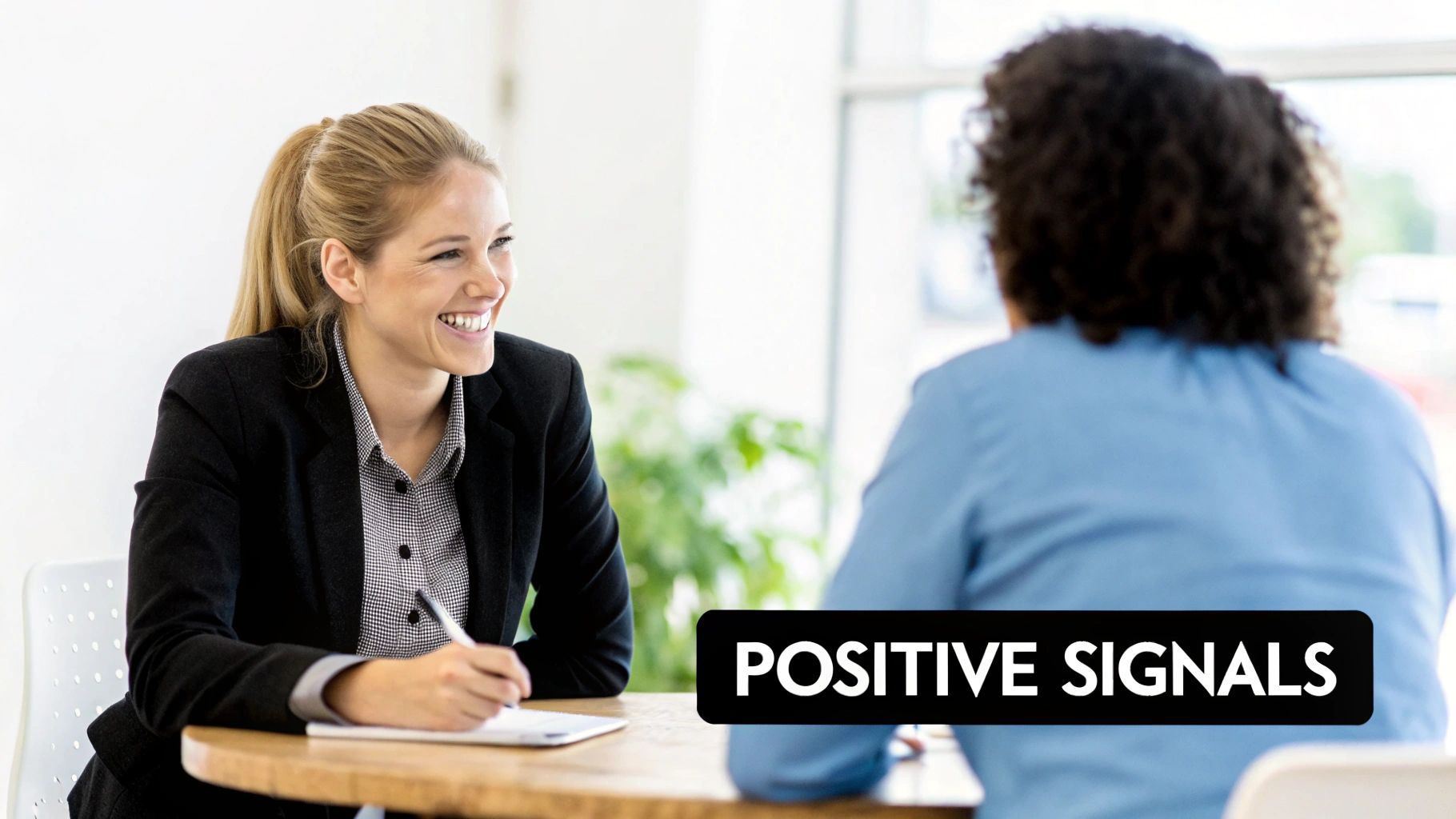
Sure, your answers are important. But the conversation you're not hearing—the silent dialogue of body language—can tell you so much more about how an interview is really going.
Picking up on an interviewer's non-verbal cues gives you a huge advantage. It helps you see the difference between someone just being polite and someone who is genuinely interested in you as a candidate. You’ll start to spot the little things that show they see you as a potential colleague, not just another name on their list for the day.
Positive Non-Verbal Signals
These are the green flags you want to see. When an interviewer does these things, it’s a strong sign they’re tuned in, engaged, and forming a good impression of you.
Leaning Forward: If an interviewer physically leans in while you're talking, it’s a classic sign of interest. They are literally closing the distance between you, showing they're hooked on what you have to say.
Consistent Eye Contact: This is a big one. When someone maintains natural, steady eye contact, it builds trust and shows they're paying attention. If their eyes are on you and not darting around the room, you’ve got their focus.
Nodding and Mirroring: A hiring manager nodding along as you explain something is basically giving you a silent "yes." Even better, if you notice they subtly copy your posture or hand gestures, that’s a subconscious sign of connection—they're building a rapport with you.
These cues are especially vital in any job that relies on teamwork. In fact, with 70% of UK recruiters actively trying to remove bias from the hiring process, that authentic, non-verbal connection becomes even more meaningful. You can find more on this in the latest recruitment trends and insights from Talos360. When they lean in and nod, you know you're hitting the mark on those crucial soft skills.
Subtle Red Flags to Watch For
Just as there are good signs, there are also a few warning signs to be aware of. Keep an eye out for these, but don't panic if you spot one—context is everything.
Remember: A single crossed arm might just mean the room is cold. Look for clusters of negative signals, not just one isolated action.
Here are a few things that might suggest things aren't going as well:
- Crossed Arms or a Closed Posture: This can create a physical barrier. It sometimes suggests the person is feeling defensive, sceptical, or has mentally checked out.
- Frequent Clock-Watching: If their eyes keep flicking to the clock or their phone, it's a pretty clear sign they're disengaged or just want the interview to be over.
- Minimal Eye Contact: An interviewer who avoids looking at you or seems distracted might have their mind elsewhere. It can be a major indicator of disinterest.
Learning to read these signals gives you another layer of feedback. It helps you understand how to know if an interview went well by revealing the true dynamic in the room long before you get any official word.
Analysing the Conversation's Content and Flow
Forget body language for a moment. The real substance of the interview—what you actually talk about—is one of the best ways to gauge how you're doing. A truly great interview stops feeling like a stiff, formal Q&A and melts into a natural, two-way conversation. It's less of an interrogation and more like you and the hiring manager are already on the same team, figuring things out together.
One of the simplest clues is the clock. If that 30-minute chat you were scheduled for easily spills over into 45 minutes or even an hour, that's a fantastic sign. The interviewer is choosing to invest their most valuable asset—time—in you. They're doing it because they're engaged and can genuinely see you in the role.
Spotting the Shift in Conversation
The moment of truth often comes when the interviewer's questions pivot from the past to the future—specifically, your future at the company. This is a huge tell when you’re trying to figure out how to know if an interview went well. They stop just asking about what you’ve done and start digging into what you would do.
This usually happens with hypothetical, forward-thinking questions. It’s a clear sign they’ve started to picture you on their team. For instance, they might ask how you’d tackle a specific project in your first 90 days or get your thoughts on a challenge the team is wrestling with right now.
Key Takeaway: When the conversation turns from "tell me about a time when you..." to "how would you help us with...", you've made the leap from just another candidate to a potential colleague.
Language That Signals Strong Interest
Certain phrases and topics are undeniable green flags. Pay close attention if the interviewer starts to "sell" the company to you. When they begin pointing out the perks, talking up the team culture, or outlining opportunities for career growth, they're not just evaluating you anymore—they're trying to win you over.
This is where you need to listen for specific, positive language that goes beyond the usual interview script.
A quick way to spot the difference is to compare standard questions with the kind of language that shows genuine interest.
Positive vs. Neutral Interview Language
| Indicator | Neutral Language (Standard Interview) | Positive Language (Strong Interest) |
|---|---|---|
| Future Focus | "Tell me about your experience with [skill]." | "How would you approach our upcoming [project]?" |
| Team Integration | "Can you describe your ideal team environment?" | "Let me introduce you to Sarah, our project lead." |
| Selling the Role | "Do you have any questions for me?" | "We have excellent training programmes for new starters." |
| Next Steps | "We'll be in touch with an update soon." | "Alex from HR will call you by Thursday about the final stage." |
When you hear that positive language, you know things are heading in the right direction. Here are a few more specific examples to listen for:
Spontaneous Introductions: If the interviewer says something like, "Hang on, let me quickly grab Sarah, our project lead," it's a massive vote of confidence. They wouldn't waste a colleague's time unless they saw you as a serious contender.
Talking Money and Benefits: While sometimes just part of the process, if they bring up salary expectations, the benefits package, or holiday policies without you asking, it suggests they're already thinking about the practicalities of making you an offer.
Clear Next Steps: A vague "we'll be in touch" is the standard, non-committal response. But a specific, "Our HR business partner, Alex, will contact you by Thursday to discuss the final stage" shows they have a clear plan, and you're in it.
Picking up on these conversational shifts is key. It helps you move past the post-interview guesswork and allows you to make a much more informed decision about your performance and what to do next.
Building Your Post-Interview Action Plan
The moment you walk out of an interview, the real work begins. Instead of getting stuck in that limbo of waiting and wondering, it’s time to take control. A proactive approach helps you move forward with confidence, regardless of what happens next.
By taking a few minutes to honestly analyse the conversation, you can turn every interview into a valuable learning experience. This isn't just about trying to guess the outcome; it’s about gathering real insights that will make you a stronger candidate next time around.
Your Post-Interview Evaluation Checklist
As soon as you can, find a quiet spot to sit down and reflect while the details are still fresh. Don’t just rely on your memory—get it down on paper or in a note on your phone.
Here’s a quick checklist to guide your thoughts:
Jot Down the Positive Signals: What specific things did they say or do? Did the interviewer switch to future-focused language, like “you will be working on…” or “your team would be…”? Write down every positive indicator you can remember.
Pinpoint the Tough Questions: Which questions tripped you up or made you pause? Were there moments you felt you could have answered better? Nailing down these tricky spots is the first step to improving your interview game.
Identify Their Main Focus: What topics did the interviewer keep coming back to? Did they zero in on a specific skill or project from your CV? This is a massive clue about what the organisation really needs right now.
Thinking things through like this turns that anxious waiting time into productive self-development. You’re not just hoping for a call back; you’re actively sharpening your skills for whatever comes next.
This flowchart shows how a really promising interview tends to unfold, moving from the standard back-and-forth into a more future-focused chat that often ends with an offer.
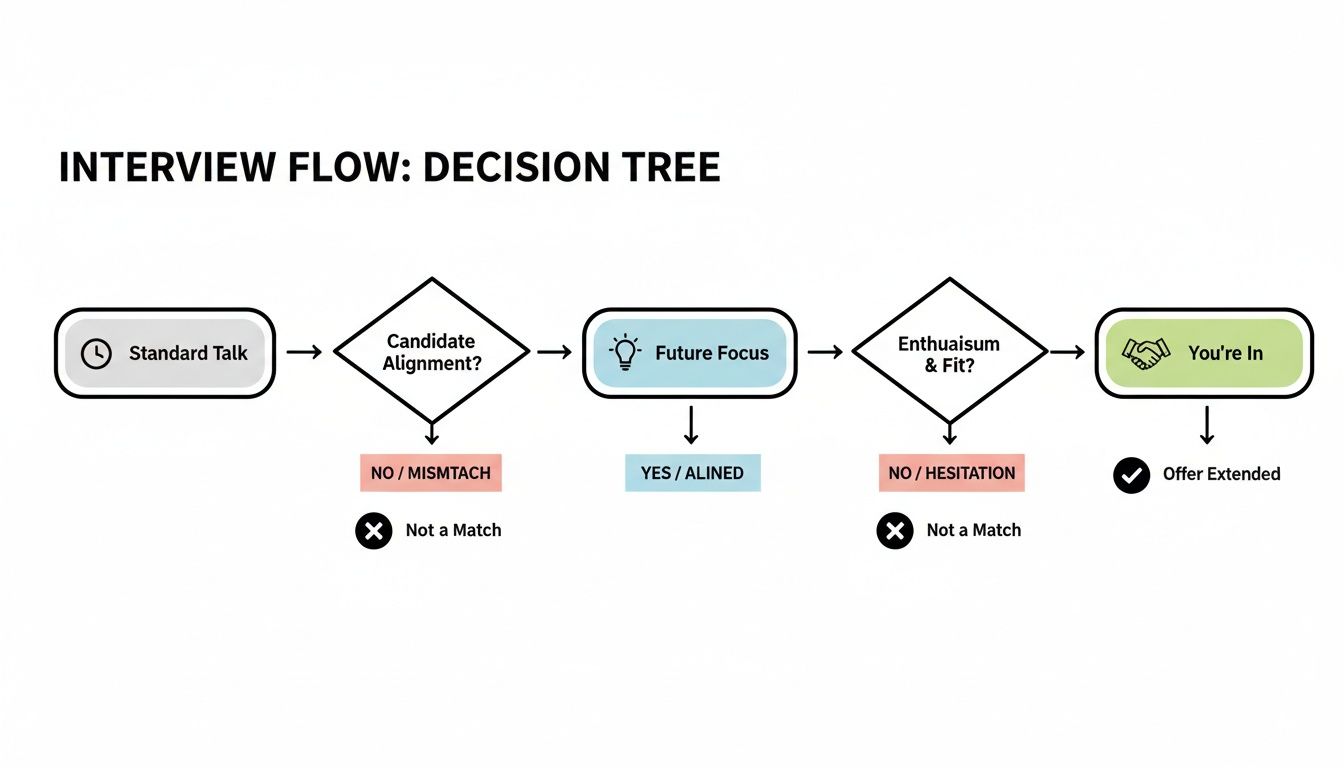
As you can see, when the conversation shifts from general questions to specific “what if” scenarios, it’s a powerful sign that they’re picturing you in the role.
Deciding on Your Next Steps
Once you’ve done your review, you’ll have a much clearer idea of what to do next. Your plan from here all depends on how you felt the conversation went.
If the signs were overwhelmingly positive and you felt a great connection, your next move is to write a solid follow-up email. This keeps you top-of-mind and shows you’re genuinely interested.
But what if the signals were a bit mixed, or you realised the job isn't quite the right fit for you? Your plan changes. Now, the goal is to use what you’ve learned to make your job search even stronger. For instance, if the interviewer kept mentioning a skill that isn’t front and centre on your CV, it’s the perfect time for an update. You can easily tweak this on an ATS-optimised CV from europass.ai, making sure your key qualifications pop for the next application. This keeps you moving forward, always prepared for the right opportunity.
How to Craft a Standout Follow-Up Email
So, the interview is done. But you’re not quite finished yet. You have one last chance to make a strong, positive impression, and that’s your follow-up email.
Think of it as more than just a quick "thank you". It’s a strategic move. A well-crafted email keeps you top of mind, reinforces your interest, and can even be the thing that nudges a hiring manager who’s sitting on the fence. It shows you’re a thoughtful, professional candidate who goes the extra mile.
The Perfect Timing
When you send it matters. You want to strike the right balance between keen and desperate, and the sweet spot is within 24 hours of your interview.
This timing is perfect because the conversation is still fresh in everyone's mind. It shows you’re organised and genuinely engaged. Send it too soon, and it can feel a bit rushed; wait any longer, and you risk getting buried under a mountain of other emails.
Key Elements of an Effective Email
Your follow-up needs to be short, professional, and most importantly, personal. Ditch the generic templates and focus on adding real value. Every great follow-up email has these three core ingredients.
A Personalised Thank You: Start by addressing the interviewer by name and thanking them for their time. Be specific about the role you discussed to avoid any confusion.
A Specific Conversation Point: This is your secret weapon. Mention something unique that you talked about—maybe a particular project that caught your interest or a great question they asked. It proves you were actually listening and aren’t just sending out a carbon copy email.
A Confident Reaffirmation: Briefly restate your excitement for the role and the company. You want to confidently connect your skills to what they need. This is a lot like the approach used in a great cover letter; you can get more insight on that by exploring how a Europass motivational letter can help you land the job interview.
Sample Follow-Up for a Technical Role
Let’s look at a real-world example. Imagine you’ve just interviewed for a role as a manufacturing technician or an electrician in Germany. Here’s how you could frame it.
Subject: Thank You – Interview for Manufacturing Technician Role
Dear [Interviewer's Name],
Thank you again for taking the time to speak with me today about the Manufacturing Technician position. I really enjoyed learning more about the team and the innovative processes at [Company Name].
I was particularly interested when we discussed the upcoming upgrade to the CNC machinery. My experience calibrating similar systems lines up perfectly with the challenges you mentioned, and I’m confident I could help ensure a smooth transition.
After our chat, I’m even more enthusiastic about this opportunity. I am very keen on the possibility of joining your team and contributing to your success.
Best regards,
[Your Name]
See how that works? It’s direct, adds value by referencing a specific pain point, and ends on a really positive, confident note. It's the perfect final touch to your interview process.
Managing the Wait and When to Move Forward
That deafening silence after an interview you thought you nailed? It’s easily the toughest part of the whole job hunt. You find yourself checking your inbox every five minutes, but letting that anxiety take over just kills your momentum.
The best thing you can do is channel that nervous energy into something productive. Whatever you do, don't put your job search on pause waiting for one potential offer. Keep applying for other roles. It keeps your options open and puts you in a position of strength, not desperation.
Using Interview Insights to Your Advantage
Think of that last interview as a free market research session. The hiring manager just told you, in their own words, exactly what the company’s biggest headaches are and the specific skills they think can solve them.
Did they keep circling back to compliance with new EU regulations? Or maybe a particular piece of software came up over and over again. That's pure gold. Don't let it go to waste—use it to sharpen your CV right now.
Key Action: Jump into your europass.ai account and tweak your skills section. If the interviewer couldn’t stop talking about project management, you need to make sure that keyword and your best project-related wins are front and centre. It’s a simple change that makes your CV that much stronger for the next application.
By constantly refining your CV with this kind of real-world feedback, you’re not just applying for jobs; you're getting better with every single submission. You can also check how your CV scores with a free ATS resume checker to make sure your updates are actually making an impact.
Understanding Realistic Timelines
Knowing what to expect can seriously dial down the post-interview stress. Of course, a quick response is always a fantastic sign, but hiring processes in Europe can be all over the place. For example, if you’re wondering whether your interview for a construction foreman job in Dublin went well, a follow-up within a day or two is a very strong signal.
But patience is the name of the game. The average time from sending your application to getting a first interview in the UK is around two to three weeks. The total time-to-hire can easily stretch to eight weeks, especially if there are multiple interview stages. Hearing back quickly is great, but don’t assume the worst if it takes longer. For a deeper dive into the numbers, StandOut CV has some great insights on job interview statistics.
Your best bet is to stick to the timeline the interviewer gave you. If they said you’d hear back by Friday, give them until Tuesday before you send a polite, short follow-up email. If there’s still radio silence after that, it’s usually time to mentally move on and pour your energy into the next exciting opportunity.
Common Questions After the Interview
Even when you feel you’ve aced an interview, a few questions can start buzzing around in your head afterwards. It's totally normal. Knowing what to expect and how to handle these common situations will help you navigate the post-interview waiting game with confidence.
How Long Should a Good Interview Last?
Honestly, there’s no magic number. But if you were booked for 30 minutes and the conversation easily flows for 45 or even 60 minutes, take that as a fantastic sign. It means the hiring manager is genuinely engaged and likely sees you as a strong contender for the role.
On the flip side, an interview that ends surprisingly quickly can sometimes (but not always!) mean it wasn't the right fit. The key is engagement—a deep, flowing conversation is always a better indicator than just watching the clock.
Is It a Good Idea to Ask for Feedback After a Rejection?
Absolutely. It shows professionalism and a real desire to grow. If you get that dreaded rejection email, it’s perfectly fine to send a polite reply thanking them for their time and asking if they’d be willing to share any feedback to help with your job search.
Keep in mind that not every organisation will respond—some have policies against it due to GDPR or other internal rules—but the ones that do can offer pure gold. That little bit of insight can be exactly what you need to sharpen your interview skills or tweak your CV for the next opportunity.
What Does It Mean If They Have More Candidates to See?
Don't let this one throw you off. It’s a completely standard part of the hiring process. Most of the time, the interviewer is simply being transparent about their timeline and where they are in the recruitment cycle. It’s not a reflection on your performance.
The best thing you can do is stay positive and professional. Thank them for letting you know and take the opportunity to quickly mention again how excited you are about the role. You want to be the candidate they can’t stop thinking about when it's time to make that final choice.
What Should I Do If I Get Another Offer While Waiting?
First off, congratulations! This is a great problem to have. The key here is to handle it with transparency and professionalism. Start by getting in touch with the company that made the offer. Thank them sincerely and ask for a reasonable amount of time to make your final decision.
Then, immediately contact your preferred company. Let them know you've received another offer but reiterate that they are still your first choice. Politely ask if they have an updated timeline for their decision. If you're a candidate they really want, this can often light a fire under them and speed things up.
Reading the signs of a good interview empowers you to navigate the job search with less stress and more confidence. By focusing on the interviewer's engagement, the conversation's flow, and specific next steps, you can gain valuable insight. Remember to trust your intuition but also to keep moving forward. A proactive approach, including a professional follow-up and continuous CV improvement, puts you in the driver's seat of your career.
Ready to make sure your CV is as strong as your interview? With europass.ai, you can build a professional, ATS-optimised CV that gets you noticed. Try Europass.ai Free Today at https://europass.ai.
Great CVs get work done
Work smarter with the CV builder trusted by skilled workers for more than a decade.
It's easy
