How to Write a CV for a Student: A Winning European Guide
Starting your career is an exciting time, but let's be honest—writing that first CV can feel like a massive hurdle. This guide is here to change that. We've designed it specifically for students and recent graduates across Europe, showing you exactly how to transform your academic projects and limited work experience into a CV that gets you noticed. We’re skipping the generic advice and diving straight into practical, actionable strategies that work. You'll learn how to structure your CV, frame your skills, and truly highlight your potential.
By the end of this guide, you will have a clear plan on how to write a CV for a student that is optimised for Applicant Tracking Systems (ATS) and actually opens doors to interviews. Ready to build a CV that shows what you can really do? Let's get started. And if you want to create a professional CV in minutes, our AI-powered builder at europass.ai can make the process much smoother.
Understanding the Modern European Job Market

Before you write a single word, it’s crucial to understand the landscape you're stepping into. The European graduate job market is competitive, and sending a generic, one-size-fits-all CV is one of the fastest routes to being ignored. Employers are swamped with applications, which has completely changed how they hire new talent.
This shift is incredibly clear in the UK, where the volume of graduate applications has hit record levels. In 2024, UK employers received over 1.2 million graduate applications – an all-time high. This followed a massive 38% jump in applications per vacancy in 2023, leaving companies with an average of 86 applications for every single graduate role (Source: Institute of Student Employers).
With this level of competition, your CV needs to be more than just a list of qualifications. It must be a sharp, strategic tool designed to cut through the noise. While our focus is on university students, many of these principles are also useful earlier on. For younger students, our comprehensive guide to a perfect CV for high school students is a great place to start.
The Rise of the Robots: Applicant Tracking Systems (ATS)
One of the biggest initial hurdles you'll face is the Applicant Tracking System (ATS). Think of it as a digital gatekeeper for your CV. Companies use this software to manage the mountain of applications they receive. The ATS scans your CV for specific keywords and phrases that match the job description, long before a human ever sees it.
If your CV isn't built to be read by these systems, it could be automatically filtered out, no matter how perfect you are for the job. This means formatting, structure, and using the right keywords aren’t just nice-to-haves—they're essential for getting your application into the 'maybe' pile.
Your CV's first reader is almost always a machine. You have to write for the ATS first to earn the chance to impress a person. This means using clear headings, standard fonts, and incorporating keywords straight from the job advert.
What Recruiters Really Want to See in a Student CV
Once your CV makes it past the ATS and lands in front of a hiring manager, they’re looking for specific things, especially from a student. They don’t expect you to have a decade of experience, but they are searching for potential and a good fit for their team.
Here’s what’s going through their mind as they scan your CV:
- Can you do the job? They’re looking for evidence of relevant skills, whether you gained them in coursework, a university project, an internship, or even a weekend retail job.
- Are you genuinely interested? A CV that has clearly been tailored for their company and the specific role shows you've done your research. It proves you’re not just spamming every job board you can find.
- Will you fit in with the team? They’re also scanning for crucial soft skills like teamwork, communication, and problem-solving. This is where your extracurricular activities or volunteer work can really shine.
Understanding what recruiters are looking for helps you shift your mindset from simply listing facts about yourself. It pushes you to frame your experience as a direct solution to their needs, turning your CV from a simple document into a powerful pitch that lands you interviews.
Choosing the Ideal CV Format and Structure
Your CV's structure is its backbone. For students, getting this right is non-negotiable. A clean, logical layout makes a powerful first impression on busy recruiters and is essential for getting past the initial screening by Applicant Tracking Systems (ATS). This structure is what turns your experience into a compelling story they can easily follow.
The biggest decision you'll make at the start is picking the right format. This choice determines the flow of your CV and what parts of your background stand out first. Get this right, and your best selling points are front and centre.
Understanding the Three Main CV Formats
As a student, you have three main options. Each one is designed for different levels of experience and career goals, so it pays to know which will work best for you.
- Reverse-Chronological: This is the industry standard and what most recruiters across Europe expect. You list your work experience and education starting with the most recent and work backwards. It’s perfect if you have a clear timeline of relevant internships, part-time jobs, or volunteer roles.
- Functional (Skills-Based): This format focuses entirely on your skills, not your work history. You group your abilities into categories like "Communication" or "Project Management" and provide examples from various experiences. It can be an option if your work history is thin or unrelated, but be cautious: many recruiters find this format confusing and hard to follow.
- Hybrid (Combination): As the name suggests, this format combines the best of both worlds. It usually starts with a detailed skills summary at the top, followed by a condensed reverse-chronological work history. This is often an excellent choice for students who want to highlight specific technical or soft skills while still providing a clear timeline of their experience.
So, how do you know which format is the right fit? This table breaks it down to help you decide based on your current situation and career goals.
Comparing CV Formats for Students
| CV Format | Best For... | Key Focus | When to Use |
|---|---|---|---|
| Chronological | Students with relevant internships or part-time work experience. | A clear, linear progression of roles and responsibilities. | When your work history directly supports your career goals and you want to show growth. |
| Functional | Students with limited direct experience or those changing career paths. | Transferable skills and abilities. | When your coursework, projects, or volunteer work are stronger than your paid work history. |
| Hybrid | Students with specific technical skills and some relevant experience. | A blend of key skills and a clear work timeline. | When you need to highlight specific expertise (like coding languages) but also show a steady work ethic. |
Choosing the best format from the start gives your application a huge advantage. It ensures the recruiter sees your most impressive qualifications immediately, rather than having to search for them.
This flowchart clearly illustrates the difference between sending a generic CV and one that you've carefully tailored for the role.
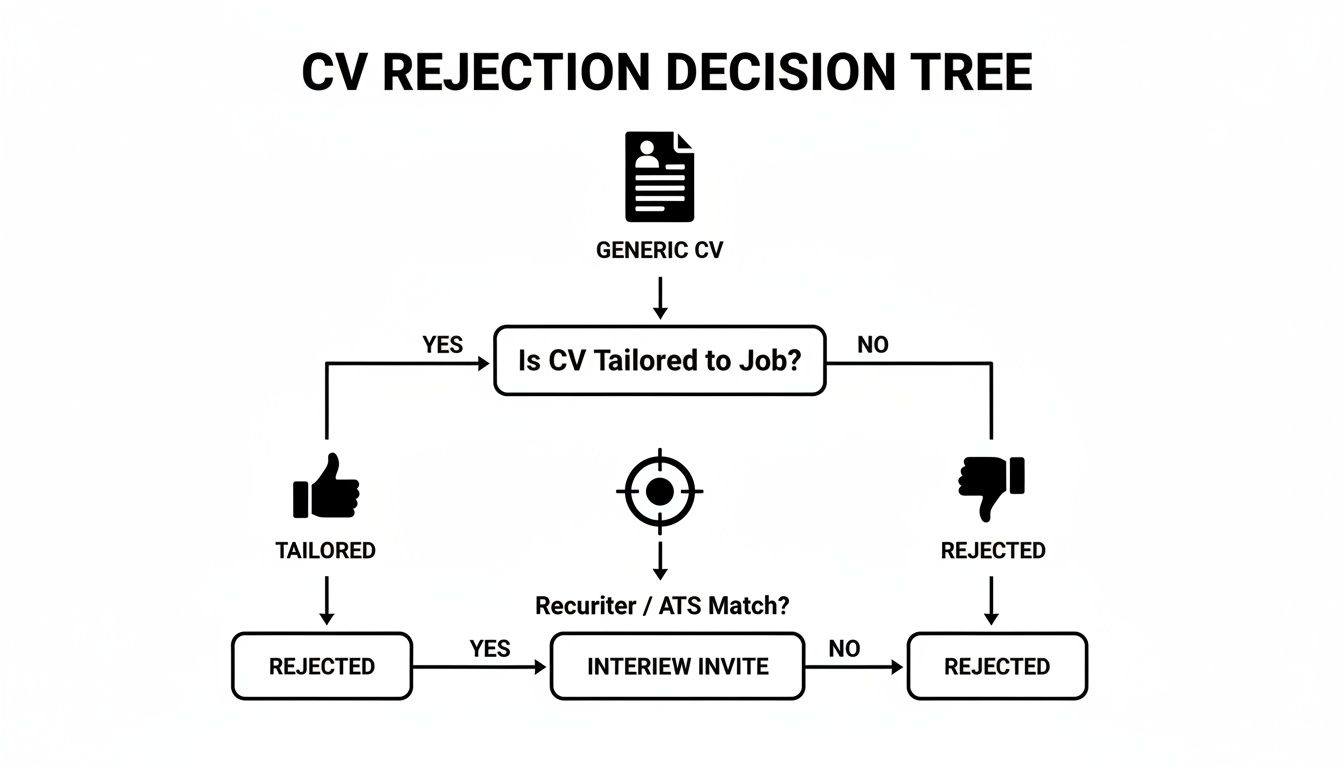
The bottom line is simple: tailoring your CV's content and structure to the specific job you're applying for is the surest way to secure an interview.
Getting the Length and Presentation Right
Once you’ve chosen a format, the small details of presentation make a big difference. For job seekers in the UK and Europe, a two-page CV is standard for experienced professionals. However, as a student, a sharp, concise one-page CV often packs a bigger punch.
It's interesting to see how trends are changing. Recent data shows that junior candidates are now providing more detail, with average CV word counts climbing to 490 words in 2024 as they highlight more skills and project work. You can explore these trends further at the University of Edinburgh Careers Service for more context.
Pro Tip: Keep your CV clean and easy to scan. Stick to a professional font like Arial, Calibri, or Verdana in a 10-12 point size. Ensure there's plenty of white space by using generous margins and clear, bold headings for each section.
To see how these principles look in practice, check out our guide on the modern Europass CV format. Better yet, building your CV with europass.ai means you start with a professionally designed, ATS-optimized template right away, taking all the guesswork out of it.
Writing a Personal Statement That Gets Read

Your personal statement is the most valuable real estate on your CV. It’s that short, sharp paragraph right at the top that acts as your professional handshake. As a student, this is your best chance to grab a recruiter’s attention and make them want to learn more about you.
Think of it as your 30-second elevator pitch. It needs to give the hiring manager a quick, clear answer to three crucial questions: Who are you? What can you offer them? And what are you looking for?
The Core Formula for an Impactful Statement
Staring at a blank page can feel daunting, but a simple formula works every time. Your goal is to keep it concise—around 50 words or 3-4 powerful sentences is the sweet spot.
A solid personal statement breaks down like this:
- Who You Are: Start with a strong adjective and your current academic status. For example, "A motivated and analytical final-year Mechanical Engineering student..."
- What You Offer: This is where you connect your skills to the employer's needs. Mention 2-3 key skills or experiences that you know they're looking for, pulling directly from the job description. This could be technical skills from your coursework or soft skills from a part-time job.
- Your Ambition: Wrap it up by stating your career goal and how it aligns with their company. Be specific: "...seeking to apply theoretical knowledge and problem-solving skills to a graduate engineering role at a forward-thinking firm."
Try to avoid starting with tired phrases like "I am a..." or "I am writing to apply for...". Jump straight into your key qualities. It shows confidence and makes an immediate impact.
Real-World Examples for Different Fields
Let's see this formula in action. Notice how each example is tailored, packed with relevant keywords, and avoids vague clichés.
For a Marketing Internship:
"A creative and data-driven final-year Marketing student with practical experience in social media content creation and campaign analysis from university projects. Eager to contribute fresh ideas and strong analytical skills to the Digital Marketing team at [Company Name] and develop expertise in SEO and PPC strategies."
For an Entry-Level Software Developer Role:
"An ambitious and detail-oriented Computer Science graduate with a strong foundation in Python, Java, and agile methodologies. Proven problem-solving abilities demonstrated through a final-year project developing a full-stack web application. Seeking to apply technical skills and a passion for clean code to a junior developer role at a dynamic tech company."
These examples work because they are specific, confident, and speak directly to what an employer in that industry needs. They bridge the gap between your academic life and your professional ambitions—which is exactly how to write a CV for a student that gets results.
With europass.ai, our AI-powered suggestions can help you craft a personal statement that feels authentic and is optimised to catch a recruiter's eye.
Turning Your Experience into Real Achievements

One of the biggest challenges students face is the feeling they don’t have any ‘real’ work experience. This is a common concern, but the key is to reframe your perspective. Your time at university, that part-time café job, and even your society memberships are filled with valuable experiences. The secret is learning how to present them not as tasks you completed, but as achievements that prove your capabilities.
This isn’t just a helpful tip; it’s essential. The job market is tough. A staggering 51.3% of so-called 'entry-level jobs' in the UK now ask for previous work experience, with employers looking for an average of 2.7 years (Source: Adzuna). This creates a significant barrier for new graduates.
Therefore, you must learn to translate everything you’ve done into the language of professional achievement.
Moving Your Education Beyond a Single Line
Your degree is far more than a title and a university name. It represents a collection of projects, research, and specialised learning that has equipped you with practical, job-ready skills. Instead of just listing it, expand your education section to showcase that depth.
Here’s how you can do it:
- List Relevant Modules: Add a short list of modules that connect directly to the job. For a software engineering role, you might include: "Relevant Modules: Data Structures & Algorithms, Object-Oriented Programming, Database Systems."
- Showcase a Key Project: Dedicate a bullet point to a major academic project. Briefly describe what you did, the skills you used (e.g., Python, MATLAB, teamwork), and the outcome.
For an engineering student, this could look like this:
Final-Year Project: Automated Robotic Arm
Designed and built a prototype robotic arm using SOLIDWORKS and Arduino, improving pick-and-place accuracy by 20% compared to the initial design brief through iterative testing and code optimisation.
See the difference? That single bullet point demonstrates technical skills, problem-solving, and a focus on measurable results. It’s far more powerful than simply stating you have a degree.
Turning Duties into Accomplishments
Now, let's apply that same achievement-focused mindset to your work history—whether that’s an internship, a retail job, or volunteer work. Recruiters aren't interested in a list of your daily tasks; they want to see the impact you made.
The key is to start your bullet points with strong action verbs and, wherever possible, add numbers to quantify your results. Ask yourself: how did I make things better, faster, or more efficient?
Here’s a simple before-and-after to show the transformation:
| Before (Duty-Focused) | After (Achievement-Focused) |
|---|---|
| Served customers at a busy café. | Increased repeat customer visits by 15% over three months by providing friendly and efficient service, as noted in customer feedback. |
| Helped organise a university society event. | Successfully co-ordinated a fundraising event for 150+ attendees, managing logistics and promotion to exceed the fundraising target by £500. |
| Responsible for stock management. | Reduced stock discrepancies by 10% by implementing a new daily checklist system for inventory tracking. |
Notice how the 'After' examples use numbers and specific outcomes to prove their value. This approach shows a recruiter that you’re a results-driven person, not just someone who follows instructions. For more guidance, especially for work placements, check out our tips on crafting a curriculum vitae for an internship.
Mastering the skill of reframing experience is fundamental to how to write a CV for a student that gets noticed. By transforming your academic and part-time roles into compelling achievements, you prove your potential and show employers what you can bring to their team from day one.
Showcasing Skills and Tailoring Your CV
Your skills section is the heart of your CV. It’s where you provide concrete proof that you can do what the job requires. For students, this section is a goldmine – it lets you showcase abilities you’ve developed everywhere, from lectures and labs to your weekend job.
A great way to start is by splitting your skills into two categories: technical (hard) and soft skills. This simple organisation makes a recruiter's job easier, allowing them to quickly assess what you bring to the table.
Identifying Your Core Abilities
First, let's focus on technical skills. These are the concrete, teachable abilities you’ve learned through your course or practical experience.
- Software Proficiency: List any relevant programmes you’re confident using. Think Microsoft Office Suite (Word, Excel), Adobe Creative Cloud, SOLIDWORKS, MATLAB, or coding languages like Python or Java.
- Languages: Be specific about your language abilities. Instead of just "Spanish," use a recognised framework like "Spanish (C1 - Advanced)" or "German (B2 - Upper Intermediate)" to add credibility.
- Technical Knowledge: If your field is more hands-on, like a trade or engineering, list any specific equipment, methodologies, or technical standards you are familiar with.
Next, it’s time to highlight your soft skills. These are the personal qualities that show how you work with others. Often, these are the skills that secure you the job, as they prove you'll be a great fit for the team.
Think about times you've had to use:
- Teamwork and Collaboration
- Problem-Solving and Critical Thinking
- Communication (Written and Verbal)
- Time Management and Organisation
- Adaptability and a willingness to learn
The Crucial Step of CV Tailoring
Sending the same generic CV for every application is one of the biggest mistakes students make. It’s a fast track to the rejection pile. To have a real chance, you must tailor your CV for each specific role.
This means carefully reading the job description and identifying the keywords and required skills the employer is looking for. Once you have them, weave that same language into your CV, especially in your personal statement, experience descriptions, and skills sections.
Tailoring isn't about rewriting your entire CV. It's about strategically adjusting the focus and language to mirror the employer's needs, proving you are the perfect fit for their specific position.
This customisation is a win-win. First, it helps your CV get past the initial ATS scan, which is looking for those keywords. Second, it immediately shows the hiring manager you’ve taken the time to do your research and are genuinely interested in their job, not just any job.
An AI-powered tool like europass.ai can make this tailoring process incredibly fast, suggesting relevant skills and phrases to help you align your CV perfectly in minutes.
Key Takeaways
You now have a clear game plan for how to write a CV for a student that showcases your potential and gets you noticed in the competitive European job market. It all boils down to a few key actions: building a clean, ATS-friendly structure, writing a compelling personal statement that grabs attention, and framing all your experience—academic or otherwise—as a genuine achievement. Remember to tailor your CV for every single application. Never underestimate the power of your university projects or part-time jobs; when presented correctly, they become powerful proof of your skills, drive, and potential. By focusing on the right skills and quantifying your accomplishments, you can confidently compete for the roles you want.
Ready to put this into practice? You can create your professional CV in minutes with the europass.ai CV builder and build an ATS-optimised document that tells your unique story.
Frequently Asked Questions
When you're putting together your first CV for the European job market, a few common questions always seem to pop up. Let's tackle them head-on.
What is the ideal CV length for a student in Europe?
For most students and recent graduates across the UK and Europe, a sharp, concise one-page CV is the gold standard. It forces you to be selective and impactful. However, a two-page CV is perfectly acceptable if you have enough genuinely relevant experience, projects, and skills to fill it without adding fluff. The golden rule is quality over quantity. Never go beyond two pages.
Should I put my university grades on my CV?
Yes, but only if they are strong. If you’ve earned a First-Class or a 2.1 Honours degree (or the local equivalent), that’s an excellent achievement and should absolutely be included. If your overall grade is lower, it’s often best to leave it off. You can still draw attention to your academic strengths by highlighting excellent marks in specific modules or projects that are highly relevant to the job you are applying for.
Are CV templates a good idea?
They can be a lifesaver, but you have to choose wisely. Using a professionally designed, ATS-friendly template from a trusted platform like europass.ai is a smart move. It ensures your formatting is clean, modern, and won’t be scrambled by recruitment software. Steer clear of overly creative templates with complex graphics, text boxes, or multiple columns. While they might look visually appealing, they often cause issues for automated screening systems, meaning your CV could be rejected before a recruiter ever sees it.
Ready to build a professional, ATS-optimised CV that gets you noticed? Start Building Your CV in Minutes with europass.ai.
Great CVs get work done
Work smarter with the CV builder trusted by skilled workers for more than a decade.
It's easy
