Lists of Skills for a CV: The Ultimate 2026 Guide for Construction & Trades
In the competitive European job market for construction, manufacturing, and the trades, your CV is your most critical tool. It's not enough to simply list your work history; you need to showcase a powerful combination of skills that grabs the attention of both hiring managers and the Applicant Tracking Systems (ATS) they use to filter candidates. Many skilled professionals struggle to translate their hands-on expertise into words that resonate on a CV, often under-selling their true value. This guide is designed to fix that.
We provide comprehensive lists of skills for a CV, tailored specifically for your industry. Forget generic advice. Here, you'll find the exact hard, soft, and technical skills that employers in sectors like construction, logistics, and skilled trades are actively searching for. We'll break down how to articulate these abilities effectively, complete with practical examples and keyword-rich phrasing that gets you past automated screening software. Ready to build a CV that truly reflects your capabilities? Create Your Professional CV with Europass.ai.
This article moves beyond basic lists. You will learn how to group related competencies, prioritise what matters most for a specific role, and frame your skills within achievement-oriented bullet points. By understanding how to strategically present your capabilities, you can build a CV that not only reflects your experience but also opens doors to better career opportunities. Your practical skills are in high demand; it's time your CV proved it.
1. Leadership & Team Management Skills
For professionals in hands-on industries like construction, manufacturing, and skilled trades, leadership is more than just a title; it's a critical soft skill that signals your readiness for greater responsibility. Foremen, supervisors, and team leads must demonstrate the ability to guide teams effectively, make sound decisions under pressure, and uphold stringent safety standards. Highlighting these skills on your CV is essential for securing promotions and increasing your earning potential.

This skill set is about proving you can translate project goals into coordinated action on the ground. It encompasses everything from delegating tasks to managing conflict and mentoring junior colleagues. When you include these competencies in your application, you are showing employers you can be trusted to manage their most valuable assets: their people and their projects.
How to Showcase Leadership on Your CV
To make your leadership capabilities stand out, you must go beyond simply listing "team management". You need to provide concrete evidence of your impact.
- Quantify Your Experience: Numbers add weight and credibility. Instead of saying "managed a team," specify "Directed a 12-person crew on a €2.5M commercial construction project." This provides a clear scope of your responsibility.
- Highlight Key Achievements: Connect your leadership directly to positive business outcomes. Mention achievements like "Supervised a warehouse team of 20+ associates, improving order picking efficiency by 15% in six months" or "Coordinated shift handovers for a manufacturing line, achieving zero safety incidents over 18 consecutive months."
- Use Powerful Action Verbs: Start your bullet points with strong verbs that convey authority and action. For a CV, words like Supervised, Coordinated, Directed, Mentored, and Managed are highly effective and ATS-friendly.
- Include Training and Certifications: If you have completed any formal leadership training, such as specific site supervisor safety schemes or project management courses relevant in Europe, be sure to list them in your education or certifications section.
2. Safety Compliance & Hazard Management
For any professional in construction, manufacturing, or logistics, a deep-rooted commitment to safety is non-negotiable. Safety Compliance and Hazard Management skills are more than just a regulatory requirement; they are a fundamental indicator of professionalism, responsibility, and your ability to protect a company's most vital assets: its people and its equipment. Employers in these high-risk sectors actively seek candidates who can demonstrate a proactive approach to safety protocols.
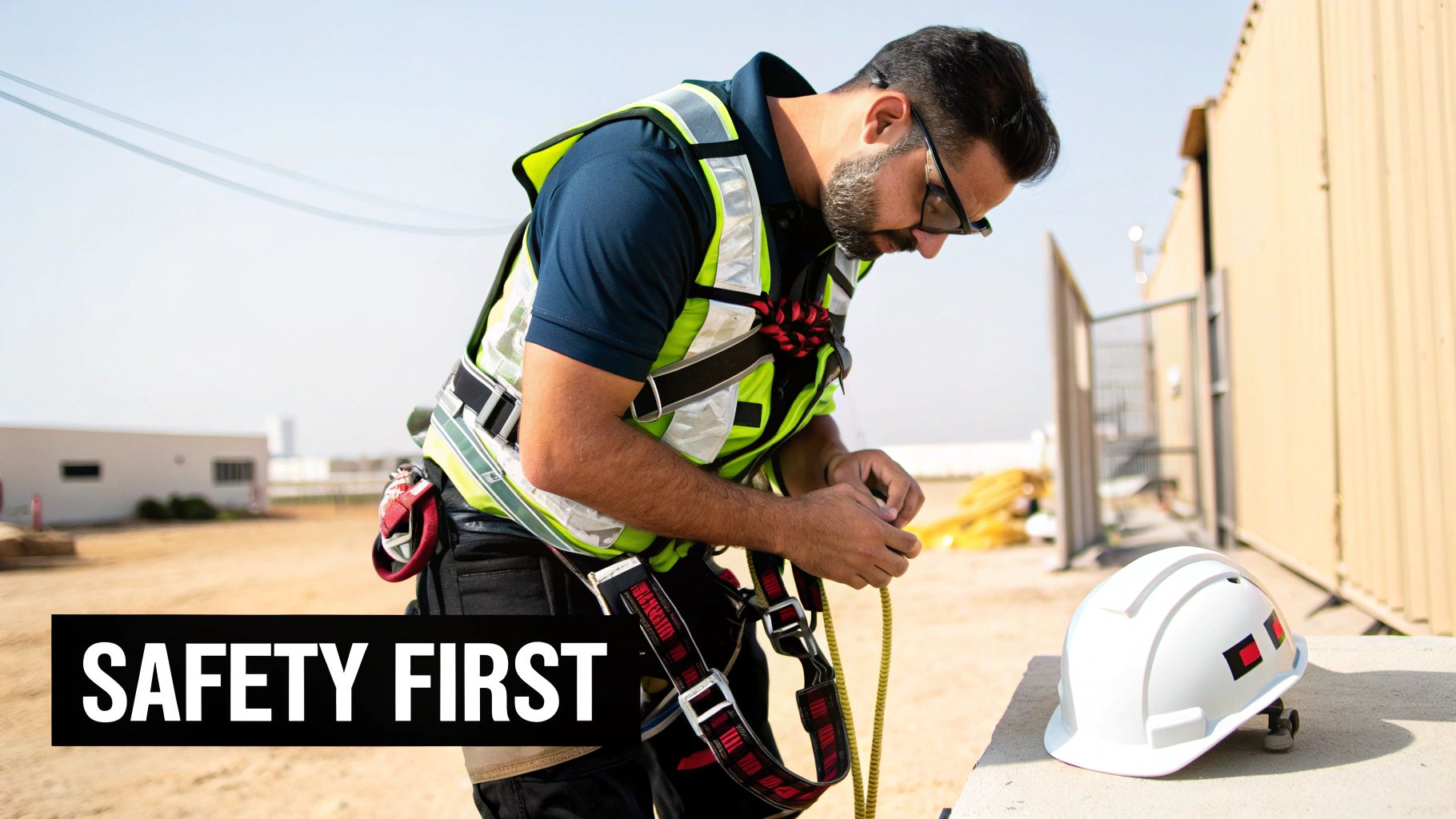
This skill set proves you understand and can implement critical procedures, from conducting risk assessments to using Personal Protective Equipment (PPE) correctly. When you feature these competencies on your CV, you are assuring hiring managers that you are a low-risk, high-value addition to their team, capable of maintaining a safe and productive work environment. It's a core component of the essential lists of skills for a CV in any hands-on industry.
How to Showcase Safety Compliance on Your CV
Simply stating "knowledge of safety" is not enough. You need to provide tangible proof of your expertise and its positive impact.
- Quantify Your Safety Record: Use numbers to highlight your diligence and effectiveness. Instead of "followed safety rules," specify "Contributed to a team-wide record of 800+ working days without a lost-time incident."
- Highlight Key Achievements: Connect your safety awareness directly to operational success. Include accomplishments like "Implemented a new fall protection programme on a construction site, reducing near-miss incidents by 40% over one year" or "Maintained a 3-year zero-incident record while operating heavy machinery."
- Use Powerful Action Verbs: Start your bullet points with words that convey vigilance and responsibility. For your CV, keywords like Enforced, Implemented, Inspected, Monitored, and Trained are highly effective and recognised by ATS.
- Include Training and Certifications: List all relevant safety qualifications prominently. Certifications like IOSH Managing Safely, NEBOSH General Certificate, or specific equipment licences (e.g., MEWP, forklift) should be clearly stated with renewal dates to show they are current.
3. Technical Equipment & Machinery Operation
For hands-on roles in manufacturing, construction, and warehouse logistics, proficiency with technical equipment is a non-negotiable hard skill. Employers need to see that you can operate specialised machinery not just competently, but also safely and efficiently. Highlighting these practical abilities on your CV directly signals your value and readiness to contribute from day one, often justifying higher pay and more specialised roles.
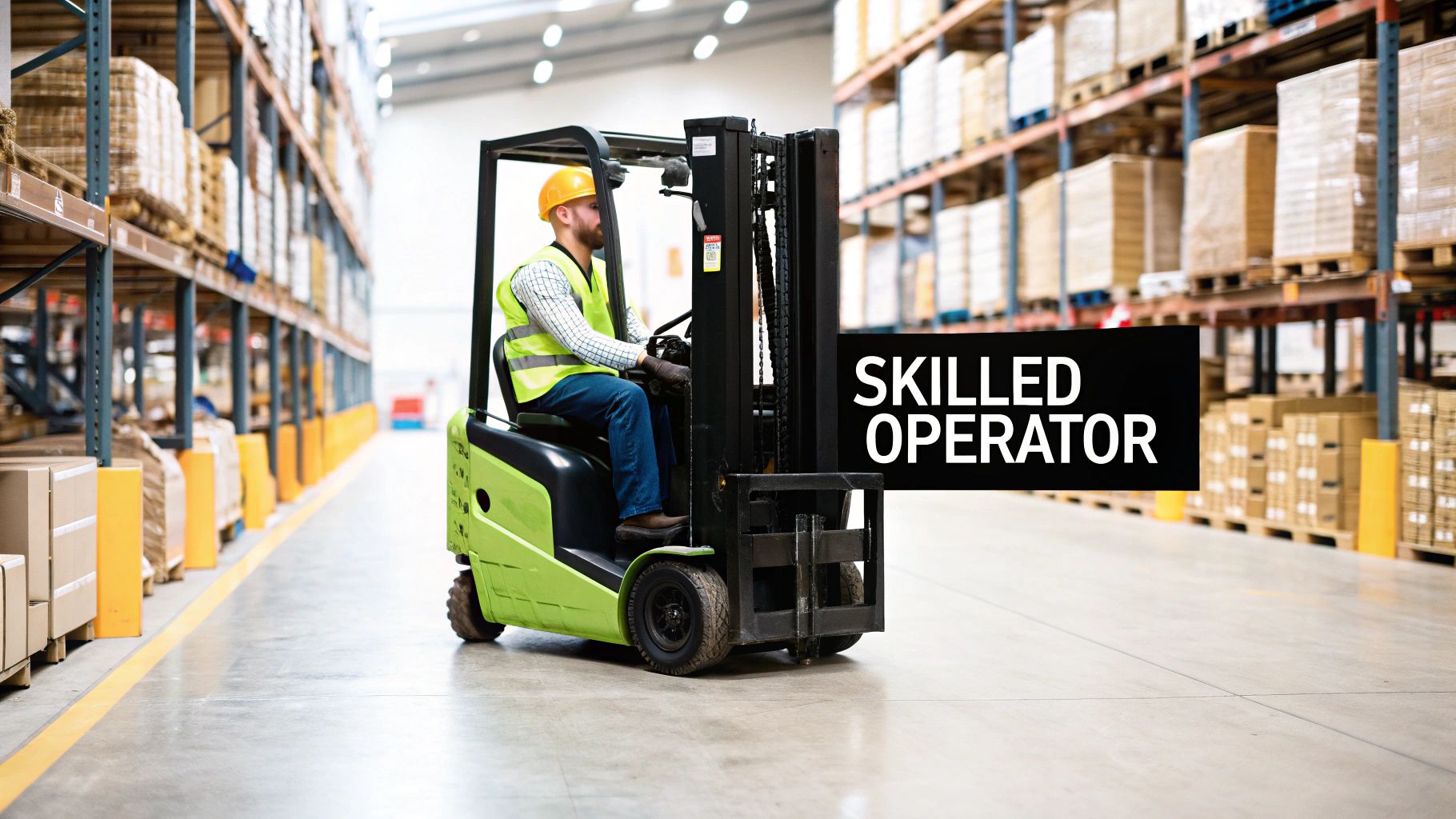
This skill set proves you are a qualified operator capable of handling valuable assets and following strict standard operating procedures (SOPs). It covers everything from daily safety checks and basic maintenance to troubleshooting minor issues and optimising performance. Including these skills in your list of skills for a CV assures recruiters that you possess the practical expertise to perform the core functions of the job.
How to Showcase Equipment & Machinery Skills on Your CV
To effectively demonstrate your technical expertise, you need to be specific and provide context for your abilities.
- Be Specific with Equipment: Instead of "Forklift Operation," write "Certified Operator of Linde and Jungheinrich forklifts." Mentioning specific brands or models like "Komatsu PC200 excavator" or "Siemens SINUMERIK CNC machine" shows precise experience.
- Quantify Your Proficiency: Add numbers to illustrate your experience level. For example, "Operated a multi-head CNC router for 2,000+ production hours with 99.8% accuracy" or "Managed warehouse inventory using reach trucks, moving over 500 pallets daily."
- List Relevant Certifications: Clearly state your qualifications. Include details like "RTITB-Certified Forklift Operator (Licence #12345, expires 06/2026)" or "Certified MEWP (Mobile Elevated Work Platform) Operator for boom and scissor lifts."
- Use Industry-Standard Verbs: Start your descriptions with strong, technical action verbs. For your CV, words like Operated, Calibrated, Maintained, Programmed, and Troubleshot are both descriptive and optimised for ATS scans.
4. Trade-Specific Technical Expertise
For skilled tradespeople in sectors like construction, electrical work, plumbing, and welding, your technical expertise is the core of your professional value. This isn't just a soft skill; it's a collection of hard-earned, practical abilities validated by years of apprenticeship, hands-on work, and official certification. Highlighting these specialised skills on your CV is non-negotiable for proving your competence, justifying your pay grade, and securing roles on high-value projects.
This skill set demonstrates your mastery of specific tools, techniques, and safety codes that are critical to your trade. It encompasses everything from interpreting complex blueprints and adhering to European or country-specific regulations to performing specialised MIG/TIG welding. When you detail these competencies, you show employers you possess the precise, verifiable knowledge required to perform the job safely and to the highest industry standards.
How to Showcase Technical Expertise on Your CV
To make your trade-specific skills impactful, you must present them with clarity and verifiable detail. Simply stating "certified electrician" is not enough.
- Be Specific with Licences & Certifications: This is your primary proof of qualification. Instead of a general mention, list the full title, issuing body, and licence number. For instance, "City & Guilds Level 3 NVQ Diploma in Installing Electrotechnical Systems and Equipment (2357)" or "Gas Safe Registered Engineer (Reg. No: 123456)."
- Detail Your Specialisations: Employers often hire for niche skills. Specify your area of focus, such as "Master carpenter with advanced expertise in custom joinery and heritage property restoration" or "Certified plumber specialising in large-scale commercial boiler installations and renewable heat pump systems."
- Use Action Verbs for Technical Tasks: Begin your bullet points with verbs that describe your hands-on work. When creating lists of skills for a CV, using words like Installed, Calibrated, Fabricated, Repaired, and Troubleshot effectively communicates your practical abilities to both hiring managers and ATS software.
- Quantify Your Project Experience: Numbers provide context and scale. Showcase your experience with phrases like "Welded and fabricated structural steel components for a 15-storey commercial development" or "Completed electrical fit-outs for over 50 new-build residential properties, ensuring 100% compliance with BS 7671 regulations."
5. Problem-Solving & Troubleshooting
For professionals in skilled, hands-on industries, problem-solving is not an abstract concept; it is a daily, practical necessity. This skill combines analytical thinking with diagnostic capability, allowing you to tackle everything from equipment failures and safety hazards to process inefficiencies. Highlighting your ability to troubleshoot effectively is crucial, as it shows employers you can minimise downtime, prevent costly errors, and maintain operational momentum.
This skill set proves you can be trusted to face unexpected challenges head-on. It demonstrates your resourcefulness and your capacity to diagnose the root cause of an issue, rather than just treating the symptoms. When you feature these competencies on your CV, you signal that you are a valuable asset who can protect the company’s equipment, time, and bottom line.
How to Showcase Problem-Solving on Your CV
To make your troubleshooting skills credible, you must provide specific examples of how you have successfully resolved issues. Avoid simply listing "problem-solver" and instead show it in action.
- Quantify Your Impact: Numbers demonstrate the value of your actions. Instead of "fixed broken machine," state, "Diagnosed a hydraulic leak in a CNC machine and completed repairs within two hours, preventing an estimated €4,000 in production losses."
- Highlight Diagnostic Methods: Show your systematic approach. Include phrases like "Troubleshot a recurring electrical fault by systematically using a multimeter to isolate the faulty circuit" or "Identified an inventory discrepancy by reviewing warehouse logs and cross-referencing shipping manifests."
- Use Powerful Action Verbs: Begin your bullet points with strong, targeted verbs. For a CV, words like Diagnosed, Resolved, Troubleshot, Identified, and Implemented are highly effective for passing through an ATS.
- Structure Your Achievements: Frame your accomplishments using the STAR method (Situation, Task, Action, Result) to create a clear and compelling narrative. You can learn more about how to demonstrate problem-solving skills effectively on your application.
6. Communication & Documentation Skills
In hands-on industrial and trade roles, clear communication is not just a soft skill; it's a fundamental safety requirement. The ability to convey instructions, report incidents, and maintain accurate records is critical for preventing accidents, ensuring project quality, and maintaining regulatory compliance. Highlighting these competencies shows employers you are a reliable, detail-oriented professional who can be trusted within a high-stakes environment.
This skill set proves you can be a vital link in the chain of information that keeps a worksite or facility running smoothly and safely. It encompasses everything from participating in daily toolbox talks to completing detailed incident reports and maintaining equipment logs. Including these skills on your CV demonstrates your understanding of operational protocols and your commitment to a safe, organised workplace.
How to Showcase Communication & Documentation on Your CV
To make these skills credible, you must provide specific examples of how you have applied them in your previous roles. Vague claims like "good communicator" are not enough.
- Specify Documentation Tasks: Detail the types of records you were responsible for. Instead of "kept records," write "Maintained daily equipment logs and pre-start checklists for a fleet of 15+ heavy vehicles, ensuring 100% compliance with site safety standards."
- Emphasise Safety-Related Communication: Connect your communication skills directly to safety outcomes. For example, "Conducted weekly toolbox talks on site-specific hazards for a multinational crew of 12" or "Authored 10+ near-miss incident reports, contributing to a 20% reduction in safety-related events."
- Use Industry-Specific Verbs: Start your bullet points with verbs that reflect your duties. For a CV, words like Documented, Reported, Communicated, Instructed, and Recorded are precise and ATS-friendly.
- Mention Systems and Software: If you have experience with specific documentation or project management software, list it. Mentioning systems like SAP, Procore, or Fieldwire adds a technical dimension to your communication skills and shows you can adapt to modern worksite technology.
7. Physical Capability, Stamina & Reliability
For professionals in demanding, hands-on industries, physical capability is not just an asset; it's a fundamental requirement. Roles in construction, warehousing, and manufacturing depend on your ability to handle physical tasks safely, maintain performance over long shifts, and be consistently present and punctual. Highlighting these foundational strengths on your CV demonstrates you are a dependable and productive team member ready for the rigours of the job.
This skill set proves you can meet the physical demands of a role without compromising safety or quality. It covers everything from lifting heavy materials and performing repetitive tasks with precision to working in challenging conditions and maintaining an excellent attendance record. When you include these competencies in your application, you are assuring employers that you are a low-risk, high-value hire who will contribute to operational continuity and productivity.
How to Showcase Physical Capability on Your CV
To effectively communicate your physical readiness, you must move beyond generic statements and provide specific, context-rich evidence of your abilities.
- Quantify Your Physical Tasks: Use numbers to illustrate the scale and consistency of your work. Instead of "lifted heavy items," specify "Consistently and safely lifted materials weighing up to 25 kg, performing 50+ lifts per shift." This gives a clear picture of your capability.
- Highlight Reliability and Attendance: Your dependability is a critical skill. Showcase it with specific data, such as "Maintained a 99% attendance record over a continuous five-year period" or "Demonstrated reliability by consistently completing all assigned shifts, including overtime during peak production seasons."
- Use Action Verbs Related to Physical Work: Begin your bullet points with strong verbs that describe physical action and endurance. For a CV, words like Operated, Assembled, Lifted, Maintained, and Constructed effectively convey your hands-on experience and are easily parsed by ATS.
- Connect Physical Skills to Outcomes: Link your stamina and reliability to tangible business benefits. For instance, "Worked 12-hour shifts on a repetitive assembly line, maintaining a 100% quality control pass rate" or "Safely operated heavy machinery in adverse weather conditions, ensuring project milestones were met on schedule."
8. Adaptability & Learning Agility
In today's fast-evolving industrial landscape, your ability to learn and adapt is as crucial as your existing technical skills. Adaptability and learning agility signal to employers that you can grow with the company, embrace new technologies, and adjust to changing operational needs. This soft skill is highly valued as industries increasingly adopt automation, digital tools, and updated safety and operational standards.
This skill set proves you are a future-proof employee who can handle unforeseen challenges and contribute to progress. It covers everything from mastering a new Warehouse Management System (WMS) to transitioning between different project types, like an electrician moving from residential to commercial work. Including these competencies in your application shows you are not just qualified for the job today, but ready for the demands of tomorrow.
How to Showcase Adaptability on Your CV
Simply stating "adaptable" is not enough; you need to provide concrete evidence of your learning agility and flexibility.
- Quantify Your Learning Speed: Numbers provide powerful context. Instead of saying "learned new software," specify "Mastered new company-wide WMS software within two weeks, exceeding the 4-week training target." This demonstrates your rapid learning curve.
- Highlight Successful Transitions: Connect your adaptability to positive business outcomes. Mention achievements like "Successfully transitioned to a new, automated manufacturing process with zero production errors during the initial three months" or "Adapted to new BS 7671 wiring regulations mid-project, ensuring 100% compliance without causing delays."
- Use Powerful Action Verbs: Begin your bullet points with dynamic verbs that convey proactive learning. For a CV, words like Learned, Adopted, Mastered, Transitioned, and Implemented are excellent choices that resonate with ATS and recruiters.
- Include Proactive Training: If you have pursued training or certifications on your own time, such as completing a forklift certification independently or taking an online course in a new welding technique, list it. This demonstrates a strong commitment to continuous professional development.
9. Cost Efficiency & Resource Management
In today’s competitive industrial and trade sectors, your ability to manage costs and resources is not just a bonus; it’s a core competency that directly impacts the bottom line. Whether you're a construction foreman minimising material overages or a warehouse supervisor streamlining picking routes, demonstrating your financial acumen signals you are a valuable, business-minded professional. Highlighting these skills on your CV proves you can deliver quality work while protecting profitability.
This skill set shows employers that you understand the bigger picture beyond your immediate tasks. It covers everything from budgeting and waste reduction to optimising labour productivity and making smart purchasing decisions. When you include these competencies in your application, you are telling potential employers that you can be trusted to handle their resources responsibly and contribute to the company's financial health.
How to Showcase Cost Efficiency on Your CV
To effectively feature your resource management skills, you must provide clear, quantifiable proof of your contributions. Avoid vague statements and focus on measurable results.
- Quantify Your Impact: Use specific figures to demonstrate the value you created. Instead of "helped save money," write "Reduced material waste by 12% through improved inventory tracking, saving an estimated €15,000 annually." This gives a precise measure of your achievement.
- Highlight Process Improvements: Connect your actions to tangible business outcomes. Include accomplishments like "Identified an equipment inefficiency and recalibrated settings, reducing production cycle time by 20%" or "Optimised daily picking routes for a team of 15, cutting labour hours by 8% per month."
- Use Powerful Action Verbs: Begin your bullet points with dynamic verbs that imply financial responsibility. For a modern, ATS-friendly CV, words like Reduced, Optimised, Forecasted, Negotiated, and Streamlined are highly effective.
- Emphasise 'Right-First-Time' Work: Frame your technical skills in the context of cost prevention. Mentioning how your precise work "eliminated expensive call-backs by ensuring 99.8% first-time-right installation accuracy" shows a proactive approach to saving money and protecting company reputation.
10. Quality Control & Attention to Detail
In construction, manufacturing, and skilled trades, quality control is not just a final check; it is a fundamental mindset that prevents costly rework, minimises liability, and protects your employer's reputation. Meticulous attention to detail signals a high level of professionalism and is a key differentiator for candidates aiming for supervisory or quality assurance (QA) roles. Highlighting this skill set shows you are committed to upholding standards and delivering excellence.
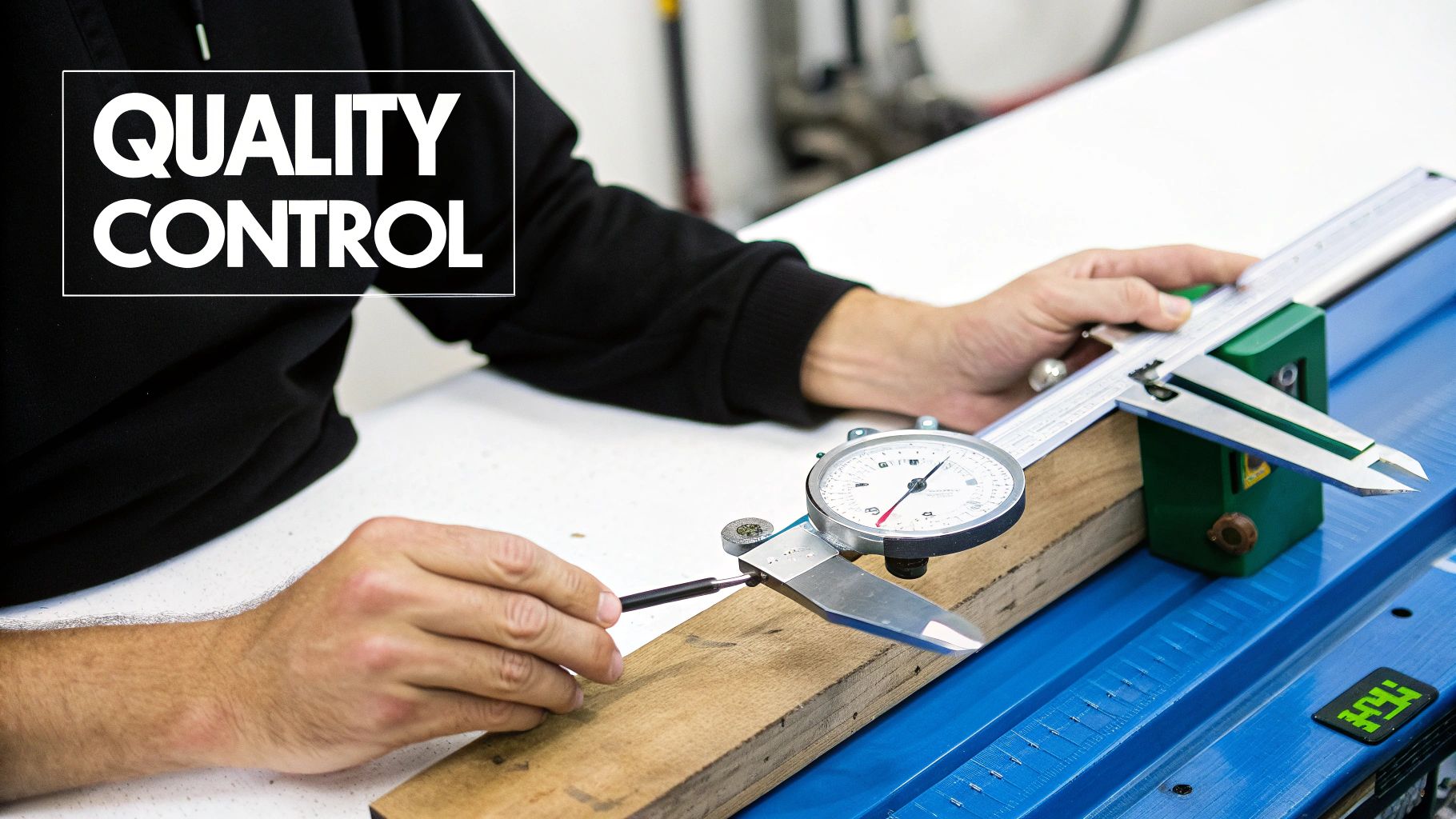
This competency is about demonstrating a systematic approach to ensuring work meets or exceeds project specifications, safety regulations, and industry standards like ISO 9001. When you include quality control skills in your CV, you are telling potential employers that you are a reliable professional who takes ownership of their work, reducing errors and enhancing customer satisfaction. This is a crucial element when creating lists of skills for a CV that will pass an initial screening.
How to Showcase Quality Control on Your CV
To effectively demonstrate your commitment to quality, you must provide specific, measurable examples of your diligence and its positive results.
- Quantify Your Impact: Use metrics to prove your effectiveness. Instead of saying "ensured quality," write "Implemented daily quality checks on a construction site, reducing rework orders by 25% over three months." Another strong example is, "Maintained a 99.8% defect-free rate on a high-volume manufacturing line by monitoring key quality metrics."
- Reference Specific Standards: Show your technical knowledge by mentioning relevant codes and standards. For example, "Performed thorough pre-delivery inspections on all electrical installations, ensuring 100% compliance with BS 7671 wiring regulations."
- Use Precise Action Verbs: Start your bullet points with verbs that convey precision and thoroughness. For a CV that performs well with automated screening, use words like Inspected, Validated, Verified, Calibrated, and Ensured compliance. This helps your CV get past the initial review performed by an ATS resume checker.
- Highlight a Quality Mindset: Include phrases that show your proactive approach, such as "Conducted final tool-down inspections at the end of each shift to guarantee site safety and readiness" or "Double-checked all material measurements before cutting, eliminating waste and improving project budget adherence."
Top 10 CV Skills Comparison
| Skill / Area | Implementation Complexity 🔄 | Resource Requirements ⚡ | Expected Outcomes 📊 | Ideal Use Cases | Key Advantages ⭐ | Quick Tip 💡 |
|---|---|---|---|---|---|---|
| Leadership & Team Management Skills | Medium — ongoing practice and coaching | Low–Medium — mentorship, short courses | Promotion potential, improved crew performance | Foremen, supervisors, shift leads | Career advancement; better safety & productivity | Quantify team size and outcomes (e.g., "Led 15, reduced incidents") |
| Safety Compliance & Hazard Management | Medium — structured training and audits | Medium — certifications (e.g. IOSH), PPE, training time | Fewer injuries, legal compliance, hiring eligibility | All construction, manufacturing, warehouse roles | Legally required; lowers costs and risk | List certifications and renewal dates prominently |
| Technical Equipment & Machinery Operation | High — hands-on skill + practical exams | High — machine access, certified training, practice hours | Faster operations, lower downtime, premium pay | Equipment operators, CNC machinists, forklift drivers | Immediate job-readiness; transferable certifications | Specify equipment/models and certification numbers |
| Trade-Specific Technical Expertise | Very high — multi-year apprenticeships | Very high — long training, licensing, continuing ed | Strong job security, higher wages, licensure | Electricians, plumbers, HVAC, welders, carpenters | Licensing increases pay and demand | List licences, journeyperson/master status, expirations |
| Problem-Solving & Troubleshooting | Medium — analytical methods + experience | Low–Medium — diagnostic tools, training | Reduced downtime, cost savings, reliability | Technicians, supervisors, maintenance crews | Widely valued; makes workers indispensable | Use STAR with measurable results (hours saved, €) |
| Communication & Documentation Skills | Low–Medium — consistent practice | Low — forms, templates, basic systems | Fewer errors, legal protection, smoother ops | Foremen, QA, customer-facing, supervisors | Prevents incidents; improves coordination | Highlight systems used (SAP, Fieldwire) and toolbox talks |
| Physical Capability, Stamina & Reliability | Low — baseline requirement; maintained over time | Low–Medium — fitness awareness, ergonomics training | Consistent productivity; fewer job-fit issues | Labour-intensive roles: warehouse, construction | Demonstrates dependability and job readiness | Quantify lifts, shift length, and attendance records |
| Adaptability & Learning Agility | Medium — mindset + short upskilling | Low — voluntary training, on-the-job learning | Faster onboarding, career mobility, tech adoption | Sites adopting new tech, cross-trained roles | Future-proofing; eases transitions | Cite specific new systems learned and timeframe |
| Cost Efficiency & Resource Management | Medium–High — process change and analysis | Medium — data access, tracking tools, stakeholder buy-in | Measurable savings, improved margins | Supervisors, project leads, operations managers | Directly improves profitability and competitiveness | Quantify savings and cite implemented improvements |
| Quality Control & Attention to Detail | Medium — standards knowledge and routines | Medium — measurement tools, QA training | Reduced rework, higher compliance and satisfaction | QA roles, inspectors, skilled trades | Prevents defects; protects reputation | Report defect rates, inspection pass rates, standards followed |
Turn Your Skills into Interviews with a Professional CV
We have navigated the essential landscape of skills that make a CV stand out in the demanding fields of construction, manufacturing, warehousing, and the skilled trades. From the critical importance of Safety Compliance & Hazard Management to the nuanced value of Adaptability & Learning Agility, the message is clear: your expertise is a powerful asset, but how you present it makes all the difference. This guide has provided extensive lists of skills for a CV, but the real power lies not in copying and pasting, but in strategic application.
Remember, your CV is more than a historical record of your employment; it is a forward-facing marketing document designed to solve a potential employer's problems. It must communicate your value proposition quickly and effectively, especially to the Applicant Tracking Systems (ATS) that act as the first gatekeepers.
Synthesising Your Skills for Maximum Impact
Let's distil the core principles from our exploration into actionable takeaways. The most effective CVs are not just lists; they are compelling narratives of professional competence.
- The Power of Quantification: Move beyond simply stating a skill. Instead of "Operated Forklift," transform it into "Operated a Linde H25D forklift to move over 200 pallets daily in a high-volume warehouse, maintaining a 100% incident-free record over two years." This provides scale, context, and proof of your proficiency.
- Prioritisation is Paramount: Every job description is a treasure map. It tells you exactly what the hiring manager values most. Your task is to mirror that language and prioritise the skills they explicitly ask for. If a role for a site foreman emphasises "Team Management" and "Cost Efficiency," those skills must appear prominently at the top of your skills section and be backed up by evidence in your work experience.
- Balancing Hard and Soft Skills: While your technical prowess in Trade-Specific Expertise or Equipment Operation gets you in the door, it's your soft skills that secure your position and facilitate your advancement. Highlighting your Problem-Solving capabilities or your Communication & Documentation skills shows you are not just a technician but a valuable team member and potential leader.
Key Insight: An ATS-optimised CV is not about stuffing keywords. It is about strategically aligning your documented experience with the precise language of the job advertisement, ensuring both the software and the human reader immediately recognise you as a qualified candidate.
From List to Livelihood: Your Actionable Next Steps
Armed with these comprehensive lists of skills for a CV, your next move is to put this knowledge into practice. Don't let your valuable, hands-on experience get lost in a poorly formatted or generic document. The transition from a skilled professional on the job site to a standout candidate on paper requires a different kind of tool.
Your CV must be a testament to your capability, showcasing your commitment to quality, safety, and efficiency. By customising your skills for each application and providing tangible proof of your abilities, you elevate your application from the "maybe" pile to the "must-interview" list. This is the final, crucial step in translating your hard-earned expertise into career-defining opportunities. The right presentation doesn’t just get you noticed; it gets you hired.
Stop struggling with confusing templates and second-guessing ATS keywords. With europass.ai, you can use our AI-powered CV builder to instantly organise your skills and experience into a polished, professional CV that is optimised for the European job market. Transform these detailed lists of skills for a CV into a powerful application in minutes. Try Europass.ai today and build the CV that lands your next interview.
Great CVs get work done
Work smarter with the CV builder trusted by skilled workers for more than a decade.
It's easy
