One Page Curriculum Vitae: How to Craft a CV That Wins Recruiters
A one page curriculum vitae isn't just a shorter document; it’s your professional highlight reel, designed to put your most relevant skills and experience front and centre. Think of it as a strategic tool that proves you value a recruiter's time and can communicate your value with powerful clarity. In the competitive European job market, this single page can be the key that opens the door to your next opportunity.
Feeling the pressure to fit your entire career onto one page? Don't worry. We'll guide you through making every word count, helping you create a focused, high-impact CV that gets noticed for all the right reasons. Ready to get started? Start Building Your CV in Minutes with Europass.ai.
Why a One Page CV Is Your Strongest Asset

In Europe's fast-moving job market, you have only seconds to make your mark.
Imagine a hiring manager at a growing tech firm in Berlin. They have one project manager role to fill and over 200 applications in their inbox. This isn’t an exaggeration; it’s the daily reality for recruiters across the continent. When you’re facing that kind of competition, a lengthy, unfocused CV can work against you.
This is where a one page curriculum vitae becomes your secret weapon. It’s not about cutting your experience short; it’s about strategically showcasing your biggest wins so they’re impossible to miss. It proves you can prioritise information and respect the recruiter's limited time.
The Power of Brevity and Focus
The single-page limit is a powerful discipline. It forces you to trim the fluff and focus only on what’s essential for the specific role you’re applying for.
Instead of listing every duty from a job you had ten years ago, you highlight the achievements that prove you’re the right person for this job, right now. For example, a marketing professional in Paris applying for a digital campaign role would feature their recent success in boosting online engagement by 30%, rather than their early experience in event coordination. A one-page CV puts the most relevant information right under the recruiter's nose, no digging required.
The numbers don't lie. Hiring managers spend just 6-8 seconds on their initial scan of a CV. All the critical details they look for—contact info, recent role, key skills—fit perfectly on one page. Brevity isn't just nice to have; it's essential.
Sailing Through the ATS
Long before a human reads your application, it must pass the Applicant Tracking System (ATS). These automated gatekeepers scan CVs for specific keywords and formatting, filtering out candidates who don't seem to be a good match.
A clean, well-structured one-page CV is naturally more ATS-friendly. Its simplicity means the software can easily parse your information and match your skills to the job description. Complex layouts and multiple pages can confuse the system, getting your application rejected before it even has a chance. A solid structure will significantly boost your job interview chances.
One Page vs Multi-Page CV at a Glance
So, how does a focused one-page CV really stack up against a traditional multi-page document for European professionals? Let's break it down.
| Feature | One Page CV | Multi-Page CV |
|---|---|---|
| Recruiter Impact | High-impact, easy to scan in seconds. | Can be overwhelming, key info gets lost. |
| ATS Friendliness | Excellent. Simple structure is easy to parse. | Risky. Complex formatting can cause errors. |
| Content Focus | Highlights only the most relevant achievements. | Often includes outdated or irrelevant details. |
| First Impression | Professional, concise, and respectful of time. | Can seem unfocused or overly detailed. |
| Best For | Most professionals with under 10-15 years' experience. | Academic, scientific, or senior executive roles. |
For most roles across Europe, from tech and marketing to finance and logistics, the one-page format is the clear winner. It’s built for impact and designed to get you noticed for the right reasons.
Ready to turn less into more? Let's start building a CV that works as hard as you do. With the right strategy and a tool like the europass.ai AI-powered CV builder, you can create a professional one page curriculum vitae in minutes.
Building Your Core CV Components for Maximum Impact
Putting together a powerful one page curriculum vitae is about building a compelling narrative that shows a hiring manager exactly why you’re the best person for the role. Each section of your CV needs to be deliberately crafted to highlight your value. Think of this as the blueprint for a CV that gets you noticed.
Let's break down each essential section with practical advice for professionals across Europe.
Crafting a Professional Summary That Works
This is the first thing a recruiter reads, so it has to make an immediate impact. Your professional summary is a short, sharp paragraph at the top of your CV that sums up who you are, what you’ve achieved, and what you bring to the table. It’s your 30-second sales pitch.
This section must be tailored to the job and packed with relevant keywords and, crucially, measurable results. Look at the difference between these two examples:
- Logistics Coordinator (Spain): "Proactive Logistics Coordinator with 5+ years of experience managing supply chains across the EU. Fluent in Spanish and English, skilled in optimising transport routes to reduce costs by 15%. Proven ability to coordinate with international suppliers and ensure on-time delivery in fast-paced environments."
- Software Developer (Netherlands): "Agile-certified Software Developer with 6 years' experience in Python and Java. Specialised in developing scalable backend solutions for fintech applications, contributing to a 20% improvement in processing speed. Passionate about writing clean, efficient code and collaborating in a cross-functional team."
See how both lead with key skills, state their experience, and include a specific, number-driven achievement? That’s what grabs attention. If you're looking for more inspiration, we have a whole article dedicated to writing standout professional summary examples for your CV.
Showcasing Your Work Experience with STAR
The Work Experience section is the heart of your CV. It's your chance to prove you can do the job by showing what you’ve already accomplished. Don't just list your duties; that tells a recruiter what you were supposed to do, not what you actually achieved.
A brilliant way to frame your experience is by using the STAR method: Situation, Task, Action, Result. This simple framework helps you turn a boring duty into a compelling success story.
Here's how it works:
- Situation: What was the context or challenge?
- Task: What was your specific responsibility?
- Action: What concrete steps did you take to handle it?
- Result: What was the outcome? Use numbers to prove it!
Key Takeaway: Always kick off your bullet points with strong action verbs (e.g., "Managed," "Implemented," "Increased") and quantify your results wherever you can. Numbers—whether they are percentages, revenue generated, or time saved—are incredibly powerful. They catch the eye and provide solid proof of your impact.
So, instead of a flat statement like, "Responsible for social media accounts," you use STAR to build something much stronger: "Grew Instagram follower count by 40% in six months (Result) by launching a targeted influencer collaboration campaign (Action) for a new fashion brand launch (Situation)." This tells a much richer story about your value.
Organising Your Skills for Clarity
A well-organised skills section lets a hiring manager see your capabilities in a single glance. On a one page curriculum vitae, every bit of space counts, so you can't afford to be messy. The easiest way to do this is to split your skills into clear categories.
Try breaking them into these groups:
1. Technical/Hard Skills
These are the specific, teachable abilities your profession requires. Be as precise as you can.
- Example for a Data Analyst: SQL, Python (Pandas, NumPy), Tableau, Power BI, Statistical Analysis, A/B Testing.
- Example for a Graphic Designer: Adobe Creative Suite (Photoshop, Illustrator, InDesign), Figma, UI/UX Design, Typography, Prototyping.
2. Soft Skills
These are the personal attributes that define how you work. They’re just as vital as your technical know-how.
- Team Collaboration
- Problem-Solving
- Time Management
- Communication
- Adaptability
Separating them like this helps both the human recruiter and the Applicant Tracking Systems (ATS) to quickly understand your capabilities.
Highlighting Education and Certifications
Your education and certifications section needs to be lean, putting your most important qualifications right at the top where they can’t be missed. The order depends on your career stage and industry.
Follow this simple order:
- Essential Licences & Certifications: Put your non-negotiable, job-critical qualifications first (e.g., PMP for Project Managers, ACCA for Accountants).
- Higher Education: List your university degrees, starting with the most recent.
- Vocational Qualifications: Add any other relevant diplomas or training.
There’s no need to list every university module you took. Just state the qualification, the institution, and the year of completion. This keeps things clean and ensures your most impressive credentials get the attention they deserve.
Getting the Design and Formatting Spot On
A truly effective one page curriculum vitae is a smart mix of strong content and clean design. What you've written is only as good as its presentation. If a recruiter can't quickly scan and understand your value in a few seconds, you've lost them. The visual layout of your CV guides their eyes straight to your best achievements.
Think of your formatting as the professional packaging for your skills. A tidy, structured layout is a reflection of your professionalism and attention to detail before you even get a chance to say hello.
The Basics: Font and Spacing
Readability is everything—for both the hiring manager and the Applicant Tracking Systems (ATS) that will likely screen your CV first. Stick to a professional, standard font that everyone recognises. You can’t go wrong with classics like Arial, Calibri, or Helvetica. They're clean, easy to read on any screen, and fully compatible with recruitment software.
Keep your main body text between 10 and 12 points. Your headings can be a touch larger, perhaps 14-16 points and bolded, to create a clear visual hierarchy. This simple structure helps the reader navigate from your summary to your experience and skills without any effort.
White space is also your best friend. A CV that’s crammed to the edges with text is an instant turn-off. Use generous margins (about 2.5 cm) and add space between sections. It gives the entire document room to breathe, making it look organised and far more approachable.
Expert Tip: It's tempting to shrink the font or margins to squeeze in more details, but don't. A clean, well-spaced CV that highlights your biggest wins is always more powerful than a crowded one listing every single task you've ever done.
Quick Formatting Dos and Don'ts
Figuring out the design rules can be a pain, especially when you're tight on space. Here’s a simple cheat sheet to keep you on track and help you dodge the common mistakes that get applications rejected.
| Do | Don't |
|---|---|
| Use a professional email address (e.g., firstname.lastname@email.com). | Use an old, unprofessional one (e.g., partylover92@email.com). |
| Stick to a single-column layout for optimal ATS readability. | Use fancy tables, columns, or graphics that confuse the software. |
| Use standard headings like "Work Experience" or "Skills". | Write massive "walls of text" with no paragraphs or breaks. |
| Check if a photo is needed for the country you're applying in. | Include a photo by default (it's not standard in the UK/Ireland, for instance). |
Following these simple rules ensures your one page curriculum vitae looks professional and makes it past the automated screening process used by most large companies today.
Why Simple is a Winner with Automated Systems
It's easy to think a flashy template with creative layouts will make you stand out. In reality, it often does the opposite. Most Applicant Tracking Systems are built to read CVs from top to bottom, left to right. A complicated design can completely scramble your information.
For example, an ATS might read two columns as one long, jumbled sentence, mixing up your job titles with your list of skills. Information tucked away in headers, footers, or text boxes often gets missed entirely. The safest and most effective choice is always a clean, single-column format that tells your career story in a logical, straightforward way.
This is where the right tool can make all the difference. Using a smart platform like the europass.ai CV builder takes the guesswork out of it. Our AI-powered templates are professionally designed to impress recruiters and have been thoroughly tested to be fully ATS-optimised. You can focus on your content, knowing the formatting is already handled.
Getting Your CV Past the Robots (ATS)
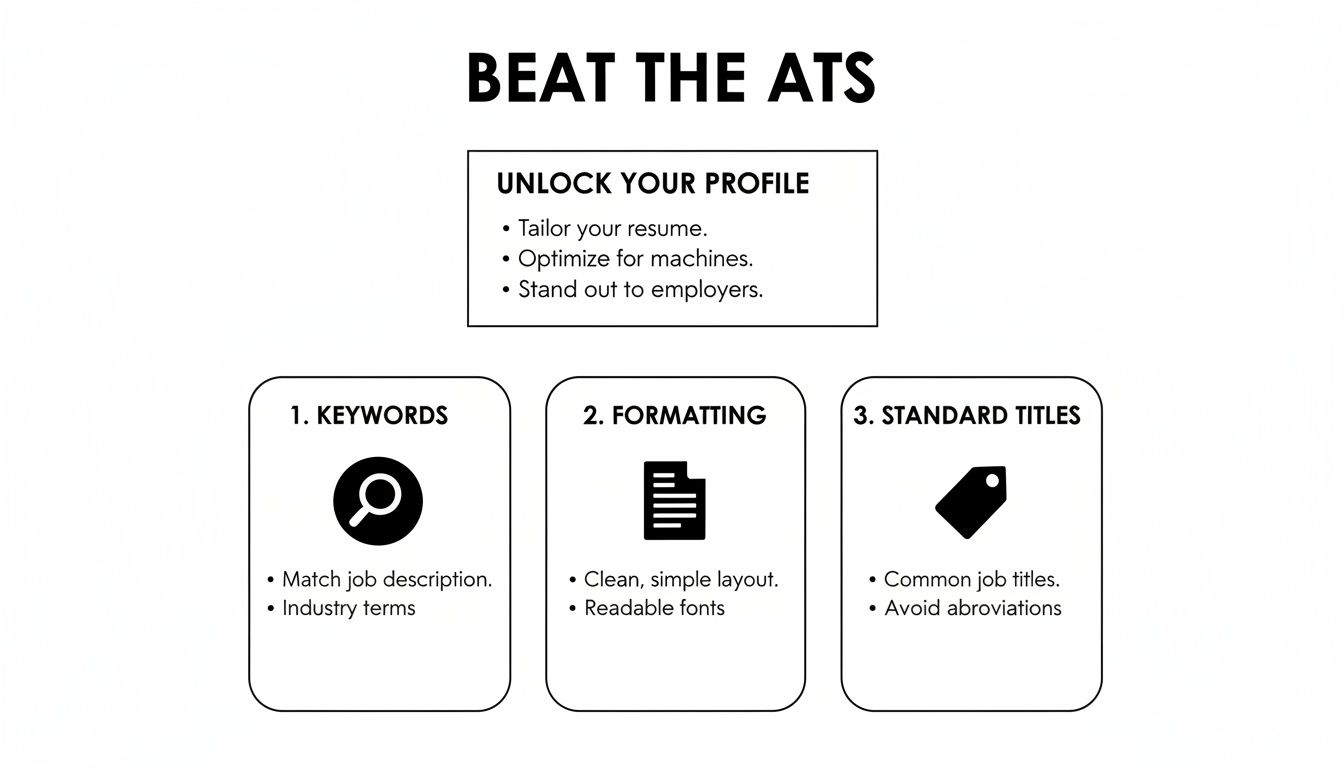
Before a hiring manager ever sees your brilliant one page curriculum vitae, it has to pass the first test: the Applicant Tracking System, or ATS. Think of it as a digital bouncer for job applications. Its job is to scan your CV for specific keywords and formatting, then rank you against all the other candidates.
If the ATS can't read your CV or doesn't find the right words, your application gets filtered out before a human even knows you applied. It sounds intimidating, but getting past this first hurdle is about clarity, not trickery.
Finding and Using the Right Keywords
The ATS essentially plays a matching game. It scans your CV for words and phrases that align with the job description. Your mission is to act like a detective, pull those exact keywords from the job advert, and integrate them naturally throughout your CV.
Let's walk through an example. Say you're applying for a 'Digital Marketing Manager' role in Dublin. The job advert might list requirements like:
- "Proven experience in SEO/SEM and PPC campaigns."
- "Responsible for managing the content calendar and social media strategy."
- "Must be proficient with Google Analytics and HubSpot."
- "Experience in lead generation and improving conversion rates."
Those bolded phrases are your goldmine. They are the exact terms the ATS is looking for. Now, you need to weave them into your CV.
- Professional Summary: You could start with, "Results-driven Digital Marketing Manager with 7+ years of experience in SEO/SEM and lead generation..."
- Skills Section: This is perfect for a bulleted list. Include terms like 'PPC Campaigns', 'Google Analytics', 'HubSpot', and 'Content Strategy'.
- Work Experience: Under a previous role, you could write, "...developed and executed a new social media strategy that increased conversion rates by 20%."
When you mirror the language from the job description, you're speaking the ATS's language and showing you’re a perfect fit.
Here's a wake-up call: a recent analysis showed that a massive 98% of Fortune 500 companies use an ATS to filter candidates. That makes optimising your CV non-negotiable. The systems favour shorter, keyword-packed documents. You can dig deeper in this handy guide to CV formatting.
Keeping Your Formatting Clean and Simple
Just as vital as the words you use is how you present them. An ATS gets easily confused by fancy designs, graphics, or unconventional layouts. It's programmed to read a document like a simple text file—straight down, left to right.
This means that formatting choices that look great to our eyes can cause your application to fail the automated screening. To keep your one page curriculum vitae ATS-friendly, stick to these ground rules:
- No Tables or Columns: An ATS reads a line from left to right. It can't handle columns and will mash the text together into an unreadable mess. Stick to a single-column layout.
- Avoid Headers and Footers: Putting your contact details in the header or footer seems logical, but most ATS programs completely ignore these sections. All your crucial info must be in the main body of the page.
- Use Standard Section Titles: Don't get creative. Use simple, direct headings like "Work Experience," "Skills," and "Education." A heading like "My Career Journey" will just confuse the system.
- Stick to Standard Fonts: Ditch the decorative script fonts. Use something clean and universal like Arial, Calibri, or Times New Roman. Anything too unusual might be unreadable for the software.
If you’re unsure if your current CV makes the cut, running it through a free ATS resume checker is a great way to get instant feedback. By nailing both your keywords and your formatting, you give your one-page CV the best possible shot at landing on the right desk.
A Real-World One Page CV Example Deconstructed
Theory is one thing, but seeing it all come together is another. Let's shift from advice to action and break down a complete one page curriculum vitae for a fictional candidate. This will show you exactly how a professional can pack their experience into a single page for maximum impact.
Meet Sofia, a Project Manager with eight years of experience. We're going to pull apart her CV section by section to show you the "why" behind every choice she made.
Sofia Costa - Project Manager CV Breakdown
1. Contact Information & Professional Title
- Sofia Costa
- Project Manager
- Lisbon, Portugal | +351 912 345 678 | sofia.costa.pro@email.com | linkedin.com/in/sofiacosta-pm
Why It Works:
Right away, the header is clean and direct. Stating her professional title, "Project Manager," right under her name tells the recruiter her level and specialisation in a split second. All the contact details are professional – she even includes a customised LinkedIn URL, which adds credibility. Everything is kept to one line to save precious space.
2. Professional Summary
- PMP-certified Project Manager with 8+ years of experience leading cross-functional teams in the tech sector. Expert in Agile methodologies, stakeholder management, and delivering complex projects on time and within budget. Proven track record of improving team efficiency by 20% and successfully launching three major software products. Eager to bring technical expertise and leadership to a challenging new role.
Why It Works:
This summary is an ATS goldmine, packed with keywords like "PMP-certified," "Agile methodologies," and "stakeholder management." It instantly flags her key qualifications and, more importantly, uses hard numbers ("improving team efficiency by 20%") to give solid proof of her value. No fluff, just facts.
3. Work Experience
- Project Manager | Tech Innovate Lda, Lisbon | 2018 - Present
- Led a team of 8 developers and designers in an Agile environment to launch a new mobile banking app, delivering the project 2 weeks ahead of schedule and 10% under budget.
- Implemented new project management software (Jira) that improved task tracking and boosted team productivity by 25%.
- Served as the primary point of contact for key stakeholders, providing regular progress updates and ensuring project goals aligned with business objectives.
Why It Works:
Every bullet point kicks off with a strong action verb ("Led," "Implemented," "Served") and gets straight to the point. That first bullet alone shows leadership, efficiency, and financial acumen. By putting the key numbers in bold, she makes her biggest achievements jump off the page.
4. Key Skills
- Technical Skills: Agile & Scrum Methodologies, Jira & Confluence, Budget Management, Risk Assessment, Stakeholder Management, MS Project
- Soft Skills: Team Leadership, Strategic Planning, Problem-Solving, Client Communication, Adaptability
Why It Works:
The skills are broken into two clear, scannable categories. This simple trick helps both the hiring manager and the ATS quickly grasp what she can do. The technical skills are specific to her profession, while the soft skills show she has the leadership qualities needed for the role.
Your CV has two audiences: the human recruiter and the Applicant Tracking System. To get past both, you need a blend of compelling achievements, the right keywords, and a simple, readable format. If you ignore one, your application might never even get seen.
5. Certifications
- Project Management Professional (PMP) - Project Management Institute (2019)
- Certified ScrumMaster (CSM) - Scrum Alliance (2017)
- Master of Science in Management, Nova SBE (2016)
Why It Works:
This section is short, sharp, and all business. It lists her most critical industry credentials first. The PMP certification is a huge plus for any project manager, so putting it front and centre is a smart move. There's nothing extra here – just the non-negotiable qualifications a hiring manager needs to see.
Sofia's CV is a perfect example of how to tell a powerful story within the tight confines of a one page curriculum vitae. It’s focused, packed with proof, and built for success. Now it’s your turn to put these ideas to work.
Ready to build your own? Create Your Professional CV with Europass.ai and put together a document that gets you noticed.
Ready to Build Your CV?
You have the game plan. We’ve walked through exactly how to build a sharp, effective one page curriculum vitae that gets you noticed. This isn't about leaving things out; it's about making every single word count to tell your unique professional story.
Just remember the fundamentals we covered: focus on what you actually achieved (with numbers!), tailor your CV for every single job application, keep the design clean and simple, and always get someone to proofread it. You already have the skills and experience. Now you have the blueprint to showcase them effectively.
Key Takeaway: Think of your one-page CV as your best tool for the job. It shows you respect the hiring manager's time, puts your biggest wins front and centre, and gives you a real shot at standing out from the stack.
Feeling ready to put this into practice? Let's get it done. The European job market is waiting.
You can use the europass.ai platform to apply everything we’ve talked about without the headache. Our AI-powered tools will help you build a professional, ATS-optimised, one page curriculum vitae in minutes, so you can move forward in your career with confidence.
Start Building Your CV in Minutes with Europass.ai and see what a difference a focused CV can make.
Common Questions About One Page CVs
Even with the best plan, squeezing your entire career onto a single page can feel like a puzzle. It’s natural to have a few questions. Let’s tackle some of the most common ones that European job seekers face, so you can finalise your CV with confidence.
Is One Page Enough if I Have Lots of Experience?
This is a big one, especially for seasoned professionals. If you’ve got over 15 years of experience, can you really fit it all on one page? The answer is a definite yes, in most cases.
The trick is to stop thinking chronologically and start thinking about relevance. A hiring manager for a senior role cares more about your strategic achievements from the last decade than the details of your first job 20 years ago.
Focus on your most impactful and recent 10-15 years of work. For older roles, you can add a small ‘Previous Career History’ section at the bottom. Simply list the company and job title – no descriptions needed. This shows you don’t have employment gaps without wasting precious space.
What Should I Cut to Make Everything Fit?
Getting your CV down to one page means being ruthless with your editing. You need to cut for maximum impact, not maximum information.
Start with these easy cuts:
- An Objective Statement: This is outdated. Your professional summary does a much better job of introducing you.
- References: The line "References available upon request" is a waste of space. It’s assumed.
- Unrelated Hobbies: Unless your hobby is directly linked to the job (e.g., coding personal projects for a developer role), leave it off.
From there, start trimming the fat from your work experience descriptions. Cut down the detail on your older, less relevant roles. Your focus should always be on the achievements that prove you can do the job you’re applying for now.
A Quick Word of Warning: It can be tempting to use a two-column layout to cram more in. Don't do it. While they might look neat, they often confuse Applicant Tracking Systems (ATS). The software can read the columns in the wrong order, making your experience look like nonsense. Always stick to a clean, single-column format to be safe.
You have the strategy and the know-how. Now it's time to put it all together and build a CV that opens doors. With europass.ai, you can apply all these tips and create a professional, ATS-optimised CV in just a few minutes.
Great CVs get work done
Work smarter with the CV builder trusted by skilled workers for more than a decade.
It's easy
