Phone Interview Questions: Master Your Next Call and Secure the Next Step
That first phone call from a hiring manager is often the most pivotal moment in your job search. For ambitious professionals across Europe, this initial conversation is your one chance to make a powerful first impression. Too many excellent candidates are filtered out at this stage, not due to a lack of technical skill, but because they were unprepared for the specific phone interview questions designed to quickly assess their suitability, experience, and professionalism. A strong performance here separates you from the competition and secures the next step: the face-to-face or video interview.
This guide will ensure you are fully prepared. We will break down the most common questions you will face, providing practical model answers and the strategies behind them. You will learn not just what to say, but how to structure your responses to showcase your expertise and align with what European hiring managers are looking for. Beyond the questions, we'll cover essential phone etiquette and a pre-interview checklist to guarantee you feel confident and ready. This preparation is key to transforming a screening call into a concrete job offer. Let’s get you ready.
1. Tell Me About Yourself and Your Experience
This is often the first and most pivotal phone interview question you'll face. It’s a direct invitation to set the stage and demonstrate your suitability right from the start. Recruiters are not looking for your life story; they need a concise, powerful summary of your professional background. Think of it as the verbal highlight reel of your career, delivered in 60-90 seconds.

Why It's Asked
Interviewers use this question to get a baseline understanding of your expertise. They are listening for keywords related to the skills, software, and processes mentioned in the job description. Your answer helps them confirm that the qualifications listed on your CV are backed by genuine, practical experience.
How to Prepare a Winning Answer
Your goal is to deliver a confident and relevant summary of your professional background.
- Structure Your "Elevator Pitch": Don’t just list your past jobs. Start with your total years of experience, mention 2-3 key accomplishments, and end by connecting your skills directly to the role you're interviewing for.
- Use Quantifiable Achievements: Numbers make your experience tangible. Instead of saying you "managed projects," say you "led a project team that delivered a €200,000 software implementation 15% ahead of schedule."
- Align with Your CV: Ensure your spoken answer mirrors the key skills and achievements on your ATS-optimised CV. This consistency is crucial. Use the same professional terminology to reinforce your profile.
- Practise Aloud: A phone interview relies solely on your voice. Rehearsing your answer ensures you sound confident and clear, without hesitation, which is essential for making a strong first impression.
2. Why Are You Interested in This Position?
This is one of the most common phone interview questions, and it’s a crucial opportunity to show you’ve done your homework. The interviewer wants to see genuine enthusiasm and a clear connection between your career goals and their company. A strong answer proves you're not just looking for any job, but that you are specifically interested in this organisation and what it offers.
Why It's Asked
Hiring managers ask this to gauge your motivation and cultural fit. Are you drawn to their reputation for innovation, their commitment to sustainability, or their opportunities for career progression? Your answer reveals whether you view this as just another paycheque or a meaningful career move. It’s their way of filtering out candidates who are applying indiscriminately from those who are truly invested.
How to Prepare a Winning Answer
A thoughtful, well-researched answer can set you apart. Aim for a response that blends your personal career ambitions with the company's specific attributes.
- Research the Company: Before the call, look at their website, LinkedIn page, and recent news. Do they have a strong market presence in Europe? Are they expanding? Mentioning a specific company value or recent achievement shows you are serious.
- Connect Your Skills to the Role: Go beyond just wanting the job. Explain why you are a good fit. For example, mention how your experience in digital marketing aligns with their goal to expand their online presence.
- Show Ambition (Not Just for Money): Avoid focusing solely on salary or location. Instead, talk about your interest in their training programmes, the chance to work on challenging international projects, or the company's reputation for promoting from within.
- Structure Your Answer: Start by expressing your admiration for a specific aspect of the company, then connect it to your skills and career aspirations. This structure mirrors the logic you'd use in a well-crafted Europass motivational letter, demonstrating clear and persuasive reasoning.
3. Describe a Time You Faced a Significant Challenge at Work
In any professional environment, resilience and problem-solving are paramount. When an interviewer asks this question, they are testing more than your technical abilities. They want to see evidence of your situational awareness, proactivity, and commitment to overcoming obstacles. This is your chance to demonstrate that you are a responsible and resourceful team member.

Why It's Asked
Hiring managers use this behavioural question to assess your real-world application of critical thinking. They want to know if you can identify a problem, develop a logical plan, and execute it effectively. Your answer reveals your problem-solving skills and whether you contribute positively to the team’s success under pressure.
How to Prepare a Winning Answer
The best way to answer is by using the STAR method (Situation, Task, Action, Result) to structure your story clearly and powerfully. Have one or two strong examples ready before the call.
- Structure Your STAR Story: Clearly outline the Situation (e.g., "Our team was facing a tight deadline on a key project..."), the Task (e.g., "...and we discovered a critical bug that threatened to delay the launch."), the Action you took (e.g., "I organised a focused troubleshooting session, re-prioritised tasks, and collaborated with another department to find a workaround..."), and the Result (e.g., "As a result, we resolved the issue and launched on time, which the client greatly appreciated.").
- Focus on Your Contribution: Even if it was a team effort, highlight your specific role and the initiative you took. This shows ownership and accountability.
- Quantify the Impact: If possible, add numbers to your result. For instance, mentioning that your action "prevented a potential €10,000 project overrun" is more impactful than simply saying "it saved money."
- Connect to Your Skills: Mention relevant skills from your CV. Saying, "Drawing on my project management skills, I knew the first step was to..." reinforces your credentials and shows you apply your expertise practically.
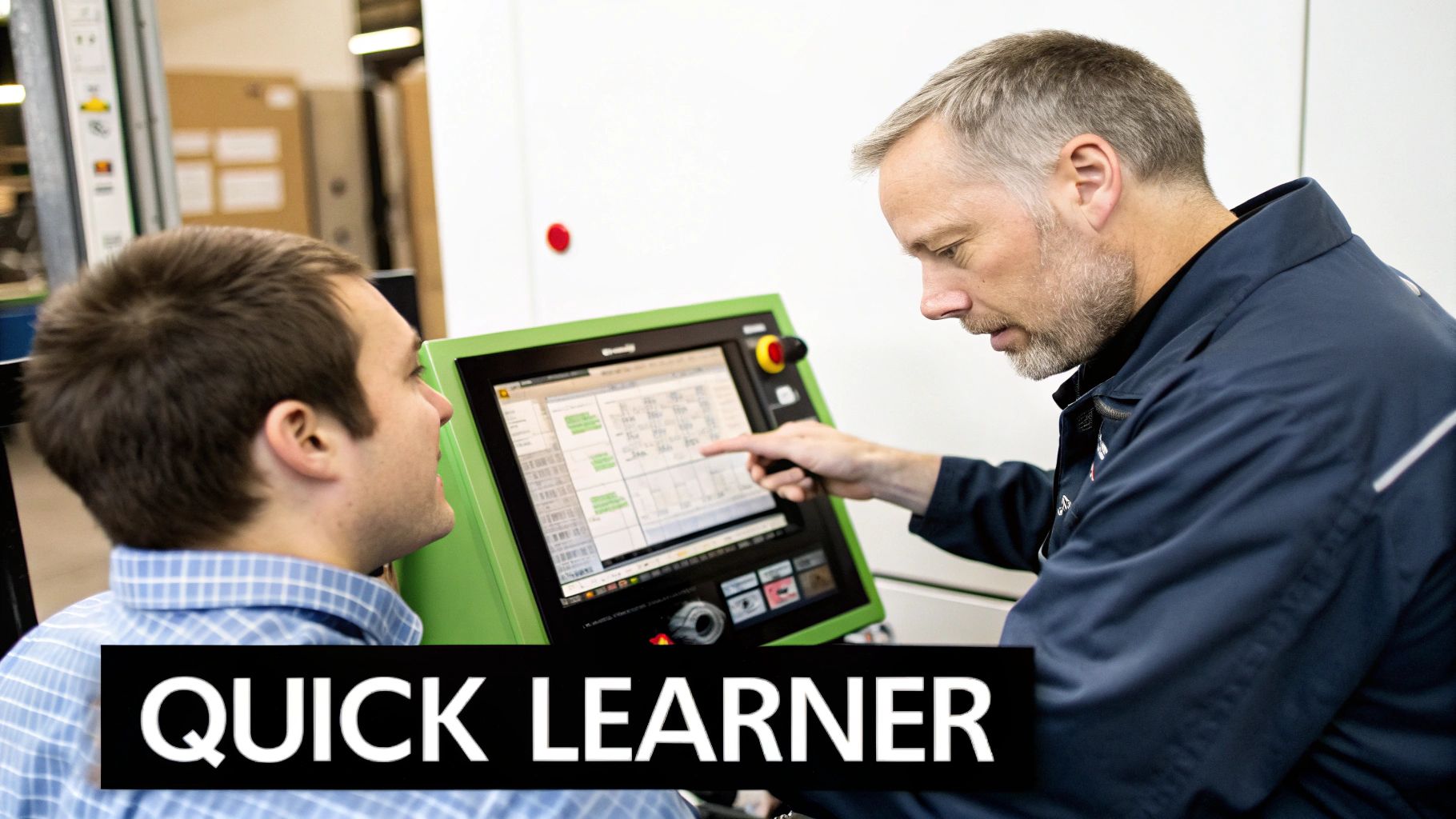
4. Tell Me About a Time You Had to Learn a New Skill or Technology Quickly
This question evaluates your adaptability, learning agility, and resilience. These are essential traits in today’s evolving job market, where new technologies and methods constantly emerge. Interviewers ask this to understand your growth mindset and ability to stay current and contribute value, even when faced with unfamiliar challenges.
Why It's Asked
Hiring managers want proof that you are proactive and not resistant to change. Your answer reveals how you handle on-the-job training, your approach to new information, and whether you take initiative in your own professional development. It's a key indicator of how quickly you can become a productive member of their team.
How to Prepare a Winning Answer
Focus on a recent, relevant example that showcases a structured learning process and a positive outcome. This is one of the phone interview questions where storytelling is crucial.
- Choose a Relevant, Recent Example: Select a story from the last 2-3 years. For instance, a marketing professional who mastered a new analytics platform or an admin assistant who learned a new CRM system to improve efficiency.
- Detail Your Learning Process: Don't just state the outcome. Explain how you learned. Did you attend formal training, shadow a senior colleague, study documentation, or use online tutorials? This shows initiative and resourcefulness. For more on this, explore these tips on how to demonstrate problem-solving skills.
- Highlight the Positive Impact: Connect your new skill to a tangible benefit. For example: "After completing the training on the new project management software, I was able to streamline our team's workflow, which reduced our average project completion time by 10%."
- Reference Your CV: If you've listed certifications or specific training on your CV, this is the perfect time to bring them up. It reinforces the written evidence with a practical story, proving your commitment to continuous learning.
5. How Do You Handle Conflict or Disagreement With a Colleague or Supervisor?
This is a classic behavioural question designed to see beyond your technical skills. In any team-oriented environment, interpersonal friction is inevitable. Hiring managers use this question to assess your emotional intelligence, communication skills, and professionalism under stress. They want to see that you can navigate disagreements constructively without disrupting team morale or productivity.
Why It's Asked
Interviewers are looking for evidence that you are a mature, collaborative team player who can handle professional disagreements with respect. They want to confirm that you focus on solutions rather than blame, understand how to communicate effectively, and can respect the chain of command, especially when a supervisor is involved. Your answer reveals your approach to teamwork and your ability to maintain a positive and productive working environment.
How to Prepare a Winning Answer
Your goal is to demonstrate a calm, methodical, and respectful approach to resolving conflict. Aim for an answer that is professional, positive, and resolution-focused.
- Use the STAR Method: Structure your response clearly. Describe the Situation (the context of the disagreement), the Task (what needed to be resolved), the Action you took (your specific, professional steps), and the positive Result (how the issue was resolved and what you learned).
- Focus on Your Actions: Centre the story on what you did to de-escalate and solve the problem. Avoid blaming or speaking negatively about the other person. For example, instead of saying, "My colleague was doing it wrong," say, "We had different views on the most efficient workflow for the task."
- Emphasise Respect and Listening: Show that your first step is to listen and understand the other person's perspective. Mentioning that you sought to find common ground or a compromise highlights your collaborative spirit. If a supervisor was involved, explicitly state that you respected their final decision.
- Keep it Professional: Choose a real but low-stakes example of a professional disagreement, not a personal dispute. A good example might be a debate over the best approach for a project or a difference of opinion on a timeline.
6. Where Do You See Yourself in Five Years?
This question is a direct probe into your career ambitions and whether they align with the opportunities the company can provide. Employers invest significant resources in hiring and training, and they want to hire candidates who see a future with their organisation. Your answer should demonstrate ambition, realism, and a clear interest in growing with the company.
Why It's Asked
Hiring managers use this question to assess your long-term career goals and gauge your potential for retention. They are looking for a candidate whose aspirations match the growth trajectory available within the role and the company. An unfocused or overly ambitious answer might suggest you'll leave as soon as a better opportunity arises.
How to Prepare a Winning Answer
Your response should be a confident blend of ambition and loyalty, tailored to the role you are applying for.
- Focus on Growth and Contribution: Frame your five-year plan around developing your skills and taking on more responsibility within their company. For example: "In five years, I hope to have become a true expert in my field here, possibly taking on mentorship responsibilities for new team members and contributing to larger, more complex projects."
- Connect to the Company: Show that you see your future with them. You could say, "I am excited about this role because it seems to offer a clear path for development. I would aim to grow into a senior position where I can make a significant impact on the team's success."
- Avoid Overly Specific Titles: Don't say "I want your job." Instead, focus on the type of work and responsibility you aspire to. This shows ambition without seeming like a threat.
- Show Flexibility: Acknowledge that plans can change. Ending with a phrase like, "Ultimately, my goal is to grow with a company where I can continue to learn and add value, and this organisation seems like an excellent place to do that," shows you are both ambitious and adaptable.
7. What Are Your Salary Expectations?
This is one of the most direct phone interview questions you will face, and it often comes up early. Hiring managers use it as a practical screening tool to ensure your compensation needs align with their budget before investing more time in the interview process. Handling it poorly can price you out of a role or leave you underpaid, so preparation is key.
Why It's Asked
The recruiter's primary goal is efficiency. They need to confirm that both parties are in the same ballpark regarding salary before proceeding. It also provides insight into how you value your skills and whether you have done your research on market rates for your profession in that specific European location.
How to Prepare a Winning Answer
Your aim is to provide a confident, well-researched answer that keeps the conversation moving forward without locking you into a figure that is too low.
- Research and Provide a Range: Never give a single number. Use sites like Glassdoor, PayScale, and local job boards to find the typical salary range for your role and experience level in your geographical area. Provide a thoughtful range, such as, "Based on my qualifications and market rates for this role in Berlin, I am seeking a salary in the range of €55,000 to €62,000."
- Consider the Total Compensation: Salary is only one part of the equation. You could add, "While my base salary expectation is in that range, I am also very interested in learning about the overall benefits package, including professional development opportunities." This shows you're thinking about the complete package.
- Try to Defer, but Be Prepared: It can be strategic to ask for the company's budgeted range first. You could say, "I'm flexible and would be interested to know what salary range you have budgeted for this position." However, be ready with your own researched range if they insist you go first.
- Practise Your Delivery: How you say it matters as much as what you say. Rehearse delivering your range calmly and professionally. This prevents you from sounding hesitant or aggressive, reinforcing your value with confidence.
8. Tell Me About Your Leadership or Mentoring Experience
This question is crucial, especially if you're aiming for a team lead or managerial position. However, don't dismiss it if you're an individual contributor. Hiring managers use this to gauge your potential to guide colleagues, handle responsibility, and contribute positively to the team culture. It reveals your ability to motivate, develop talent, and make sound decisions.
Why It's Asked
Interviewers want to see if you can do more than just your core tasks. They’re looking for candidates who can elevate the entire team. Your answer demonstrates your interpersonal skills, patience, and commitment to quality. For leadership roles, it's a direct test of your management philosophy and track record.
How to Prepare a Winning Answer
Focus on specific examples that show your leadership in action, even if it was in an unofficial capacity.
- Highlight Informal Leadership: You don’t need a formal title to be a leader. Think of times you trained a new hire, mentored a junior colleague, or took the lead on a challenging project. These examples are just as valuable.
- Use the STAR Method: Structure your response using the Situation, Task, Action, Result method. For example: Describe a situation (a junior team member was struggling with new software), the task (your responsibility to help them improve), the action you took (provided one-on-one coaching), and the result (they became proficient, improving the team's overall productivity by 15%).
- Quantify Your Impact: Numbers speak louder than words. Mention improvements in team performance, reductions in errors, or increased efficiency that resulted from your guidance.
- Connect to Company Values: Briefly mention how your leadership style (e.g., collaborative, hands-on, supportive) aligns with the company's values if they are mentioned in the job description. This shows you've done your research and are a good cultural fit.
9. How Do You Stay Current With Industry Changes?
The modern workplace is evolving rapidly. This is one of the phone interview questions that reveals your commitment to continuous improvement, adaptability, and professional growth. Hiring managers use it to see if you are an active participant in your career or a passive one. They want to hire candidates who invest in staying relevant.

Why It's Asked
This question assesses your proactivity and passion for your profession. The interviewer is checking if you understand that technology and best practices are constantly reshaping job requirements. Your answer shows them whether you will be an asset who embraces new processes or someone who resists change.
How to Prepare a Winning Answer
Show, don't just tell. Your answer should provide concrete evidence of your dedication to professional development.
- Mention Specific Resources: Name the industry publications, podcasts, or online forums you follow. Referencing respected European sources demonstrates genuine engagement.
- Showcase Certifications and Training: Discuss any recent courses or certifications you have completed or plan to undertake. For instance, "I recently completed a certification in Agile project management to keep my skills sharp."
- Connect Learning to Action: The best answers link learning to practical results. For example, "After reading about a more efficient data analysis technique, I applied it to our monthly reporting, which saved the team about five hours of work each month."
- Express Curiosity: Show you are interested in their company's approach. You could end your answer by asking, "I'm keen to learn more about the specific technologies you use and what training opportunities are available for the team."
10. Why Did You Leave Your Previous Position?
This is a classic question for a reason. Interviewers use it to gauge your professional maturity, motivations, and what you want from your career. Your answer reveals your stability and whether your goals align with what the company can offer, ensuring a good long-term fit.
Why It's Asked
Hiring managers are checking for a few key things: your reasons for leaving, your attitude towards past employers, and the clarity of your future ambitions. They want to see a positive career progression, not a pattern of unresolved conflicts. Your answer helps them understand if you are running away from something negative or running towards a positive new opportunity.
How to Prepare a Winning Answer
Your goal is to be honest, positive, and forward-looking. Keep your answer concise and professional.
- Frame Your Departure Positively: Never speak ill of a previous employer, manager, or colleagues. Instead, focus on what you sought to gain, such as new challenges, skill development, or better growth opportunities. For example, you might say you are looking for a company with a stronger focus on international markets, which you know this company has.
- Be Factual and Professional About Redundancy: If you were made redundant or the company downsized, state the facts simply and without bitterness. For example: "My previous company went through a restructuring, which unfortunately eliminated my role." Then, quickly pivot to what you are looking for now.
- Connect Your Goals to Their Role: This is the most critical part. Show you have researched their company. Explain specifically what about this position appeals to you. Mention the company’s reputation, a specific project, or the chance to use certain skills. For example: "I was excited to see this role because your company is known for its innovation in the fintech space, an area where I am very keen to develop my skills further."
- Practise Your Response: This is one of the phone interview questions that can easily trip you up if you aren't prepared. Rehearse your answer so you can deliver it confidently and professionally, demonstrating that you are a thoughtful and deliberate candidate.
Your Next Steps to Acing the Call
You’ve navigated the common phone interview questions. The journey from submitting your CV to landing an interview is a significant achievement, and this initial call is your first real opportunity to bring your qualifications to life. Preparation is no longer just an advantage; it's the foundation upon which successful interviews are built.
Mastering this stage is about more than just reciting pre-written answers. It's about demonstrating your competence, professionalism, and genuine interest in the role. By internalising the strategies we've discussed, you can turn a potentially stressful screening into a confident, professional dialogue that showcases your true value.
Key Takeaways: From Preparation to Performance
Let's distil the core principles from this guide into actionable takeaways. These are the crucial points to remember as you prepare:
- Structure is Your Ally: Rely on frameworks like the STAR method (Situation, Task, Action, Result) to give your answers clarity and impact. This is especially powerful for behavioural questions, allowing you to tell a compelling story.
- Relevance is Paramount: Every answer should be a bridge connecting your experience directly to the job description. Before the call, map your skills and achievements to the key requirements of the role.
- Professionalism Extends Beyond Words: Your tone, clarity of speech, and ability to listen are just as important as your answers. Find a quiet space, use a reliable connection, and project confidence through your voice.
- Authenticity Builds Trust: While preparation is vital, your answers should not sound robotic. Let your personality show. An authentic connection with the interviewer can be a powerful differentiator, especially when cultural fit is critical.
Ultimately, acing your phone interview is about proving that the skilled professional highlighted in your CV is the real deal. You've already passed the initial screening; this call is your chance to validate that success with your voice, experience, and personality. Embrace the preparation, trust in your abilities, and walk into that conversation ready to demonstrate why you are the ideal candidate for the job.
Before your next phone interview, ensure your CV is perfectly aligned with the job description to reinforce your answers. With europass.ai, you can quickly customise your ATS-optimised CV for each application, ensuring your skills and experience perfectly match what recruiters in Europe are looking for. Start building your professional CV in minutes and make sure your first impression is a powerful one.
Great CVs get work done
Work smarter with the CV builder trusted by skilled workers for more than a decade.
It's easy
