What Is a Cover Letter for Jobs and Why Does It Still Matter?
So, you're putting together your job application and wondering, "what is a cover letter for jobs, and do I really need one?" Think of it as the personal introduction to your CV. It’s a one-page document you send with your application to give a potential employer some context and show them who you are beyond the bullet points on your CV.
If your CV is the what—a factual list of your skills and experience—then your cover letter is the why. It’s your chance to make a genuine connection with the hiring manager, express your enthusiasm, and explain why you’re the right person for that specific job. In the competitive European job market, it's a powerful tool to make you stand out.
Ready to craft an application that gets you noticed? You can Create Your Professional CV with Europass.ai in minutes.
The Real Purpose of Your Cover Letter
In a crowded job market, your CV does a great job of listing your qualifications. But it can’t always capture your personality or your genuine excitement for a role. That’s where the cover letter steps in. It’s not just another document; it’s a tool that turns your application from a dry list of facts into a compelling story that connects with a real person.
Essentially, your cover letter has three main goals:
- Show you’ve done your homework: It proves you're genuinely interested in this organisation and this role, not just sending out applications to any open position.
- Connect the dots for the recruiter: It allows you to draw a clear line from the job requirements to your most relevant skills, showing the hiring manager exactly how you can solve their problems from day one.
- Let your personality shine through: It offers a glimpse of your communication style and professional attitude, helping you stand out from other candidates who might have similar experience on paper.
Do Cover Letters Still Matter in Today's Job Market?
Many job seekers wonder if anyone even reads cover letters anymore. The answer is a resounding yes. The data shows they are still a critical part of the hiring process for most managers across Europe.
These statistics make it crystal clear: skipping the cover letter is a missed opportunity. Research in the UK job market shows that 60% of hiring managers require one, and even when they’re marked as optional, 73% read them anyway.
What’s more, a huge 83% of hiring managers admit they use cover letters to assess a candidate’s communication skills and genuine interest. That means your cover letter plays a massive part in their decision-making process.
To give your application the best possible chance, take a moment to understand the importance of a Europass cover letter. By crafting a targeted message, you take control of your narrative and make a first impression that lasts.
Your Cover Letter's Key Functions at a Glance
Here’s a quick breakdown of the essential roles your cover letter plays in getting you noticed. Think of it as your personal marketing document.
| Function | How It Helps You Stand Out |
|---|---|
| Personal Introduction | Gives a human voice to your application, moving beyond the facts of your CV. |
| Highlighting Key Skills | Draws immediate attention to the specific skills that match the job description. |
| Demonstrating Interest | Shows the company you've done your research and are passionate about this specific role. |
| Explaining Your "Why" | Articulates why you want to work for them and what motivates you beyond a salary. |
| Showcasing Personality | Offers a glimpse of your communication style and professional character. |
Each of these functions works together to build a strong, positive impression before a recruiter even finishes reading your CV. It’s your opening move, and it pays to make it a good one.
Understanding the Anatomy of a Great Cover Letter
Think of your cover letter like a well-organised workshop—every tool has its place, and every part serves a clear purpose. A great cover letter follows a simple, logical structure that guides the hiring manager through your story without any confusion. Let's break down this structure into its essential components.
By understanding what goes where, you can build a powerful document piece by piece, ensuring it’s both professional and easy to read.
The Professional Header and Salutation
This is the very top of your letter, and it needs to be clean and professional. It sets the stage for everything that follows.
- Your Contact Details: Start with your full name, phone number, a professional email address, and a link to your LinkedIn profile. Make it incredibly simple for them to get in touch.
- Date and Employer’s Details: Add the current date, then the hiring manager’s name (if you can find it), their title, the company name, and its address. A little research on LinkedIn often reveals the right person to address.
- The Opening Salutation: Whenever possible, address the hiring manager directly (e.g., "Dear Ms. Kowalski,"). If you’ve searched everywhere and can't find a name, use a specific alternative like "Dear [Department] Hiring Team,". Avoid the generic "To Whom It May Concern."
This initial section shows your attention to detail and professionalism from the very first glance.
The Engaging Opening Paragraph
You have one chance to make a first impression. Your opening paragraph must grab the reader’s attention and make them want to continue reading.
Your goal here is simple: state the position you're applying for and express your genuine enthusiasm for the role and the company. Show them you’ve done your homework. For instance, a software developer might mention being impressed by the company's recent open-source contribution.
Key Takeaway: Ditch the passive openings like "I am writing to apply for...". Instead, lead with your passion or a key achievement that directly relates to the job. This immediately sets you apart from the stack of other applicants.
The Persuasive Body Paragraphs
This is the heart of your letter, where you connect your skills and experience to what the employer actually needs. Use two or three short paragraphs to build your case.
Don't just repeat the same points from your CV. Instead, pick one or two key requirements from the job description and provide specific, quantified examples of how you’ve met them. A logistics coordinator could describe how they improved delivery efficiency by 15% by implementing a new routing software, directly addressing a need for process improvement.
This is your opportunity to tell a short story that proves your value. For a deeper dive into structuring these sections, our complete guide on how to write a cover letter offers step-by-step instructions and more examples.
The Confident Closing and Call to Action
End your letter on a strong, forward-looking note. The final paragraph should summarise your interest and confidently state what you want to happen next.
Reiterate your enthusiasm for the opportunity and thank the hiring manager for their time and consideration. Crucially, include a clear call to action. This isn't being pushy; it's being proactive and professional.
End with a simple, direct statement like, "I am eager to discuss how my experience in project management can bring value to your team." Finally, sign off with a professional closing, such as "Yours sincerely," followed by your typed name.
How to Customise Your Cover Letter to Get Noticed
Sending the same generic cover letter for every job is one of the biggest mistakes you can make in your job search. Imagine a hiring manager looking at dozens of applications. A letter that hasn’t been written specifically for them stands out for all the wrong reasons and is often the first to be discarded.
Customising your letter is your secret weapon. It does two simple but powerful things. First, it proves you’re genuinely interested in this job, not just any job. Second, it shows the employer exactly how your skills are the perfect solution to their problems. That little bit of extra effort can make all the difference.
The job market is tough. Recent data shows that the average job advert pulls in a high volume of applications. With so much competition, recruiters are looking for any quick reason to say "yes," and a personalised letter gives them exactly that. In fact, a whopping 63% of hiring managers say that explaining why you want to join their specific company is one of the most important things you can do. You can learn more about the research on Multiverse.io and see what else recruiters are looking for.
Your Three-Step Customisation Plan
Making your letter stand out doesn’t need to be a huge task. Just follow this straightforward process to turn a bland template into a message that speaks directly to the hiring manager.
- Analyse the Job Advert: Read the job description carefully and identify 3-5 key phrases or must-have skills. These are the exact words the Applicant Tracking System (ATS) and the recruiter are scanning for.
- Research the Company: Spend ten minutes on the company’s website or their LinkedIn page. What projects are they proud of? What are their company values? Mentioning something specific shows you’ve done your homework.
- Connect Your Experience: Now, weave those keywords and company facts into your letter. You need to show, not just tell. Instead of saying "I am a good communicator," try something like, "My experience presenting quarterly reports to multicultural teams aligns with your company's global focus and need for clear cross-departmental communication."
An Example in Action
Let's see how this works for a professional role. Imagine a marketing manager applying for a position at a sustainable fashion brand in Berlin.
Generic Statement: "I am an experienced marketing professional with a strong track record."
Customised Statement: "Having followed your brand's journey towards a circular economy, I was particularly impressed by your recent 'Re-Wear' campaign in Germany. My experience launching a similar initiative that increased customer engagement by 40% and was featured in Eco-Age demonstrates my ability to drive impactful, mission-aligned marketing that would support your brand's ethos from day one."
See the difference? The second version is specific, knowledgeable, and connects the applicant's skills to the company’s real-world work. It shows genuine interest and makes a far stronger impression, turning a standard application into one they'll remember.
Turning Career Gaps and Changes into Strengths
Let’s be honest, a gap on your CV or a complete career switch can feel like a weak spot. Many people worry it’s an instant red flag for employers. But it’s just part of your professional journey, and your cover letter is the perfect place to frame that narrative in a positive light.
Instead of trying to hide it, your letter gives you the chance to address it proactively. You can confidently explain why you took time off—whether it was to gain new skills, for family reasons, or to pivot your career. This isn't about making excuses; it's about showing you’re honest, adaptable, and resilient.
Explaining Gaps with Confidence
First, having a gap on your CV is more common than you think, especially across Europe. A recent analysis found that almost half of UK job seekers have gaps in their work history, with 24% having been out of work for a year or more. And here’s the crucial part: 49% of hiring managers actually expect you to explain it in the cover letter. So, tackling it head-on is exactly the right move. You can find more details in LiveCareer's UK employment gap report.
When you explain a gap, keep it brief, positive, and always link it back to the skills you gained.
- For Upskilling: "After a decade in logistics, I took a planned six-month break to complete a professional certification in Supply Chain Management, which has equipped me with the latest digital procurement strategies."
- For Family Reasons: "I stepped away from my previous role for a year to support my family. This time sharpened my time management and problem-solving skills, and I am now eager to bring that renewed focus back to the workforce."
Highlighting Transferable Skills
Changing careers is another moment where your cover letter truly shines. It’s your opportunity to connect the dots for the hiring manager, showing them that your experience is valuable, even if it comes from a different industry.
The key is to focus on your transferable skills—core abilities like leadership, communication, project management, and problem-solving that are valuable in any role.
Consider a retail manager who wants to move into an office administrator role. In your cover letter, you wouldn't just say you "managed a shop." You’d highlight how you managed budgets, coordinated team schedules, handled client communications, and resolved complex logistical issues—all critical skills for an effective administrator. Reframing your experience this way shows a recruiter you already have the foundational skills to excel.
Cover Letter Examples You Can Actually Use
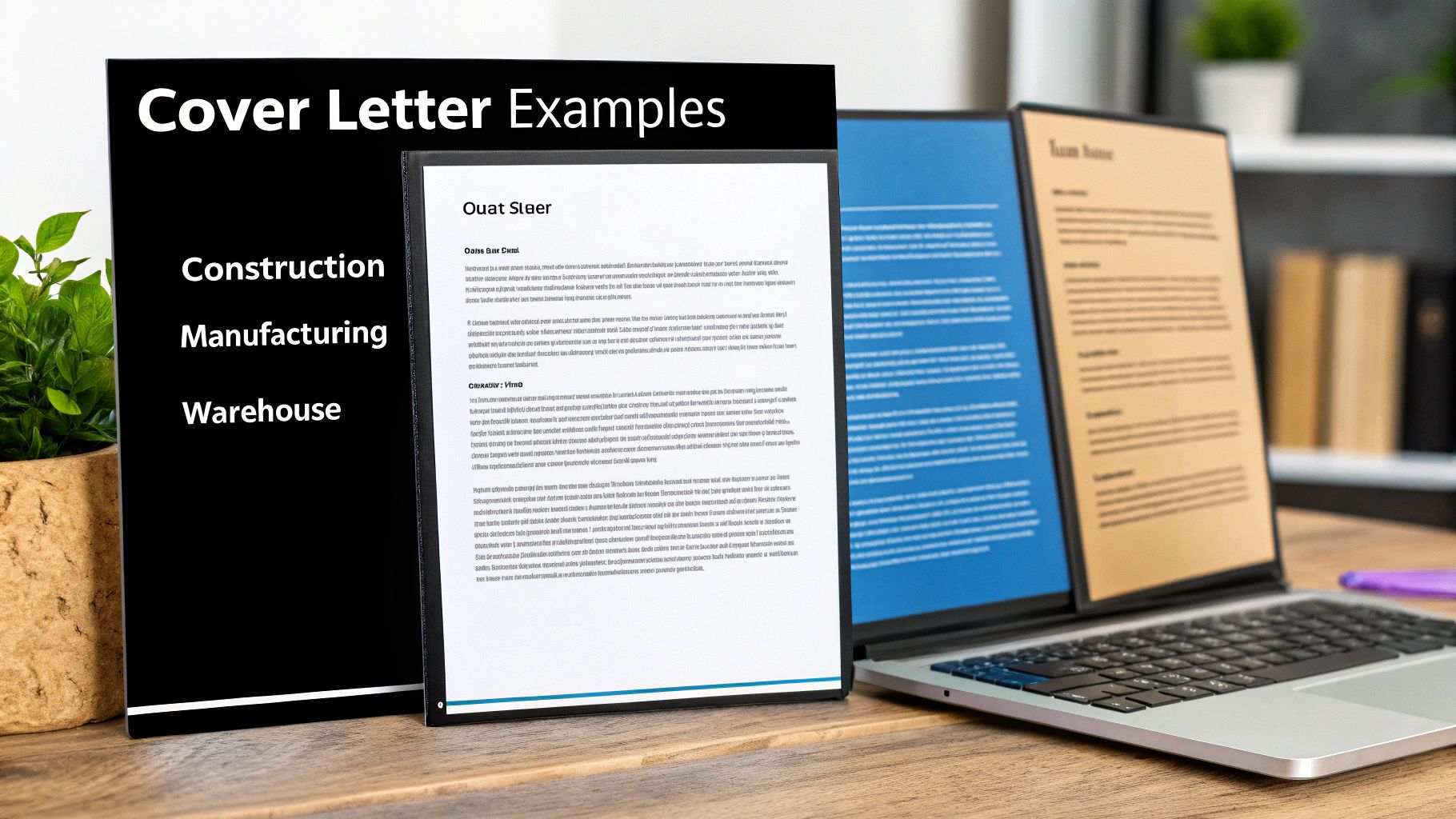
Theory is one thing, but seeing how it all comes together in practice is what really makes it click. Let's look at a few real-world snippets for common European roles to show you exactly what a strong, tailored cover letter looks like.
These aren't just generic templates. They’re practical, role-specific examples designed to give you a clear idea of what gets a hiring manager’s attention.
Notice how each one connects the applicant's experience directly to what the employer needs. They use specific achievements and keywords to build a powerful case. Think of these as a launchpad for your own story.
IT Project Manager (Career Changer)
This example is for a former events manager moving into an IT Project Manager role in Dublin, highlighting transferable skills.
I was excited to see the opening for an IT Project Manager, as my decade of experience in corporate event management has equipped me with a robust skill set in stakeholder coordination and timeline delivery that aligns perfectly with your requirements. In my previous role, I managed a €250,000 conference budget, coordinating with over 30 vendors and technical teams to deliver a flawless event for 1,000 attendees. I am adept at using project management tools like Asana and Trello and am confident my ability to manage complex logistics under pressure will allow me to transition smoothly into the tech environment and drive your projects to successful completion.
Why it works: It directly addresses the career change by focusing on transferable skills like budget management and vendor coordination. Using hard numbers (€250k budget, 30 vendors) provides concrete proof of capability and shows readiness for the new role.
Digital Marketing Specialist (Recent Graduate)
Here we have a recent graduate from a university in Madrid applying for their first full-time role, focusing on practical experience and enthusiasm.
As a recent graduate with a Master's in Digital Marketing and a passion for data-driven strategy, I am writing to express my keen interest in the Digital Marketing Specialist position. During my internship at a local start-up, I was given responsibility for managing the company's social media channels, where I grew our Instagram following by 35% in six months by developing and executing a content strategy focused on user-generated content. I am proficient in Google Analytics and SEO best practices and am eager to apply my skills to help your team achieve its marketing goals.
Why it works: Despite limited professional experience, it highlights a specific, measurable achievement (35% growth) from an internship. It also mentions relevant technical skills (Google Analytics, SEO), showing the candidate is ready to contribute from day one.
Nurse Applying to a Specialist Clinic
This snippet is from an experienced nurse in Stockholm applying for a role in a specialised cardiology clinic. It focuses on relevant expertise and patient care.
I am writing to express my strong interest in the Cardiology Nurse position at your clinic, a facility I have long admired for its patient-centred approach to cardiovascular care. In my current role on the general medical ward at Södersjukhuset, I have actively sought opportunities to work with cardiac patients and have completed advanced training in ECG interpretation. My experience in managing post-operative care for heart patients and my compassionate communication style would allow me to contribute effectively to your team's high standards of patient support.
Why it works: It shows genuine interest and research by mentioning the clinic’s reputation. It highlights specialised training (ECG interpretation) and relevant experience, demonstrating a proactive approach to career development and a perfect fit for the specialist role.
Create a Job-Winning Cover Letter in Minutes
Putting all this advice into practice for every single job application can feel overwhelming, especially when you're already busy with your job search. This is where having the right AI-powered tool can make all the difference, turning hours of stressful writing into just a few simple clicks.
Imagine creating a perfectly tailored, professional cover letter without the usual guesswork.
Your Strategic Partner in the Job Search
The europass.ai cover letter generator is designed to do the heavy lifting for you. Our AI-powered platform intelligently scans the job description you’re targeting. It identifies the crucial keywords and skills the employer wants to see and helps you weave them naturally into your letter.
This ensures your application is optimised to get past automated Applicant Tracking Systems (ATS) and land in front of a real person.
- Save Valuable Time: Stop staring at a blank page. You can generate multiple, unique cover letters for every role you apply for in a fraction of the time.
- Eliminate Errors: Our built-in checks help you avoid stressful typos and grammar mistakes that can get your application discarded.
- Boost Your Confidence: Send every application knowing your cover letter is polished, professional, and precisely tailored to the job. For more guidance, take a look at our guide on how to write a cover letter using a template.
Ready to build an application that truly gets you noticed? Start building your CV and cover letter in minutes with europass.ai.
Your Cover Letter Questions Answered
To wrap things up, let's go over some of the most common questions people have about cover letters. Think of this as your go-to guide for those nagging doubts, ensuring you have all the details sorted.
How Long Should a Cover Letter Be?
Keep it concise and to the point. The ideal length is between 250 and 400 words. This is usually enough to fill a single A4 page with proper formatting and white space, without it looking cramped.
This gives you plenty of room to introduce yourself, connect your skills to the job, and show your enthusiasm, all without boring the person reading it. A recruiter is always more likely to read a punchy, focused letter than a long, rambling one.
Should I Write One If It Is Optional?
The short answer: absolutely, yes. When a job advert says a cover letter is "optional," see it as a golden opportunity to get one step ahead of the competition.
Most applicants will take the easy route and skip it. By sending a well-crafted letter, you instantly show you’re willing to put in the extra effort and that you're genuinely interested in the role. It’s a simple but powerful way to prove you’re a serious candidate.
What Is the Best File Format?
Always, without exception, save and send your cover letter as a PDF. This isn't just a suggestion; it’s a professional standard for several important reasons:
- Preserves Formatting: A PDF looks exactly the same no matter what computer or device it's opened on. Your carefully planned layout stays intact.
- Professional Standard: It’s the expected format for professional documents. Sending a Word document can look unprofessional and may be altered accidentally.
- ATS Compatibility: Most modern Applicant Tracking Systems are designed to parse PDFs correctly, so you won’t have to worry about your details getting scrambled.
Can I Use the Same Cover Letter for All Jobs?
That’s a definite no. Sending the same generic cover letter for every application is one of the fastest ways to get your CV rejected. Recruiters can spot a copy-and-paste job from a mile away, and it signals that you aren’t particularly interested in their specific role.
As we’ve discussed, tailoring your letter is everything. Weave in keywords from the job description and mention something specific about the organisation. This custom touch shows you’ve done your research and are the right fit for their team, not just any team.
Creating a professional, tailored cover letter doesn't have to be stressful. Let the AI-powered tools at europass.ai give you a competitive edge. Start Building Your CV in Minutes and land the interviews you deserve.
Great CVs get work done
Work smarter with the CV builder trusted by skilled workers for more than a decade.
It's easy
