What Is a Europass CV and Should You Use One?
Navigating the European job market can feel like trying to speak a new language, especially when every country has its own idea of what a CV should look like. Job searching is tough enough without confusing formats holding you back. So, what is a Europass CV? Simply put, it’s a standardised CV format created by the European Union to help make your skills and qualifications easy for employers and educational institutions to understand, no matter where in the EU you apply. It was designed with the best intentions: to simplify cross-border applications. But is it still the best tool for your job search today?
Feeling stuck with outdated templates? Let's explore how you can create a professional, ATS-optimised CV in minutes.
Understanding the Europass CV in Simple Terms
Think of the Europass CV as a universal passport for your professional life. Its main purpose is to break down barriers by creating a common language for job seekers, hiring managers, and academic institutions all over Europe.
Whether you're a software developer from Spain aiming for a job in Germany or a recent graduate in Poland chasing an internship in France, the Europass format ensures your information is presented in a consistent, predictable way. This standard layout means everyone is on the same page, regardless of their native language or local hiring customs.
The Core Structure
The official Europass CV follows a very strict, prescribed structure. Any CV created through the official portal ends up looking almost identical, usually with that distinct blue-and-white design. This uniformity is its defining feature, for better or worse.
Key sections almost always include:
- Personal Information: This section often includes your photo, full address, and date of birth, which can be a significant disadvantage in countries with strict anti-discrimination laws, like the UK.
- Work Experience: A straightforward chronological list of your previous jobs and responsibilities.
- Education and Training: Your academic background and any relevant certificates or courses you've completed.
- Personal Skills: A detailed breakdown of your language skills, communication abilities, and digital competencies.
To give you a quick overview, here are the key features of a standard Europass CV.
Europass CV at a Glance
| Feature | Description |
|---|---|
| Standardised Layout | A fixed, consistent format recognised across all EU member states. |
| Cross-Border Focus | Designed specifically to simplify job and academic applications between countries. |
| Comprehensive Sections | Includes dedicated areas for personal skills, digital competencies, and languages. |
| Official Portal | Created and managed through the European Union's official Europass online platform. |
This table shows how the Europass aims for clarity and consistency above all else.
The big idea behind this format is a good one: to make moving between countries for work or study much simpler. The problem is, its one-size-fits-all approach can be a real drawback in competitive job markets where making a personal impact is everything.
While the original Europass format had its place, today’s job hunt calls for something more modern and effective. The good news is you don’t have to throw out the principles. AI-powered tools like europass.ai let you build a professional, ATS-optimised CV that respects European standards but also gives you the freedom to truly stand out. You can learn more about what recruiters expect now by checking out the modern Europass CV format and how to make it work for you.
Europass CV Compared to a Standard UK CV
When you're applying for jobs, the CV format you choose matters more than you might think. While the Europass CV is built around a single European standard, it's a world away from what most UK recruiters are used to seeing. Knowing the difference is crucial for making the right first impression and giving yourself the best chance.
Think of a standard UK CV as your personal marketing document. It’s designed to sell your skills quickly and efficiently. Recruiters often spend mere seconds on each application, so your CV needs to be clear, concise, and impactful. The rigid, and often lengthy, Europass format can sometimes work against this need for instant impact.
Structure and Flexibility
The most obvious difference is the layout. A standard UK CV gives you total freedom. You can customise the structure to put your best assets front and centre, whether that’s a powerful key skills section or a list of impressive achievements. It’s all about grabbing the recruiter’s attention from the get-go.
The Europass CV, on the other hand, follows a fixed, unchangeable template. Every section has its designated spot, leaving you with very little room to tailor the presentation to the specific job you’re after. This rigidity can mean your most relevant qualifications get buried deep in the document.
Content and Personal Details
This is where the really critical differences lie, especially when it comes to personal information. A Europass CV has standard fields for your photo, date of birth, gender, and nationality. In the UK, including these details isn’t just unusual—it’s a major professional misstep.
Thanks to UK anti-discrimination laws like the Equality Act 2010, employers actively discourage this kind of personal data to prevent unconscious bias during hiring. Submitting a CV with your photo and age can, unfortunately, lead to it being rejected straight away.
Length and Recruiter Expectations
Brevity is king in the UK job market. The golden rule is to keep your CV to a maximum of two pages. This forces you to be ruthless, focusing only on the information that’s directly relevant to the role you want.
In contrast, the detailed sections required by the Europass can easily push the document to three pages or more. That extra length can be a real disadvantage, as a busy UK recruiter simply may not have time to read through it all.
For example, a marketing manager in Munich applying for a senior role in London would find their application lands better with a tailored two-page CV. A recent survey of 1,200 UK recruiters revealed that only 12% regularly recognise the Europass format. A massive 88% said they prefer clean, tailored, UK-style CVs. And while a Europass often averages three pages, studies show 92% of UK recruiters expect CVs to be two pages at most. You can always explore more recruiter preferences and insights to get a better feel for the UK market.
The core difference is purpose. A standard UK CV is a persuasive, tailored pitch for a specific job. The Europass CV is a comprehensive, standardised record of your entire professional and educational history.
To make these differences crystal clear, let's break them down side-by-side.
Europass CV vs Standard UK CV Key Differences
This table gives you a quick snapshot of how the two formats stack up against each other.
| Feature | Europass CV | Standard UK CV |
|---|---|---|
| Structure | Rigid and standardised, with fixed sections. | Flexible and customisable to highlight key strengths. |
| Length | Often runs to three or more pages due to detailed sections. | Strictly one to two pages maximum to ensure conciseness. |
| Personal Data | Commonly includes a photo, date of birth, and nationality. | Personal data is excluded to comply with anti-discrimination laws. |
| Purpose | To provide a comprehensive, cross-border record of skills. | To create a targeted, persuasive marketing document for a role. |
Ultimately, choosing the right format depends on where you're applying. For the UK, a tailored, standard CV is almost always the smarter choice.
When You Should Use a Europass CV
While your standard CV is your go-to for most private sector jobs, the Europass CV shines in a few very specific arenas. Knowing exactly when to use it can be the strategic move that gets your application the right kind of attention.
Think of it like this: you wouldn't wear a business suit to a building site. The same logic applies here. The Europass CV is a specialised tool for particular environments, and its real power is its standardisation—a feature that’s incredibly valuable where fairness and consistency across different nationalities are the top priorities.
Public Sector and EU Institutions
If you're applying for a job within a European Union institution, the Europass CV often isn't just a good idea—it's expected. Organisations like the European Commission, the European Parliament, or the European Central Bank field thousands of applications from every member state.
The standardised format is a lifesaver for their HR teams. It lets them compare candidates from wildly different educational and professional backgrounds on a level playing field, ensuring everyone's qualifications are presented in the same way. This is precisely the scenario what is a europass cv was built for.
For roles within the EU's official bodies, using the Europass format signals that you understand their procedures and are serious about the application. It demonstrates a level of professional awareness that a non-standard CV might lack.
Academic and Research Applications
Academia across Europe is another area that frequently leans on the Europass format. When you’re applying for research grants, university positions, or EU-funded educational programmes like Erasmus+, the detailed, comprehensive nature of the Europass CV really works in your favour.
It creates a clear, chronological record of your publications, qualifications, and research projects that’s easily understood by academic committees all over the continent.
- Erasmus+ Programmes: For student and staff mobility applications, the Europass is often a mandatory part of your documentation.
- University Admissions: Many European universities request it for postgraduate applications to make assessing international candidates simpler.
- Research Funding: When you apply for grants from EU-backed bodies, the format provides a consistent framework for evaluation.
Skilled Trades in Specific Countries
Finally, the Europass CV can be a brilliant choice for skilled tradespeople looking for work in certain EU countries. In places like Germany or Austria, where formal qualifications and apprenticeships are meticulously documented, the structured format is very well-received.
It allows electricians, mechanics, or construction workers to clearly lay out their specific certifications and hands-on experience in a way that local employers instantly recognise and trust.
Choosing the right format is a crucial part of your job search strategy. By understanding these specific use cases, you can make an informed decision and make sure your application is perfectly aligned with what the employer is looking for.
Why the Europass CV Can Hurt Your UK Job Search
Thinking of using a standard Europass CV for a job in the UK? You might want to think again. While it’s built for consistency across Europe, its rigid format can clash with what British recruiters and modern hiring software expect to see. Knowing its pitfalls is the first step to crafting a CV that actually opens doors in the UK's competitive job market.
The biggest issue is its one-size-fits-all nature. Your CV is your personal marketing tool—its job is to sell you. The Europass format locks you into a structure that prevents you from putting your best achievements front and centre, which is a massive disadvantage when recruiters only give each application a few seconds of their time.
A Problematic Template
The official Europass template forces you into a generic layout used by thousands of other candidates, making it incredibly difficult to stand out. When a hiring manager sees that same old format for the tenth time that day, it can signal a lack of effort or an unawareness of UK professional norms. Neither of those makes for a great first impression.
On top of that, many UK recruiters who sift through hundreds of applications just aren't familiar with its structure. This can cause confusion, and a confused recruiter is more likely to simply set your application aside in favour of a clear, standard UK CV they can understand instantly.
Incompatible with UK Hiring Laws
This is a big one. The Europass format has standard fields for your date of birth, nationality, and gender. In the UK, including these details is a major red flag because it goes against anti-discrimination laws. Many companies will reject a CV with this information on sight to avoid any legal risks.
UK companies are bound by laws like the Equality Act 2010, which bans discrimination based on personal characteristics. You can explore more on why the Europass CV is good or bad depending on the situation. By sending a CV with these details, you’re putting the employer in an awkward position before they've even read about your skills.
In the UK job market, an estimated 85% of CVs are rejected by Applicant Tracking Systems (ATS) before a human ever sees them. A generic Europass format just isn't built to get past this first digital hurdle. Discover more insights about these CV myths.
Poor ATS Performance
Finally, let's talk about the software. The Europass CV's table-based layout and odd formatting are a nightmare for Applicant Tracking Systems (ATS) to read correctly. These systems are the gatekeepers for most medium-to-large companies in the UK, and they scan your CV for keywords before a person ever sees it.
If an ATS can't parse your CV, it can't pull out your skills, experience, or even your contact details. This means your application often gets automatically rejected, no matter how perfect you are for the role. Your CV needs to be designed for both human eyes and machine scanning, and the standard Europass format often fails the machine test.
How to Build a Modern ATS-Optimised CV
It’s time to ditch the outdated templates and build a CV that actually gets you noticed in today's job market. Creating a powerful, ATS-optimised CV isn’t about fancy designs; it's about being smart and focusing on what both recruiters and their software are looking for. The aim is to present your experience clearly and compellingly, making it easy for anyone (or anything) to scan.
This means changing how you think about your experience. Instead of just listing your duties, you need to show your achievements with real numbers. Don’t just say you were "responsible for managing stock." Frame it as an accomplishment: "Reduced stock discrepancies by 15% by implementing a new inventory tracking system." That small shift makes a world of difference.
Focus on Quantifiable Achievements
Recruiters want to see the impact you made, not just the tasks you ticked off a list. Numbers tell a compelling story and give solid proof of your value.
Before you even start writing, take a moment to think about what you've actually accomplished in your past roles. Ask yourself questions like:
- How much time or money did I save the company?
- By what percentage did I boost efficiency or output?
- How many people did I train or lead on a project?
- How many successful projects did I see through to completion?
Adding these metrics turns your CV from a passive list of jobs into an active showcase of your skills. This is especially true for skilled trades. For a logistics professional in Rotterdam, quantifying achievements like "Improved on-time delivery rates from 88% to 95% within six months" is far more powerful than just listing duties.
Tailor Your Content with Keywords
Think of an Applicant Tracking System as a search engine for CVs. It scans your document for specific keywords and phrases that match the job advertisement. If your CV is missing those keywords, it probably won’t ever be seen by a human.
Your strategy here is simple. For every single job you apply for, read the description carefully. Pinpoint the key skills, qualifications, and responsibilities the employer is after. Then, weave those exact terms naturally throughout your CV, especially in your professional summary and work experience sections. Using a tool to double-check your work can be a massive help. You can learn how to use a free ATS resume checker to make sure your content is spot on.
This flowchart shows the unfortunate journey a standard Europass CV often takes in the UK—from submission straight to rejection.
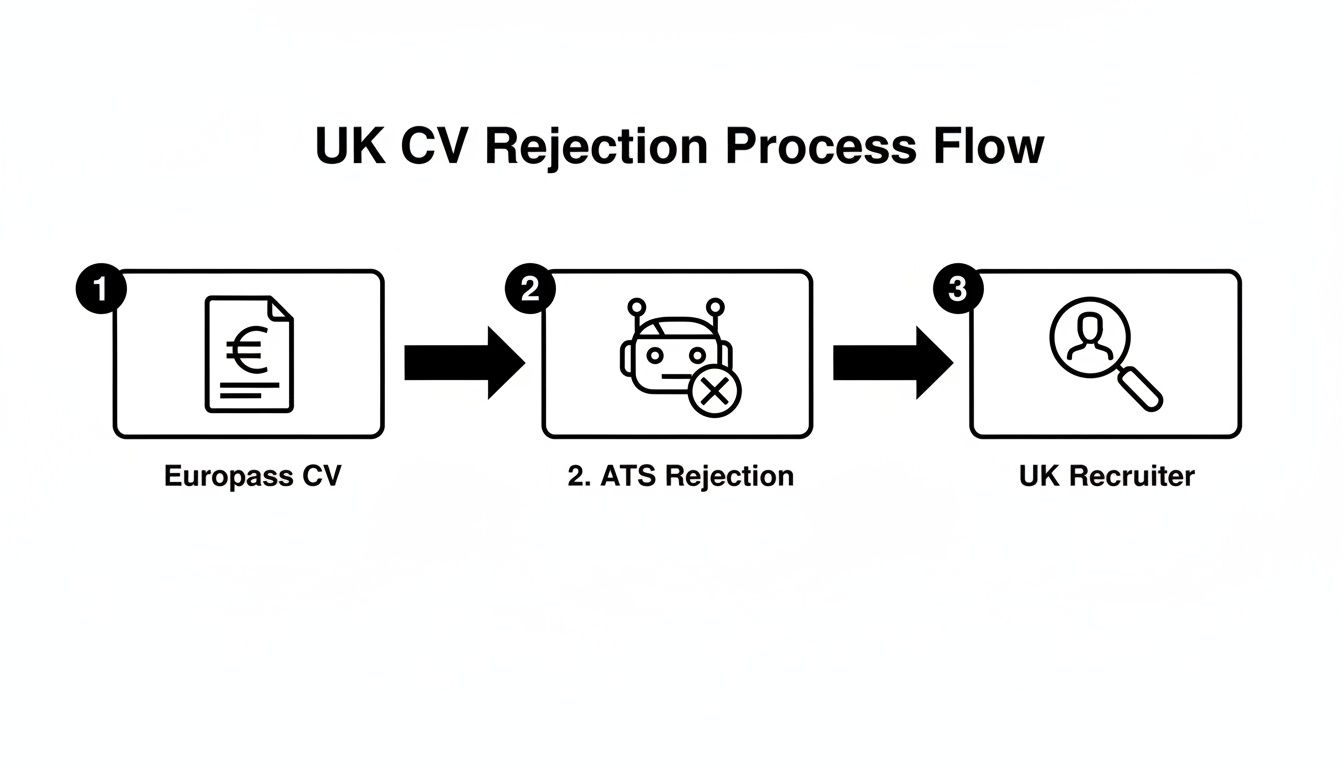
As you can see, a format that isn’t optimised for modern systems often gets filtered out before a recruiter even has a chance to see it.
Choose a Clean, Professional Template
Finally, the look of your CV really does matter. It needs to be clean, professional, and easy for both people and software to read. Stay away from cluttered layouts, unusual fonts, or flashy graphics that can confuse an ATS.
A great CV template strikes a perfect balance between a professional look and simple readability. It should guide a recruiter’s eyes to the most important information while making sure every word can be understood by automated systems.
This is where europass.ai really helps. Our AI-powered platform guides you through all these steps in just a few minutes. It suggests powerful, number-based achievements for your role, helps you work in the right keywords, and offers a library of modern, ATS-optimised templates. You get the familiar, recognised structure of a European format, but with the modern performance you need to land an interview. Start Building Your CV in Minutes with europass.ai.
So, What's the Final Verdict on the Europass CV?
Let's quickly recap the main points we've covered about the Europass CV. At its core, it's a standardised format created by the EU to make skills and qualifications easy to understand for employers and institutions right across Europe.
It definitely has its place, especially if you're applying for jobs within EU bodies, academic roles, or cross-border schemes like Erasmus+. In those specific situations, its uniform layout is a real plus, creating a level playing field for every candidate.
Where to Go From Here in Your Job Hunt
But for most jobs in the private sector, particularly in competitive markets like the UK, the official Europass format can be more of a hindrance than a help. Its rigid design, inclusion of personal details that go against UK norms, and poor performance with Applicant Tracking Systems (ATS) can stop your application in its tracks.
To get noticed, you need a modern, ATS-optimised CV that does one thing well: sells you. It needs to highlight your unique skills and professional wins, not just list them in a generic box.
It's time to ditch the one-size-fits-all templates. Your next move should be to build a CV that catches a recruiter's eye for the right reasons and is designed to sail through those initial digital checks.
This is all about taking a tailored approach and showing a potential employer exactly what you can do for their organisation.
Ready to build a professional CV that recruiters will actually read and that can beat the bots? Create Your Professional CV with Europass.ai and take the next step in your career journey today.
Frequently Asked Questions About the Europass CV
It’s completely normal to have questions when you’re figuring out a new CV format. To help you get your head around it all, we've pulled together some of the most common queries about the Europass CV. Think of this as your quick-start guide to using it with confidence.
Is the Europass CV free to create?
Yes, if you use the official European Union portal, creating a CV is completely free. The downside is that the free templates are notoriously rigid and, frankly, not built for the modern job market. Many are not optimised for Applicant Tracking Systems (ATS), which is a huge problem in today's automated hiring landscape.
That’s why many professionals are switching to more advanced CV builders. Platforms like europass.ai offer a massive upgrade, with professionally designed templates, AI-powered writing suggestions, and layouts built from the ground up to sail through automated screening. It’s the kind of competitive edge that really matters.
Should I include a photo on my CV?
This one is all about location, location, location. In places like the UK, Ireland, and the US, you should never put a photo on your CV. This practice helps prevent unconscious bias during the hiring process and aligns with strict anti-discrimination laws. Including a photo could lead to your application being rejected on the spot.
However, in other parts of Europe, like Germany or Spain, a professional headshot is still standard practice and even expected. The golden rule? Always do a quick bit of research on the local customs for the specific country where you are applying.
Can I change the Europass CV format?
If you're using the official EU website, then no, you can't. The format is locked in, which is one of the biggest complaints people have about it. This lack of flexibility means you can't rearrange sections to show off your best qualifications or tailor the layout for a specific role.
This is where a dedicated CV builder really shines. It puts you back in control, letting you pick from a range of modern, flexible templates. They don't just look better; they're strategically structured to pass ATS scans and grab a recruiter's attention.
The gold standard for CV length in most European markets is a maximum of two pages. A concise, powerful document respects the recruiter's time and makes a stronger impact.
How long should my Europass CV be?
Because the official Europass format is so detailed and section-heavy, it's easy for it to sprawl out to three pages or even more. While that might feel thorough, it's rarely what recruiters want to see.
For most jobs across the UK and Europe, you should aim for a maximum of two A4 pages. Remember, recruiters are busy people. Your goal is to give them a sharp, impactful document that highlights your most relevant skills and experience without any unnecessary fluff.
Ready to build a CV that actually gets you noticed? With europass.ai, you can create a professional, ATS-optimised CV that stands out from the crowd in just minutes.
Great CVs get work done
Work smarter with the CV builder trusted by skilled workers for more than a decade.
It's easy
