A Guide to the Perfect Financial CV Format That Wins Interviews
Staring at a blank page, wondering how to structure your finance CV? You're not alone. In a highly competitive European market, your CV is your first handshake with a potential employer, and you need to make it count. The right financial cv format is your ticket past the Applicant Tracking Systems (ATS) and into the hands of a hiring manager. It's about presenting your skills and achievements in a way that’s impossible to ignore.
Feeling the pressure is completely normal, but we're here to help you turn that blank page into a powerful career tool. Let's break down exactly how to build a CV that showcases your value, tells a compelling story, and opens the door to your next big opportunity in finance. Ready to craft a CV that gets you noticed? Create your professional CV with europass.ai in minutes.
Why the Reverse-Chronological Format Is Your Best Bet
There's a reason the reverse-chronological format is trusted by finance professionals across Europe. It’s the gold standard. For the UK job market in particular, it’s the top choice because it logically showcases your career advancement—precisely what recruiters want to see in finance roles.
This layout immediately puts your most recent successes front and centre. It allows you to:
- Spotlight your latest wins: By placing your current or last role at the top, you're showing off your most advanced capabilities right away.
- Paint a clear picture of your growth: Recruiters can easily follow your journey, from junior analyst to senior manager, watching your responsibilities expand.
- Meet recruiter expectations: This is the format hiring managers know and trust. It makes your CV easy to scan and digest in seconds.
And forget about those stuffy, outdated objective statements. A modern financial CV kicks off with a punchy professional summary to grab their attention from the first line. For a deeper dive, check out our guide on how to write a powerful CV opening statement.
To give you a clearer picture, here’s a quick rundown of the essential components that make up a high-impact financial CV.
Key Sections of a Modern Financial CV
| Section | Purpose | Key Information to Include |
|---|---|---|
| Contact Information | To make it easy for recruiters to get in touch. | Full name, phone number, professional email, and a link to your LinkedIn profile. |
| Professional Summary | A brief, powerful pitch of your expertise. | 2-3 sentences highlighting your key skills, years of experience, and biggest achievements. |
| Work Experience | To detail your career progression and impact. | Job titles, company names, dates, and 3-5 bullet points with quantifiable results for each role. |
| Education | To show your foundational knowledge. | Degree, university name, and graduation date. Relevant certifications go here, too. |
| Skills | To showcase your technical and soft abilities. | A mix of hard skills (e.g., Excel, financial modelling) and soft skills (e.g., communication, analysis). |
| Certifications | To highlight specialised qualifications. | Professional credentials like ACCA, CIMA, CFA, or other industry-specific certifications. |
Each of these sections plays a crucial role in building a narrative that positions you as the ideal candidate.
A well-organised CV does more than just list your experience; it tells a compelling story of your value. It’s your marketing document, designed to secure that all-important interview.
Think of your CV as the trailer for your career—it needs to be engaging, highlight the best parts, and leave the audience (the recruiter) wanting to see the full movie (the interview).
Building the Core of Your Financial CV
Right, let's get the foundations sorted. These are the core building blocks of your financial CV, and getting them right is non-negotiable. Each part has a specific job to do, and together they’ll tell a powerful story about your career. Think of this as the essential framework before we start layering on your impressive achievements.
First up, your contact details. Place them right at the top where they can’t be missed. Keep it clean and professional. All you need is your name, phone number, a sensible email address (like firstname.lastname@email.com), and a link to your LinkedIn profile.
A quick but important note: if you’re applying for roles in the UK or Ireland, leave your photo off. It’s standard practice to avoid unconscious bias, and frankly, it looks more professional. It also helps your CV sail through those tricky ATS screeners.
Crafting a Compelling Professional Summary
This is your headline act. Forget the old, tired "Objective" statement. You need a sharp, 3-4 sentence professional summary that acts as your 30-second elevator pitch. It’s the very first thing a recruiter reads, so it needs to land with impact. Vague waffle just won't cut it.
So, instead of a generic line like, "Experienced finance professional seeking a new challenge," you need to be far more specific.
For example: "FRM-certified risk analyst with 8+ years of experience mitigating market volatility for FTSE 100 companies. Proven success in developing quantitative models that reduced portfolio risk by 15% and ensured full compliance with Basel III regulations."
See the difference? That instantly tells the reader your specialisation, seniority, and a hard-hitting, quantifiable win.
Structuring Your Work Experience
This section is the heart and soul of your CV. There's only one way to format this: reverse-chronological order. Start with your most recent job and work backwards. It’s what every finance recruiter in Europe expects to see because it clearly maps out your career path.
For every role, you’ll need to list:
- Job Title: Use the official, industry-standard title. No creative interpretations here.
- Company Name & Location: The organisation's name and the city you worked in.
- Dates of Employment: A simple month and year format is best (e.g., Oct 2020 – Present).
Under each job, aim for three to five bullet points. These should focus less on day-to-day duties and more on your actual accomplishments. We’ll get into how to load these up with powerful metrics in just a moment.
Listing Education and Key Certifications
Your education provides vital context, especially if you’re at the start of your career. In fact, if you're a recent graduate, this section should come before your work experience.
Keep the presentation clean and straightforward.
- Degree: BSc (Hons) Finance, 2:1
- University: University of Manchester
- Graduation Year: 2021
Certifications are absolute gold in the finance world. They’re a shorthand for your expertise. Designations like ACCA, CIMA, or CFA deserve their own dedicated section, or at the very least, a prominent spot next to your education.
Think of these certifications as high-value keywords. They’re exactly what recruiters and applicant tracking systems are programmed to look for, giving your CV an immediate boost in credibility. Nailing these core sections builds a solid launchpad for a CV that truly opens doors.
How to Quantify Your Achievements
In the world of finance, numbers are everything. They tell the whole story. A CV that just lists your duties is easy to forget, but one that shows your measurable impact is impossible to ignore. It’s the difference between saying you "managed budgets" and proving you "slashed operational costs by 15%."
This is where you demonstrate your real commercial value. Every bullet point in your work history should be a mini-testament to your ability to save money, boost efficiency, or drive growth. Abstract skills are fine, but it’s the hard data that gets the attention of recruiters and hiring managers.

From Duties to Data-Driven Results
Shifting from a passive list of tasks to active, quantified achievements takes a change in mindset. Stop thinking about what you did and start focusing on why it mattered. A brilliant way to frame your accomplishments is with the Problem-Action-Result (PAR) method.
Think about a challenge you were facing (the Problem), what you did to tackle it (the Action), and the measurable outcome you delivered (the Result). This simple structure turns a routine task into a powerful case study of your effectiveness.
- Before (Duty-focused): Responsible for managing financial reporting.
- After (Result-focused): Streamlined the monthly financial reporting process by implementing new automation software, which cut report generation time by 40%.
See the difference? The second example doesn't just state a responsibility; it proves your impact with a concrete metric. This is the kind of detail that will elevate your financial CV format from average to outstanding.
Finding the Numbers in Your Role
You might think quantifying your work is tough, but the data is usually right there. Start by asking yourself a few key questions about your past roles:
- How much money did I save the company?
- By what percentage did I increase revenue or improve efficiency?
- How many people was I responsible for managing or training?
- What was the scale of the accounts or transactions I handled?
Even if you don't have an exact figure, a solid estimate is far better than nothing at all. You can use words like "approximately," "over," or "up to" to frame your numbers honestly. For instance, "Reduced invoice processing errors by approximately 25%" still packs a serious punch.
The core idea is simple: every single bullet point should answer the question, "So what?" If you can't tie your action back to a positive business outcome, it's not strong enough for your CV.
This data-first approach is crucial in the competitive UK finance sector. A standout CV might highlight creating a system that led to 45% cost reductions or achieving 15% portfolio growth over three years. These figures turn skills into the tangible proof that hiring managers are desperate to see. You can find more great tips on how to quantify your financial achievements on Indeed.
Quantified Examples for Different Finance Roles
Let’s look at how this plays out in practice for a few different specialisations.
For a Financial Analyst:
- Weak: Analysed market trends to inform investment strategies.
- Strong: Developed and maintained complex financial models that identified undervalued assets, contributing to a €1.2M increase in portfolio value in FY2023.
For an Accountant:
- Weak: Handled accounts payable and receivable.
- Strong: Managed an accounts receivable portfolio of €5M, successfully reducing Days Sales Outstanding (DSO) from 45 to 32 days.
For a Finance Manager:
- Weak: Led the annual budgeting process.
- Strong: Directed the annual budget process for a €50M division, identifying and implementing cost-saving initiatives that reduced operational expenses by 12% year-on-year.
When you focus on metrics like these, you’re not just listing job functions. You’re building a compelling business case for why you are the best person for the job.
Getting Your CV Past the Robots (ATS)
Before a hiring manager ever sees your perfectly polished CV, it has to get past the first hurdle: the digital gatekeeper. We're talking about Applicant Tracking Systems, or ATS. This software scans, sorts, and ranks applications based on how well they match the job description. If you get this part wrong, your application can be rejected before a human even lays eyes on it.
You have to learn the rules of the game to get a chance to play. That means building your financial CV format specifically to beat the bots.
How ATS Software Reads Your CV
Imagine an ATS as a super-efficient but very literal assistant. It doesn’t care about fancy graphics or creative layouts. It's looking for specific information in specific places.
The software scans for keywords and phrases that match the job advert. It also tries to understand your CV's structure by looking for standard headings like "Work Experience" and "Education." This is why a creative heading like "My Career Journey" is a terrible idea—it can confuse the system and cause it to misinterpret your entire professional history.
A huge number of large companies across Europe now use an ATS to handle the sheer volume of applications they receive. Your job is to create a CV that speaks the system's language loud and clear.
Finding and Using the Right Keywords
So where do you find these magic keywords? Your main source is right in front of you: the job description. Read it through carefully. Highlight the skills, qualifications, and software they mention repeatedly.
For most finance roles, you'll be looking for things like:
- Hard Skills: Financial modelling, risk assessment, budgeting, forecasting, IFRS, GAAP.
- Software: SAP, Oracle, QuickBooks, Advanced Excel (VLOOKUP, Pivot Tables).
- Soft Skills: Commercial acumen, stakeholder management, analytical thinking.
Once you have your list, weave these terms naturally into your CV. Your professional summary, skills section, and work experience bullet points are all prime real estate for these keywords. The idea is to mirror the language the employer uses.
If you want to be extra sure, running your document through a free ATS checker is a great final step. It will give you an idea of how your CV stacks up before you hit "send."
Formatting That Won't Get You Filtered Out
Getting past the ATS is as much about what you leave out as what you put in. Overly complex formatting is a surefire way to confuse the software, which can lead to it scrambling your details or missing them entirely.
Stick to these simple rules for a clean, ATS-friendly layout:
- Use standard fonts: Classics like Calibri, Arial, or Times New Roman are your best bet.
- Ditch tables and columns: A simple, single-column layout is safest as older ATS versions struggle to read them correctly.
- Keep bullet points simple: Standard round or square bullets work perfectly.
- Save it as a PDF: This locks in your formatting. Always name the file professionally, like "FirstName-LastName-CV.pdf."
In the UK market, this is especially critical. Around 75% of recruiters use an ATS to screen candidates, scanning for specific phrases like 'financial risk analyses' or 'strategic planning'. Following UK conventions like using A4 size, leaving off a photo, and using British English spellings (e.g., analyse, organisation) is non-negotiable if you want to pass that first automated filter. You can learn more about crafting a CV that UK recruiters love to get the details right.
Tailoring Your CV for Specific Finance Roles
Sending out the same generic CV for every finance job is a common but costly mistake. The world of finance is incredibly diverse; the skills a top-tier Financial Analyst needs are worlds away from what makes a brilliant Accountant. If you want to get noticed, you have to show you understand this distinction. This means taking your core financial CV format and customising it for every single application.
A targeted approach proves to the hiring manager that you've not only read the job description but have also thought deeply about how your experience solves their specific problems. This attention to detail is a non-negotiable trait for any serious finance professional.
Before your CV even lands on a recruiter's desk, it has to pass through an Applicant Tracking System (ATS).
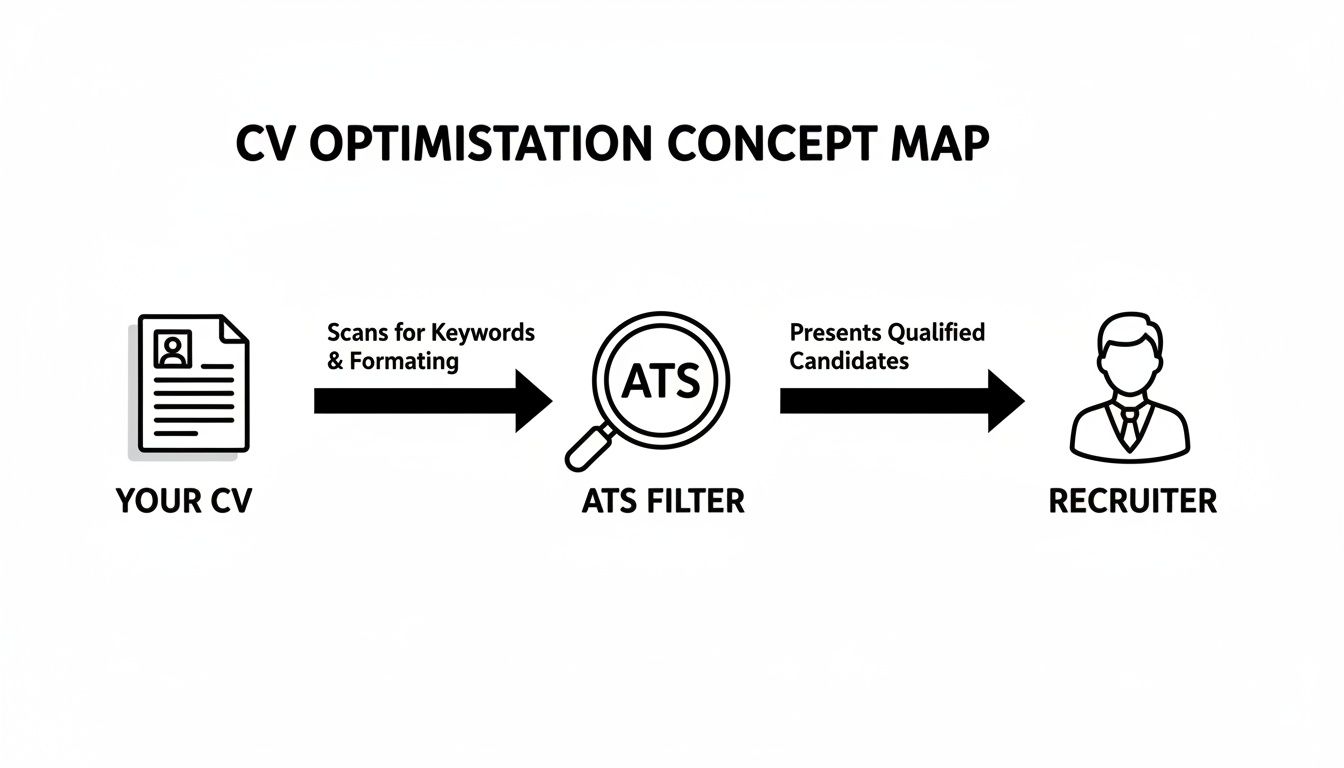
This journey is precisely why loading your CV with the right keywords is so critical. You need to get past the machine before you can impress the human.
For the Financial Analyst
When you're applying for a Financial Analyst role, your CV needs to be all about data, forecasting, and modelling. Recruiters are looking for sharp analytical minds with serious technical skills.
Make sure these areas shine:
- Technical Skills: Don't be shy about your proficiency with tools like SQL, Python, or R. Your Excel skills are also paramount, so explicitly mention your expertise in financial modelling, VBA, and Power BI.
- Key Achievements: Put numbers to your successes. For instance, "Developed a new forecasting model that improved accuracy by 15%, leading to better inventory management."
- Top Keywords: Weave in terms like "financial modelling," "variance analysis," "data visualisation," "budgeting," and "forecasting" naturally throughout your experience section.
For the Accountant
An Accountant's CV, on the other hand, should radiate precision, integrity, and a deep understanding of compliance. The focus shifts from predicting the future to ensuring the accuracy and legality of the past.
Here’s what to highlight:
- Compliance Knowledge: Showcase your grasp of accounting standards like IFRS or UK GAAP. Mentioning direct experience with tax filings or statutory reporting is a huge plus. For a deeper dive, our guide on the perfect accountant curriculum vitae format has you covered.
- Audit Successes: Talk about your role in internal or external audits. A great example would be, "Played a key role in the year-end audit, resulting in zero major findings and praise for organised documentation."
- Top Keywords: Ensure your CV includes phrases such as "accounts reconciliation," "financial reporting," "general ledger," "tax compliance," and "audit support."
A tailored CV isn't just about swapping out a few keywords. It’s about re-framing your entire experience through the lens of the specific role you're targeting, ensuring every bullet point resonates with what that particular employer needs most.
For the Finance Manager
Applying for a Finance Manager position? Your CV needs to pivot towards leadership, strategic thinking, and commercial acumen. It's no longer just about the numbers themselves, but how you use them to drive the business forward and lead a team.
Your CV must spotlight:
- Leadership Experience: Be specific about the size of the teams and budgets you've managed. Try a bullet point like, "Led a team of four junior accountants, providing mentorship that contributed to a 20% increase in departmental efficiency."
- Strategic Impact: Connect your financial work to the company's bottom line and overall goals. For example, "Developed and implemented a new budgeting process that reduced departmental spending by €250k annually."
- Top Keywords: Your CV should feature terms like "strategic planning," "budget management," "team leadership," "stakeholder management," and "financial strategy."
Final Checks and Common Mistakes to Avoid
Right, you’ve put in the hard work and your CV is almost ready. Before you hit send, it’s time for one last, meticulous review. In finance, attention to detail isn’t just a nice-to-have, it’s a core part of the job. A single typo or a wonky margin can signal carelessness—the last impression you want to give a recruiter who lives and breathes precision.
This final check is your chance to make sure your professional story is told flawlessly.

Treat this step like a final audit. Print your CV and read it aloud – you’d be surprised what you catch. Better yet, ask a trusted colleague to give it a fresh pair of eyes. After staring at a screen for hours, your brain starts to miss the obvious.
Polish Your Professional Presentation
Your digital footprint is just as important as the document itself. A few quick tweaks to how you present your CV can make a world of difference.
- File Format: Always send your CV as a PDF. It locks in your formatting so it looks the same on any device and prevents accidental edits. A Word doc can look completely different from one computer to another, which comes across as sloppy.
- File Naming: Ditch generic names like ‘CV.pdf’. Go for something clear and professional, like FirstName-LastName-CV.pdf. It’s a small thing, but it helps the recruiter stay organised.
- Email Address: Make sure your contact email is professional. An address like
partyking2004@email.comis a one-way ticket to the deleted folder. Stick to a simple format likefirstname.lastname@email.com.
Common European CV Pitfalls to Dodge
When you're navigating the European job market, you need to be aware of local cultural and legal norms. Including the wrong information can be a major red flag for recruiters working to strict compliance standards.
In Europe, with GDPR in full swing, less is more when it comes to personal data on a CV. Including details you shouldn’t can make you look out of touch with professional privacy standards.
Steer clear of these common mistakes:
- Excessive Length: Stick to a maximum of two A4 pages. Anything longer risks the recruiter losing interest. Be concise and impactful.
- Unnecessary Personal Details: Do not include your date of birth, marital status, or nationality unless the job advert specifically asks for it. Under GDPR, this information is not relevant to your ability to do the job.
- A Photo (in the UK/Ireland): While you might see photos on CVs in other parts of Europe, it's a firm ‘no’ for UK and Irish applications. This is standard practice to help prevent unconscious bias during the hiring process.
Your Financial CV Questions Answered
Trying to get your head around the nuances of the European job market can be a challenge. To help you put the finishing touches on your CV with confidence, let's tackle some of the most common questions we hear from finance professionals.
How Long Should a Financial CV Be in the UK and Europe?
For most finance professionals with less than 10 years of experience, a sharp, one-page CV is ideal. It forces you to be ruthless and focus only on what truly matters.
If you’re a seasoned professional with a longer career, you can stretch to two pages. But that’s the absolute limit. Remember, recruiters spend just seconds on the first scan, so make sure your biggest wins are front and centre on page one.
Should I Include a Photo on My Financial CV?
This is a big one, and it really depends on where you're applying.
In the UK and Ireland, the answer is a definite no. It's standard practice to leave photos off to avoid unconscious bias in the hiring process. Including one can work against you.
However, in countries like Germany or France, a professional headshot is often expected. The golden rule? Always research the local customs for the specific country you're targeting.
What Are the Most Important Skills to List?
A standout financial CV shows you're the full package – you have the technical expertise and the soft skills to back them up. You need to prove you can do the job and be a great person to work with.
Here are a few must-haves to consider:
- Technical Skills: Think Financial Modelling, Data Analysis, Budgeting & Forecasting. You’ll also want to mention advanced Excel skills (VBA, Pivot Tables) and any experience with major ERP systems like SAP or Oracle.
- Soft Skills: Don’t underestimate these! Attention to Detail is non-negotiable in finance. Commercial Acumen, Problem-Solving, and strong Communication for managing stakeholders are also huge selling points.
Always tailor your skills section to what’s in the job description. It’s the single best way to get past the initial ATS screen and grab a human recruiter’s attention. This shows them you're the perfect fit for what they actually need.
Feeling ready to build a CV that truly opens doors? With europass.ai, you can create a professional, ATS-optimised financial CV in just a few minutes. Our AI-powered platform guides you through the process, ensuring your skills and achievements get the spotlight they deserve. Start Building Your CV in Minutes.
Great CVs get work done
Work smarter with the CV builder trusted by skilled workers for more than a decade.
It's easy
